 Marco Williams
Most dog owners picking between these two brands assume they’re comparing a budget option against a more premium one. That framing isn’t quite right — and once you understand why, the decision gets a lot simpler.
Diamond Naturals vs Taste of the Wild is really a comparison of two formulas from the same manufacturer, built for different buyers at different price points. Diamond Naturals is grain-inclusive, affordable, and built for everyday reliability. Taste of the Wild is grain-free, protein-forward, and priced higher for a reason that we’ll get into.
Both are solid foods. But the right pick depends entirely on your dog’s needs and your household’s real budget — not on which bag looks more premium at the store.
Best overall value: Diamond Naturals Beef Meal & Rice — Grain-inclusive, named meat first ingredient, guaranteed probiotics, and one of the most affordable high-protein dog foods under $1.15/lb.
Best grain-free pick: Taste of the Wild High Prairie — Seven protein sources, 32% protein, no grains. Worth the premium if your dog needs it.
Best for large breeds: Diamond Naturals Large Breed Chicken & Rice — Guaranteed glucosamine and chondroitin at $1.10/lb. Hard to beat for big dogs.
Best for chicken-sensitive dogs: Taste of the Wild Pacific Stream — Salmon-first, no poultry protein in the top ingredients. Strong option for dogs reacting to chicken-based foods.
Wait — Are Diamond Naturals and Taste of the Wild Made by the Same Company?
Yes. Both brands are owned and manufactured by Diamond Pet Foods, a family-owned company based in Meta, Missouri, that has been making pet food since 1970. This is not a minor footnote — it’s the single most important context for this comparison.
Diamond Pet Foods runs seven manufacturing facilities across the U.S. Both Diamond Naturals and Taste of the Wild come out of those same plants. They share quality control systems, safety testing protocols, and — when things went wrong in 2012 — the same recall.
The foods aren’t identical, though. The formulas are genuinely different: different ingredient philosophy, different protein sources, different price positioning. But if you’re considering Taste of the Wild because you believe it comes from a more premium or safety-conscious manufacturer, that’s not what’s happening. You are paying more for a different formula from the same family-owned company.
That’s useful context. It’s not a dealbreaker either way.
Recall History: What Every Buyer Should Know
Because both brands share manufacturing facilities, their recall histories are connected. Here is the complete picture for both.
Diamond Naturals recall history:
- December 2005 — Aflatoxin contamination at the South Carolina facility
- April 2012 — Salmonella contamination across multiple dry formulas
- May 2012 — Expanded salmonella recall, additional products added
- March 2013 — Low thiamine levels found in a kitten formula
Taste of the Wild recall history:
- May 2012 — Salmonella-related recall linked to the shared Diamond Pet Foods facility in Gaston, South Carolina
The 2012 event is the one that matters most. It hit both brands simultaneously because it originated at the same plant. The CDC reported 49 confirmed human salmonella infections from the outbreak. Diamond Pet Foods later paid $2 million to settle a class action lawsuit, and the FDA found the company had not taken all reasonable precautions at the time.
Neither brand has had a confirmed recall since 2013 — a 12-year clean record. Since then, Diamond Pet Foods has implemented a “test and hold” program, over 1,600 microbiological tests weekly, and annual third-party GMP audits through NSF International. You can verify current recall status anytime at the FDA pet food recall database.
With recall history out of the way, here’s where these two brands actually part ways — what goes into the bag.
Diamond Naturals vs Taste of the Wild: Ingredients Side by Side
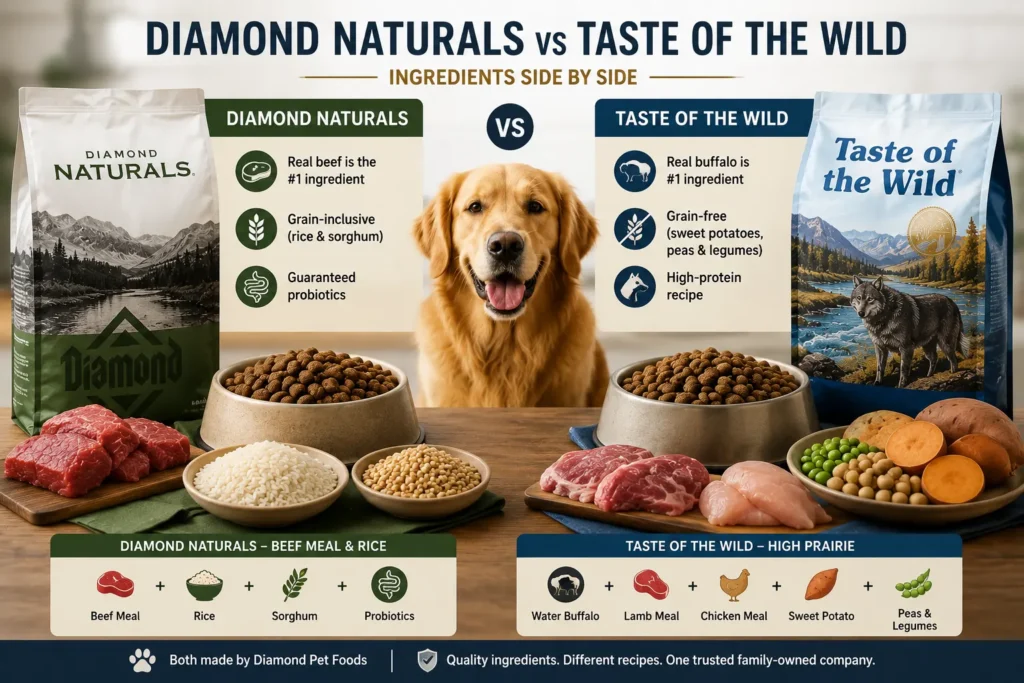
This is where the two brands actually diverge. The manufacturing connection is the same. The formulas are not.
Is Diamond Naturals a good dog food? Yes — and the ingredient panel backs that up. The Beef Meal & Rice formula leads with beef meal as the first ingredient, which is a concentrated protein source containing up to 300% more protein by weight than fresh meat. The moisture has already been removed, so what’s left is dense, usable protein. Supporting that are grain sorghum and white rice — both digestible carbohydrate sources that are easier on most dogs than corn or wheat.
Taste of the Wild High Prairie leads with whole water buffalo, which sounds more impressive but contains significantly more moisture. Once cooked and dried down, the actual protein contribution from fresh buffalo is lower than the label implies. The real protein density comes from lamb meal and chicken meal, which appear in positions two and three.
The bigger difference between these two foods is the carbohydrate base. Diamond Naturals uses grains. Taste of the Wild is grain-free, relying on sweet potatoes, peas, and pea flour instead. On a dry matter basis — which removes moisture from the equation to give a true comparison — Diamond Naturals’ protein sits around 28% and Taste of the Wild High Prairie’s around 36%, both solidly above average for this price tier.
On grain-free dog food and DCM risk: The FDA investigated a possible link between grain-free diets high in legumes — peas, lentils, chickpeas — and dilated cardiomyopathy (DCM) in dogs. The investigation ran from 2018 through 2022. No definitive causal link was established, and the investigation has since been closed without a formal conclusion. Taste of the Wild’s grain-free formulas do contain significant legume content. If your dog has a cardiac history or belongs to a DCM-predisposed breed, consult your vet before committing to a grain-free diet.
Both brands also disclose that some ingredients are sourced internationally. Folic acid and taurine come from China for both brands — these compounds can only be reliably sourced there. Diamond Naturals’ chicory root comes from Belgium. This is disclosed on both companies’ websites and is not unusual in the industry.
| Factor | Diamond Naturals Beef & Rice | Taste of the Wild High Prairie |
|---|---|---|
| First ingredient | Beef meal | Water buffalo |
| Protein % | 25% minimum | 32% minimum |
| Fat % | 15% minimum | 18% minimum |
| Fiber % | 3.5% maximum | 4% maximum |
| Calories per cup | 399 kcal | 370 kcal |
| Grain-free? | No | Yes |
| Legume content | Low | High (peas, pea flour) |
| Probiotics added? | Yes — 80M CFU/lb | Yes — 80M CFU/lb |
| Glucosamine | 300 mg/kg | Not listed |
| AAFCO life stage | Adult maintenance | Adult maintenance |
| Price per pound | ~$1.07/lb | ~$2.11/lb |
| Cost/day — 30 lb dog | ~$0.54 | ~$1.05 |
Note: Prices based on Tractor Supply and Petco listings as of May 2026. Check current prices before purchasing.
Product Reviews: The 4 Most Popular SKUs Compared
Products selected based on U.S. search volume, Amazon and Chewy availability, and verified buyer review counts.
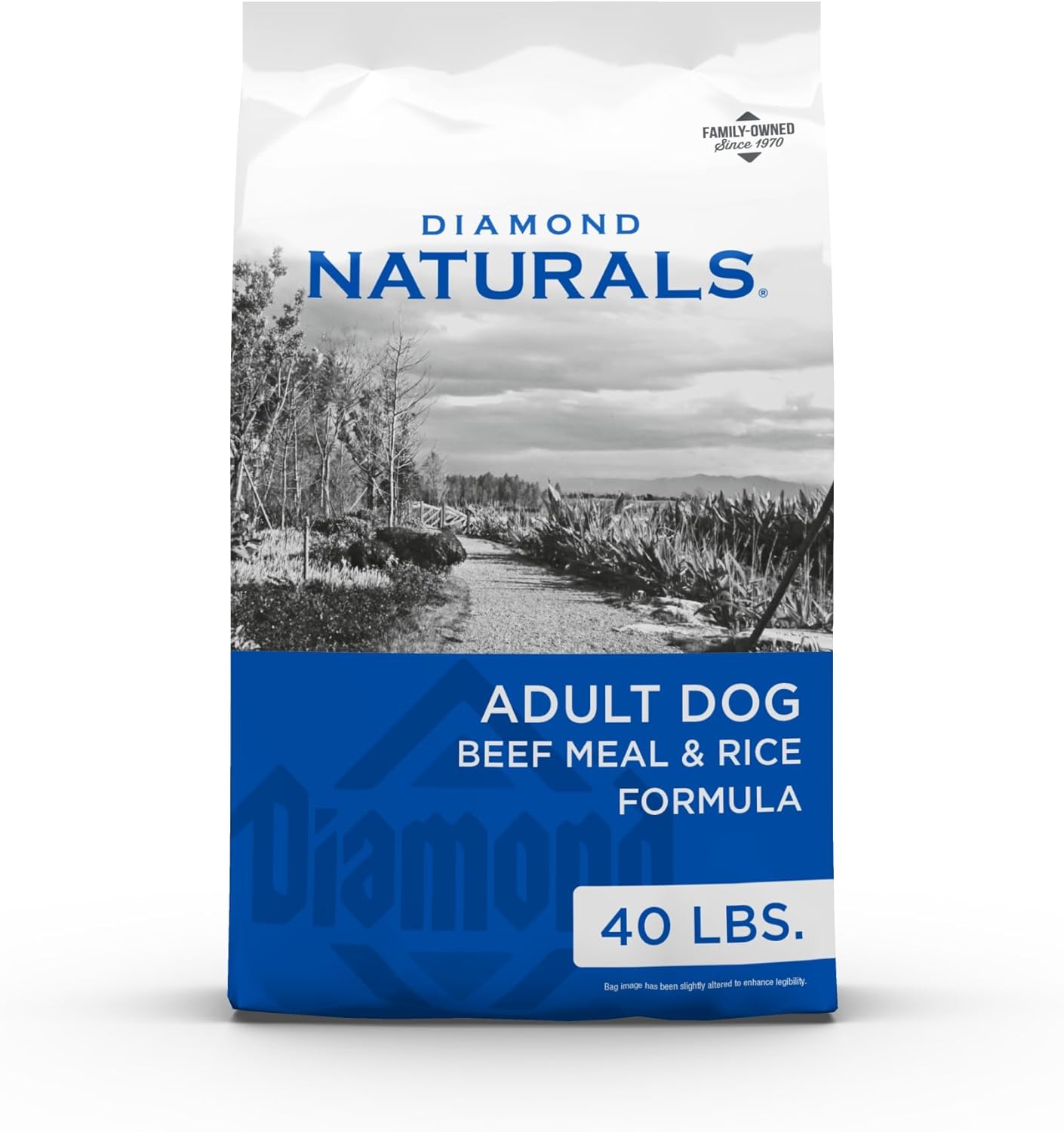
Price: ~$42.99 (40 lb) | $1.07/lb
Price per day: ~$0.54 (30 lb dog) | ~$0.87 (60 lb dog)
First 5 ingredients: Beef meal, grain sorghum, ground white rice, dried yeast, egg product
Protein / Fat / Fiber: 25% / 15% / 3.5%
Calories: 399 kcal/cup
Grain-free? No — grain sorghum and white rice
Probiotics: K9 Strain, 80M CFU/lb guaranteed
AAFCO: Adult maintenance
Ratings: 4.7/5 (Chewy, 2,800+ reviews) | 4.6/5 (Amazon, 5,000+ reviews)
This is the workhorse formula in the Diamond Naturals lineup and one of the more honest values in the mid-range dog food market. The beef meal first ingredient delivers real, dense protein. Buyers consistently report firm stools, improved coat quality, and high palatability — dogs eat it eagerly, which matters when you’re cycling through a 40-pound bag. The most common complaint is kibble size: the disc-shaped kibble runs large, and some owners of smaller breeds find it awkward. A handful of reviews also mention inconsistent powder-to-kibble ratio between bags, which the brand acknowledges can happen.

- Price: ~$43.99 (40 lb) | $1.10/lb
- Price per day: ~$0.74 (60 lb dog, ~3¼ cups/day per official feeding guide)
- First 5 ingredients: Chicken, chicken meal, whole grain brown rice, cracked pearled barley, ground white rice
- Protein / Fat / Fiber: 23% / 13% / 3.5%
- Calories: 327 kcal/cup
- Grain-free? No
- Probiotics: K9 Strain, 80M CFU/lb guaranteed
- Glucosamine: 750 mg/kg | Chondroitin: 250 mg/kg — both guaranteed on label
- AAFCO: Adult maintenance
- Ratings: 4.7/5 (Chewy, 3,200+ reviews) | 4.7/5 (Amazon, 4,500+ reviews)
This formula is built specifically for large and giant breed dogs with three meaningful differences from the standard adult recipe. Lower fat (13% vs 15%) helps big dogs maintain healthy body condition without excess weight gain. Reduced caloric density (327 kcal/cup vs 399 for the standard adult formula) means large dogs consume slightly more volume per meal, which many find more satisfying. And the guaranteed glucosamine and chondroitin — at label-verified levels — make this one of the few foods at this price point with real joint support baked in. Working dog owners and Australian Shepherd breeders are repeat buyers who frequently cite consistent formula and coat condition. The main negative: some buyers report the 40-pound bag arriving open or with seal damage through third-party shipping, so order direct from Chewy or Petco when possible.

- Price: ~$58.99 (28 lb) | $2.11/lb
- Price per day: ~$1.05 (30 lb dog) | ~$1.78 (60 lb dog)
- First 5 ingredients: Water buffalo, lamb meal, chicken meal, sweet potatoes, peas
- Protein / Fat / Fiber: 32% / 18% / 4%
- Calories: 370 kcal/cup
- Grain-free? Yes — sweet potatoes and peas as carbohydrate base
- Legume content: Peas and pea flour in positions 5 and 6
- Probiotics: K9 Strain, 80M CFU/lb guaranteed
- AAFCO: Adult maintenance
- Ratings: 4.7/5 (Amazon, 7,800+ reviews) | 4.6/5 (Chewy, 6,400+ reviews)
High Prairie is the bestselling Taste of the Wild formula and one of the top-selling grain-free dog foods in the U.S. market. Seven different protein sources — buffalo, lamb meal, chicken meal, egg product, bison, venison, and beef — give it broad nutritional coverage and make it useful for protein rotation. The 32% protein and 370 kcal/cup are meaningfully higher than Diamond Naturals, which matters for active and working dogs burning serious energy. The strongest positive theme in reviews is palatability — dogs that rejected other foods clean their bowls on High Prairie. The most consistent complaint is digestive upset during the transition from grain-inclusive food. A 10-to-14-day transition resolves this for most dogs. A smaller number of reviewers report ongoing loose stools that didn’t resolve, which suggests this formula is not ideal for dogs with sensitive digestive systems.

- Price: ~$58.99 (28 lb) | $2.11/lb
- Price per day: ~$1.05 (30 lb dog)
- First 5 ingredients: Salmon, ocean fish meal, sweet potatoes, peas, pea flour
- Protein / Fat / Fiber: 25% / 15% / 3%
- Calories: 360 kcal/cup
- Grain-free? Yes
- Probiotics: K9 Strain, 80M CFU/lb guaranteed
- AAFCO: Adult maintenance
- Ratings: 4.6/5 (Amazon, 3,200+ reviews) | 4.5/5 (Chewy, 2,800+ reviews)
Pacific Stream is Taste of the Wild’s salmon-forward formula and the go-to recommendation for dogs that react to poultry protein sources. Salmon leads as the first ingredient, supported by ocean fish meal — giving the formula a focused protein base that makes it easier to identify a reaction if one occurs. German Shepherds and Golden Retrievers with chronic itching are the breeds most frequently mentioned in positive Pacific Stream reviews, with buyers consistently reporting visible coat and skin improvement within 4–6 weeks. The main downside is the lentil content in position 6 (after peas and pea flour in positions 4 and 5), which some dogs don’t tolerate well and which increases the legume load relevant to DCM discussions. If your dog has a fish allergy rather than a poultry allergy, this is not the right formula.
Full comparison at a glance:
| Product | Brand | Grain-free | Price/lb | Protein % | Calories/cup | Best For |
|---|---|---|---|---|---|---|
| Beef Meal & Rice | Diamond Naturals | No | $1.07 | 25% | 399 | Budget adults, multi-dog homes |
| Large Breed Chicken & Rice | Diamond Naturals | No | $1.10 | 23% | 327 | Large/giant breeds, joint health |
| High Prairie | Taste of the Wild | Yes | $2.11 | 32% | 370 | Active dogs, protein variety |
| Pacific Stream | Taste of the Wild | Yes | $2.11 | 25% | 360 | Allergy-prone, chicken-sensitive |
Now that you know what’s in each formula, here’s how to match your specific dog to the right one.
Diamond Naturals or Taste of the Wild: Which Should You Actually Buy?
If you have a tight budget or multiple dogs
Diamond Naturals is the clear pick. When you’re filling two or three bowls daily — whether that’s a Labrador and a Border Collie or three rescue mutts — that ~$1/lb price difference adds up to real money by the end of the year. At $1.07/lb versus $2.11/lb, Diamond Naturals is one of the most affordable high-protein dog foods available without stepping down to low-quality filler brands. The nutritional gap between these two foods is smaller than the price gap for healthy adult dogs on normal activity levels.
If your dog has a chicken sensitivity
Taste of the Wild Pacific Stream is the better fit. It opens with salmon and ocean fish meal, with no poultry protein in the first several ingredients. Chicken sensitivity is common in German Shepherds, Boxers, and Bulldogs — if that’s your dog, Pacific Stream gives you a clean, single-species fish base that’s easier to assess if a reaction occurs.
If you have a large or giant breed dog
Diamond Naturals Large Breed Chicken & Rice is the better value. The guaranteed glucosamine (750 mg/kg) and chondroitin (250 mg/kg) are on the label — not a marketing claim but a measurable, verified inclusion. For big dogs prone to joint issues — think Great Danes, Saint Bernards, Newfoundlands — having joint supplements built into the food rather than added separately is a genuine convenience and cost saving. At $1.10/lb, it’s one of the only large-breed formulas with real joint support at this price point.
If you’re worried about grain-free dog food and DCM risk
Choose Diamond Naturals. The quality control floor is identical for both brands — same manufacturer, same testing protocols. The meaningful difference here is the formula: Diamond Naturals is grain-inclusive, so it doesn’t carry the high legume load that the FDA investigated in connection with DCM. For Dobermans, Great Danes, Boxers, Golden Retrievers, and Cocker Spaniels — breeds known to be predisposed to dilated cardiomyopathy — grain-inclusive is the lower-risk choice with current evidence. Consult your vet before making any diet change for a dog with a confirmed or suspected cardiac condition.
If you have a high-energy or working dog
Taste of the Wild High Prairie is the better match. At 32% protein and 370 kcal/cup versus Diamond Naturals’ 25% protein and 399 kcal/cup, High Prairie’s higher protein percentage is better calibrated for dogs burning serious daily energy — hunting dogs, agility competitors, farm working dogs. Interestingly, Diamond Naturals is the slightly more calorie-dense food per cup (399 vs 370), meaning working dogs actually eat fewer cups of Diamond Naturals per day. The real advantage of TOTW High Prairie for performance dogs is the significantly higher protein percentage (32% vs 25%), not caloric density.
If neither brand fits — if your dog has a diagnosed food allergy, confirmed IBD, or a complex health condition — neither of these foods is the right starting point. Vet-guided therapeutic nutrition will outperform any over-the-counter food comparison in those cases.
The Real Cost Difference: Diamond Naturals vs Taste of the Wild
Bag price is a terrible way to compare dog food costs. What actually matters is how much it costs to fill your dog’s bowl every day — and over the course of a year, the gap between these two brands is bigger than most people expect.
These are general feeding guidelines — always check with your vet to determine the right daily amount for your specific dog.
Reference feeding rates (from official bag guides):
- 30 lb dog: 2 cups/day DN | 2 cups/day TOTW
- 60 lb dog: 3¼ cups/day DN | 3¼–3¾ cups/day TOTW
| Diamond Naturals | Taste of the Wild | |
|---|---|---|
| Price per pound | $1.07 | $2.11 |
| Daily cost — 30 lb dog | ~$0.54 | ~$1.05 |
| Daily cost — 60 lb dog | ~$0.87 | ~$1.78 |
| Annual cost — 30 lb dog | ~$195 | ~$385 |
| Annual cost — 60 lb dog | ~$317 | ~$650 |
The annual gap for a single 60-pound dog is ~$333. For a two-dog household at that size, you’re looking at roughly $666 per year in savings choosing Diamond Naturals — without any meaningful drop in nutritional quality for healthy adult dogs.
If Taste of the Wild is the right food for your dog’s specific needs, that premium is worth paying. If you’re on the fence, that math should help clarify the decision.
How Much Should You Feed Your Dog? (Diamond Naturals & Taste of the Wild)
These are general guidelines — always consult your vet before starting any new diet, especially if your dog has a health condition.
Most people overfeed without realising it. Both brands’ guidelines tend to run on the generous side — start at the lower end of the range and adjust based on your dog’s body condition score, not just their weight on the scale.
| Dog Weight | Diamond Naturals Beef & Rice | Taste of the Wild High Prairie |
|---|---|---|
| 5–10 lbs | ½ – 1 cup | ½ – ¾ cup |
| 10–20 lbs | 1 – 1½ cups | ¾ – 1½ cups |
| 20–30 lbs | 1½ – 2 cups | 1½ – 2 cups |
| 30–40 lbs | 2 – 2½ cups | 2 – 2⅓ cups |
| 40–60 lbs | 2½ – 3¼ cups | 2⅓ – 3 cups |
| 60–80 lbs | 3¼ – 4 cups | 3 – 3¾ cups |
| 80–100 lbs | 4 – 4⅔ cups | 3¾ – 4⅓ cups |
| 100+ lbs | Add ⅓ cup per 10 lbs over 100 | Add ⅓ cup per 10 lbs over 100 |
Source: Diamond Pet Foods official feeding guide (diamondpet.com) and Taste of the Wild official guide (tasteofthewildpetfood.com), verified May 2026. Split daily amounts into two meals.
Three things to know about transitioning and feeding:
- Transition slowly. Moving between any two foods — especially from grain-inclusive to grain-free — should take 7 to 14 days. Start with 25% new food mixed into 75% old food, and shift the ratio every 2–3 days. Dogs with sensitive stomachs need the full 14 days.
- Watch for overfeeding signs. Loose stools, significant weight gain, or a dog that seems constantly hungry despite eating recommended amounts are all signals to reassess the portion and talk to your vet.
- Kibble form matters for some dogs. Diamond Naturals uses a larger disc-shaped kibble that some small-breed dogs struggle with. Taste of the Wild’s kibble is smaller and rounder. Both brands offer smaller-bag trial sizes — worth testing before committing to a 40-pound bag.
Frequently Asked Questions
Are Diamond Naturals and Taste of the Wild made by the same company?
Yes. Both are owned and manufactured by Diamond Pet Foods — formally Schell & Kampeter, Inc. — a family-owned company headquartered in Meta, Missouri. They share manufacturing facilities and quality control systems. The formulas themselves are genuinely different, though — different ingredients, different price points, different positioning.
Is Taste of the Wild worth the extra cost over Diamond Naturals?
For most dogs, no — not unless your dog has a specific reason to need grain-free or exotic protein rotation. Diamond Naturals delivers comparable nutrition for a healthy adult dog at roughly half the annual cost. If your dog genuinely needs grain-free, thrives on protein variety, or is a high-drive working dog, the premium is justified.
Is grain-free dog food safe? What about the DCM concern?
The FDA investigated a possible link between grain-free diets high in legumes and dilated cardiomyopathy in dogs. The investigation ran from 2018 to 2022 and was closed without establishing a definitive causal link. Taste of the Wild’s grain-free formulas contain peas and pea flour. If your dog has a cardiac history or belongs to a breed predisposed to DCM — Dobermans, Golden Retrievers, Boxers, Great Danes — discuss diet with your vet before switching to grain-free. This is a general guideline and not medical advice.
Which brand has had more recalls?
Diamond Naturals has four recalls on record (2005, April 2012, May 2012, 2013). Taste of the Wild has one (May 2012). The critical context: the 2012 salmonella recall affected both brands simultaneously because it came from a shared manufacturing facility. Neither brand has had a confirmed recall since 2013.
Can I switch between Diamond Naturals and Taste of the Wild safely?
Yes, with a gradual transition. The standard is 7 to 10 days, but 14 days is better for dogs switching from grain-inclusive to grain-free. Start with 25% new food mixed with 75% current food, then shift the ratio every 2–3 days. Some dogs experience loose stools during a grain-free transition — this typically resolves within a week. If it persists, slow the transition or consult your vet.
Our Verdict: Diamond Naturals vs Taste of the Wild
Diamond Naturals is the better choice for most dog owners. It is a genuinely good dog food — real named meat as the first ingredient, guaranteed probiotics, no corn, wheat, or soy, and a 12-year clean safety record — at a price that makes it accessible for households with one dog or five. For healthy adult dogs without specific dietary requirements, there is no nutritional argument strong enough to justify spending nearly twice as much per year on Taste of the Wild.
Taste of the Wild earns its price for the right dog. The 32% protein, seven-protein formula, and grain-free profile make High Prairie a legitimate choice for active dogs, protein-rotation feeders, and owners whose dogs simply do better off grains. Pacific Stream is the best option when chicken sensitivity is the primary concern. These are real differentiators — not just marketing.
The shared manufacturer is worth knowing but shouldn’t drive your decision alone. Both brands come from the same safety-tested facilities. The difference that actually matters is what’s in the bag and what your dog needs from it.
If you’re starting fresh, try Diamond Naturals Beef Meal & Rice first. If your dog needs grain-free or protein variety, Taste of the Wild High Prairie is a reliable Taste of the Wild alternative to more expensive grain-free options like Orijen or Acana.
Either way, you’re choosing between two foods made in the same American facilities, tested to the same standards. The difference is in the formula — and now you know which one fits your dog.
We update this article every 90 days as pricing and formulations change.
Always consult your vet before making significant changes to your dog’s diet, particularly if your dog has a known health condition or is on a therapeutic diet.