 Marco Williams
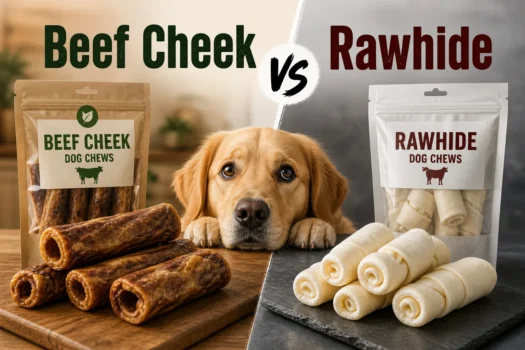
Some products sold as beef cheek are still rawhide — and the companies selling them are counting on you not knowing that.
That’s the real story behind the beef cheek vs rawhide for dogs debate. Both chews look almost identical: white, rolled, tough, and loved by dogs. But how they’re made, what chemicals they’ve been exposed to, and how safely your dog can digest them are completely different questions — and the label on the bag doesn’t always tell the truth.
There’s no AAFCO standard definition for “rawhide,” which means any manufacturer can define the term however benefits them. One major brand, Redbarn, actually discloses in their Chewy FAQ that their beef cheek rolls “would still be considered a rawhide product.” Most brands aren’t that honest.
The good news: quality beef cheek from a transparent brand is meaningfully safer than traditional rawhide. The skill is knowing how to tell them apart before you buy.
Must Read: Purina Pro Plan vs Royal Canin — if you’re rethinking your dog’s entire diet alongside their chews, that comparison is worth reading too.
Best overall: Brutus & Barnaby Beef Cheek Rolls — single-ingredient, grass-fed, transparent South American sourcing, top-rated for aggressive chewers across large and giant breeds.
Best budget pick: ValueBull Beef Cheek Rolls — bulk pricing drops cost to under $3/piece without sacrificing single-ingredient sourcing or grass-fed Angus beef.
Best for sensitive stomachs: Amazing Dog Treats Beef Cheek Rolls — one of the only brands publishing a full guaranteed analysis on the label; grass-fed, sourced from Turkey, no chemicals or additives.
Best rawhide-free alternative: Earth Animal No-Hide Chews — made in a USDA-inspected U.S. facility from all-natural ingredients with no hide material at all; best for owners who want zero connection to animal skin.
Beef Cheek vs Rawhide for Dogs: What’s Actually Different?
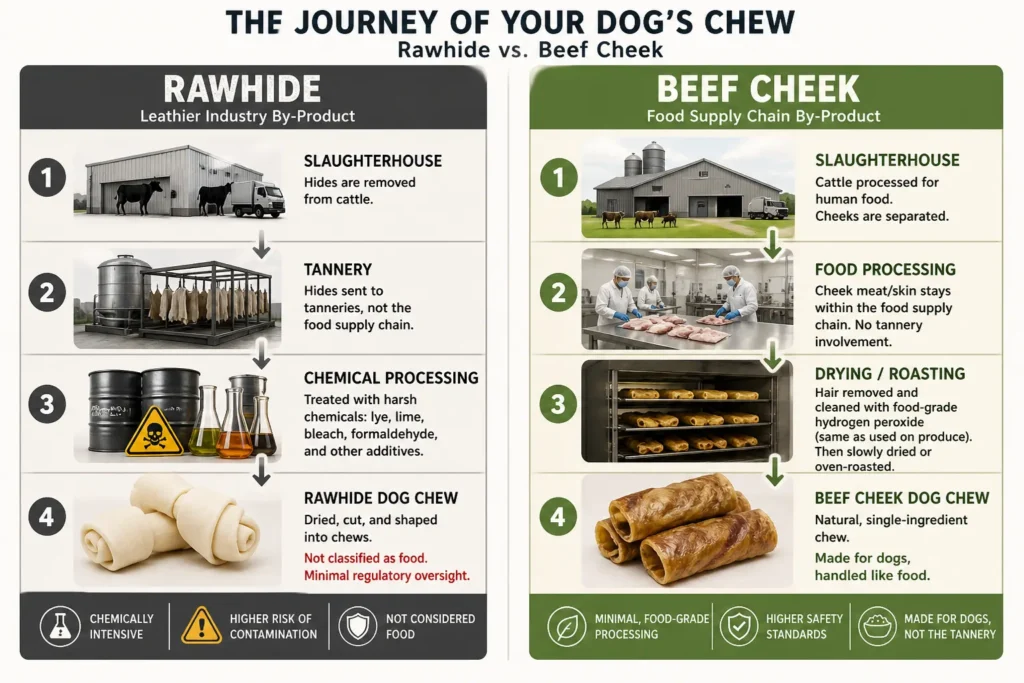
First, a structural clarification: beef cheek is sometimes a type of rawhide. This is the most important thing to understand before buying either product, and most articles gloss over it entirely.
Traditional rawhide is the inner layer of animal hide — a direct by-product of the leather tanning industry. After slaughter, hides are soaked in high-salt brines for weeks or months during transport. At the tannery, they’re treated with ash-lye solutions or sodium sulphide liming to remove fat, then chemically stripped of hair, rinsed, and in many cases bleached with hydrogen peroxide or whitened with titanium oxide. Formaldehyde and artificial colorings can also be present. The FDA does not classify rawhide as food, so manufacturing oversight is minimal. Most rawhide is produced in China.
True beef cheek chews are different in origin. They’re made from the cheek skin and facial tissue of cattle that travels through the food supply chain — not the tanning plant. Without the leather-industry connection, the harsh chemical treatments don’t apply. Hair is removed, and quality brands use only food-grade hydrogen peroxide (the same wash used on produce) before slow-drying or oven-roasting.
Here’s the catch: some products labeled “beef cheek” use full-thickness cattle hide cut from the “cheek flaps” of the leather hide. That is still rawhide under a different name. Dog Food Advisor documented this practice in detail. Redbarn is the rare brand that admits it. Most don’t.
The question to ask before any purchase is: is this a by-product of the leather industry or the food industry?
| Factor | Beef Cheek (Quality Brand) | Rawhide (Traditional) |
|---|---|---|
| Raw material source | Cheek meat/skin — food supply chain | Inner hide — leather industry by-product |
| Chemical processing | Minimal: hair removal, food-grade wash only | Extensive: lye, lime, bleach, formaldehyde |
| Digestibility | High — softens and breaks down safely | Poor — does not break down in stomach |
| Blockage risk | Lower when correctly sized | High — swells up to 4x its size when swallowed |
| Bacterial contamination | Low | Moderate-High — multiple FDA Salmonella recalls |
| Protein content | 75–81% crude protein | Low — structural collagen from processed hide |
| Country of origin | Brazil, Turkey, USA, South America | Mostly China |
| Price per piece | $3–$8+ | $0.25–$1.50 |
| Vet recommendation | Generally preferred | Many vets advise against |
| Label transparency | Better on quality brands | Poor — no regulatory standard |
The 6 Best Beef Cheek and Rawhide-Free Chews for Dogs (Reviewed)
These picks are based on ingredient transparency, verified sourcing, U.S. availability on Amazon and Chewy, published nutritional data, and real owner review counts. Every product card below uses the same data points — if a brand couldn’t or wouldn’t provide a data point, that’s noted explicitly.

- Price: ~$8–$9/piece standard | lower per-piece in 10-pack
- Sizes: 5–7 inch, 10–12 inch
- Ingredients: Single ingredient — free-range beef cheek
- Source: South America (Brazil/Argentina), grass-fed
- Protein: Single-ingredient beef cheek (full guaranteed analysis not published by brand)
- Country of origin: Brazil / Argentina
- Certifications: Additive-free, chemical-free, preservative-free; FDA-approved facility (per brand)
- Star rating: 4.6/5 (800+ reviews — Amazon and Chewy combined)
Brutus & Barnaby is the most consistently recommended brand among owners of German Shepherds, Bernedoodles, Labs, and other heavy-chewing breeds. The 10–12 inch rolls can hold up across multiple sessions for powerful chewers — owners of Irish Terriers and large mutts report the rolls surviving extended chewing without breaking into sharp fragments. The plain beef flavor (no coating, no glaze) is also why sensitive-stomach dogs and picky eaters tend to accept these when they’ve rejected other chews. The main complaint is price: at $8+ per piece, owners of dogs who finish them quickly find the cost hard to sustain weekly.

- Price: $2.80–$7.04/piece | varies by pack size (25–50 count bulk)
- Sizes: 5–6 inch, 9–10 inch jumbo
- Ingredients: Single ingredient — free-range Angus beef cheek
- Source: Brazil, grass-fed
- Protein: High-protein, low-fat (full guaranteed analysis not published; single-ingredient Angus beef)
- Country of origin: Brazil
- Certifications: No chemicals, no preservatives, no artificial ingredients; hand-inspected per unit
- Star rating: 4.4/5 (1,000+ reviews on Amazon)
ValueBull is the brand that makes beef cheek financially sustainable as a regular chew rather than an occasional treat. A 25-count jumbo pack brings cost per piece under $7; 50-count drops it closer to $2.80 — making it competitive with mid-range rawhide while being a far safer product. The trade-off is size inconsistency: natural treats vary, and some owners report receiving pieces smaller or thinner than expected. For multi-dog households or owners buying on a monthly basis, this is the most practical option on the list.

- Price: ~$3–$4/piece (4-count pack)
- Sizes: 6 inch
- Ingredients: Single ingredient — beef head skin
- Source: Turkey, free-range grass-fed, no antibiotics or steroids
- Protein: Crude Protein 75.39% min | Crude Fat 7.48% min | Crude Fiber 0.7% min | Moisture 12.23% max | Ash 4.9% max
- Country of origin: Turkey (hand-packed in USA)
- Certifications: No chemicals, no preservatives, no additives; hand-packed at U.S. facility
- Star rating: 4.5/5 (500+ reviews on Chewy)
Amazing Dog Treats is one of the only brands in this category that publishes a full guaranteed analysis on the product page — a transparency signal that most competitors skip entirely. Owners of dogs with previously documented digestive issues (from rawhide or other chews) report zero GI problems after switching to these. The Turkey sourcing also makes this a viable option for dogs with sensitivities to South American or Brazilian beef. The most common complaint is a noticeable natural odor, which is simply what a single-ingredient dried animal product smells like and not a quality issue.

- Price: ~$4–$5/piece (4-count pack)
- Sizes: 5–6 inch (designed for medium breeds)
- Ingredients: Single ingredient — beef cheek
- Source: USA-sourced and manufactured
- Protein: Single-ingredient beef cheek (full guaranteed analysis not published by brand)
- Country of origin: USA
- Certifications: No additives, no gluten, no grains, no fillers, no preservatives; crafted in the USA
- Star rating: 4.3/5 (Chewy)
Pack Approved earns its spot for one specific reason: fully domestic sourcing and manufacturing, which is rare in this category. Most beef cheek comes from South America or Turkey — not because those regions are lower quality, but because cheek tissue is more readily available there at scale. For owners who specifically want a U.S.-sourced, U.S.-made product, this is the clearest choice on the market. The 5–6 inch size is ideal for medium breeds between 30–60 lbs — large enough to require real chewing time, small enough not to overwhelm a Border Collie or Cocker Spaniel. One limitation: the lack of a published guaranteed analysis means nutritional comparisons require trusting the brand’s single-ingredient claim alone.

- Price: ~$5–$8/piece | guaranteed weight: 1.2 oz (small), 3 oz (large)
- Sizes: Small, Large
- Ingredients: Beef cheek — Redbarn’s Chewy FAQ states this “would still be considered a rawhide product”
- Source: USA (manufactured in Kansas)
- Protein: Not published by brand
- Country of origin: USA (Kansas)
- Certifications: SQF-certified; exceeds Good Manufacturing Practices; tested at brand-owned lab
- Star rating: 4.3/5 (300+ reviews on Chewy)
Redbarn is the most transparent brand on this list — in the wrong direction. They openly confirm their beef cheek is technically a rawhide-type product. That honesty earns them a spot here specifically as a transition chew: if your dog has been chewing rawhide for years without problems, Redbarn is a meaningful step up. It uses cattle cheek material rather than tannery-sourced hide, is manufactured domestically under SQF certification, and skips artificial additives. It is not in the same category as the products above, but it is significantly better than mass-market Chinese rawhide. Main complaint from buyers: rolls can be thin and less durable than competing brands.

- Price: ~$10–$15/piece
- Sizes: Small, Medium, Large, Extra Large (multiple protein flavors)
- Ingredients: Multi-ingredient — rice flour, chicken/salmon/venison, eggs, herbs (varies by flavor); no animal hide of any kind
- Source: USA (USDA-inspected facility)
- Protein: Varies by flavor; protein-forward formulation with whole food ingredients
- Country of origin: USA
- Certifications: Made in USDA-inspected U.S. facility; no rawhide, no artificial preservatives, no added chemicals
- Star rating: 4.2/5 (400+ reviews — Amazon and Chewy combined)
Earth Animal No-Hide is the only product on this list with zero connection to animal hide or skin of any kind. It’s made from whole food ingredients — rice flour, eggs, and a named protein — formed into a chew-like shape and baked rather than dried. For owners who have had a rawhide scare, whose vet has specifically warned against any hide-based product, or who simply want the maximum possible distance from the rawhide category, this is the right pick. The trade-off: it does not last as long as beef cheek for aggressive chewers, some dogs ignore it entirely, and at $10–$15 per piece it is the most expensive option here.
Full Comparison Table
| Product | Type | Price/Piece | Protein | Country | Star Rating | Best For |
|---|---|---|---|---|---|---|
| Brutus & Barnaby | Beef cheek | $8–$9 | Single ingredient | Brazil/Argentina | 4.6/5 | Aggressive chewers, large breeds |
| ValueBull | Beef cheek (Angus) | $2.80–$7 | Single ingredient | Brazil | 4.4/5 | Budget, multi-dog households |
| Amazing Dog Treats | Beef head skin | $3–$4 | 75.39% crude protein | Turkey (USA-packed) | 4.5/5 | Sensitive stomachs, label transparency |
| Pack Approved | Beef cheek | $4–$5 | Single ingredient | USA | 4.3/5 | Medium breeds, domestic sourcing |
| Redbarn | Beef cheek (rawhide-type) | $5–$8 | Not published | USA (Kansas) | 4.3/5 | Rawhide-to-beef-cheek transition |
| Earth Animal No-Hide | Hide-free chew | $10–$15 | Whole food protein | USA | 4.2/5 | Zero hide contact, post-scare owners |
Beef Cheek or Rawhide: Which Should You Actually Buy?
This is a decision, not a research exercise. Here is how to pick based on your dog’s specific situation.
If your dog has a sensitive stomach or history of digestive issues →
Buy Amazing Dog Treats Beef Cheek Rolls — or step up to Earth Animal No-Hide if your vet has specifically warned against any hide-based product. Rawhide is not an option here: it does not break down reliably in a dog’s stomach, can swell up to four times its size when swallowed, and has caused intestinal obstructions requiring emergency surgery. Quality beef cheek softens as it’s chewed and digests far more easily. Always supervise chewing sessions and remove any piece small enough to swallow whole. Consult your vet before introducing any new chew if your dog has an existing GI diagnosis. [INTERNAL: best dog food for itchy skin] — if digestive issues also show up as skin or coat problems, your dog’s food may be part of the picture too.
If you’re on a budget →
Buy ValueBull Beef Cheek Rolls in the 25-count or 50-count bulk pack. Rawhide is cheaper per piece — sometimes dramatically so — but the hidden cost is risk. A single intestinal blockage surgery runs $2,000–$5,000. At bulk pricing, ValueBull brings cost per piece to under $3, which is competitive with premium rawhide and comes without the chemical processing, Chinese manufacturing concerns, or digestibility problems. For households with multiple dogs or owners who give chews several times per week, the math on bulk beef cheek is straightforward.
If you have a large or giant breed dog →
Buy Brutus & Barnaby Beef Cheek Rolls in the 10–12 inch size. German Shepherds, Labrador Retrievers, Bernese Mountain Dogs, Rottweilers, and similar breeds are powerful chewers who can bite off large rawhide chunks faster than they can safely swallow them — which is exactly how blockages happen. The 10–12 inch Brutus & Barnaby rolls are thick enough to hold up across multiple sessions for large jaws. Owners of giant breeds specifically report satisfaction with chew duration that smaller or thinner rolls don’t deliver. [INTERNAL: best dog food for large breeds] — large-breed owners often revisit both food and chew choices at the same time.
If your dog is a picky eater →
Start with Brutus & Barnaby plain beef cheek before anything else. Picky dogs frequently reject artificially flavored or glazed chews — which includes most commercial rawhide, which is commonly coated with smoke flavoring, beef broth spray, or chicken flavor. A plain, single-ingredient beef cheek smells and tastes like actual beef, because that is what it is. Owners of Shelties, Australian Shepherds, and notoriously picky small breeds report strong acceptance rates. If your dog ignores the plain version after two or three attempts, try the bully-dusted variant before writing off the category entirely.
One situation where you can skip chews altogether: if your dog is on a raw or whole-food diet, canned sardines in water (no salt added) or a small piece of fresh salmon provides meaningful omega-3s and satisfies some chewing interest without any processed product. This works best for light chewers whose owners are primarily after the nutritional benefit. For dogs who need the extended chew session for anxiety relief or mental stimulation, a physical chew is still the better tool — but whole food is always worth considering first.
4 Red Flags on Any Dog Chew Label — Skip It If You See These
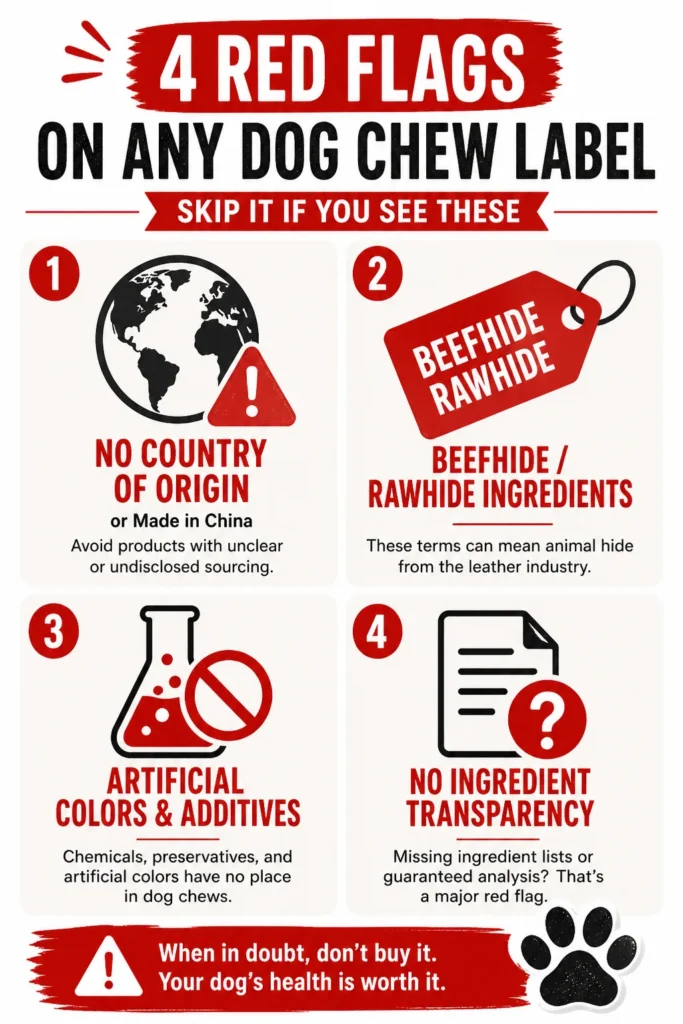
Most owners scan labels quickly. These four things are worth a full stop:
- “Made in China” or no country of origin listed. The majority of rawhide safety incidents — Salmonella recalls, chemical contamination, arsenic findings — have involved Chinese-manufactured products. If a chew label doesn’t list country of origin at all, treat it as a red flag. Transparency about origin is a baseline quality signal.
- Ingredient says “beefhide,” “beef hide,” or “rawhide.” These are leather-industry by-products, regardless of what the front of the package calls the product. “Beef cheek” on the front of the bag means nothing if the ingredient panel says “beefhide.”
- Artificial colors, flavors, or preservatives listed. A single-ingredient dried animal product needs none of these. Smoke flavoring, titanium dioxide (whitener), and artificial beef or chicken flavor are common in cheap rawhide and have no business being in a dog chew.
- No ingredient list or guaranteed analysis whatsoever. Pet chews are not held to the same labeling standards as pet food in the U.S. Some brands exploit this by putting almost nothing on the label. If you can’t find the ingredient and country of origin, move on.
Frequently Asked Questions
Is beef cheek actually rawhide?
It depends on the brand. True beef cheek chews are made from the facial tissue of cattle that goes through the food supply chain — not the leather tanning industry — and are processed without the chemicals that make traditional rawhide concerning. Some products labeled “beef cheek” are technically full-thickness cattle hide from the cheek portion of the leather hide. Redbarn explicitly acknowledges in their product FAQ that their beef cheek rolls “would still be considered a rawhide product.” Always read the ingredient list and confirm the brand discloses their sourcing clearly.
Can beef cheek chews cause blockages?
They are significantly less likely to cause blockages than traditional rawhide, but no chew is completely risk-free. Quality beef cheek softens as it’s chewed and breaks down more easily in a dog’s stomach. Rawhide, by contrast, can swell up to four times its size when swallowed. To minimize any risk with beef cheek: size the chew correctly for your dog’s breed, supervise every session, and remove the chew before it gets small enough to swallow in one piece. Consult your vet before introducing any chew if your dog has a history of GI problems.
How long do beef cheek rolls last?
It depends almost entirely on your dog’s size and chewing intensity. A moderate-chewing medium-breed dog — a Border Collie, a Cocker Spaniel, a Sheltie — might take 20–60 minutes on a 6-inch roll. A German Shepherd or Lab working on a 10-inch roll might take 30 minutes to several hours. Power chewers like Pit Bulls and American Bulldogs can finish a 10-inch roll in under 30 minutes, at which point the 12-inch jumbo size and thicker-cut variants become the practical choice.
What are signs my dog should not be chewing rawhide?
Watch for vomiting, gagging, retching, or repeated swallowing attempts during a session — these can signal a blockage is forming. After chewing, signs of concern include continuous vomiting, loss of appetite, severe lethargy, and significantly reduced energy levels. Rawhide can also cause loose stool or diarrhea in dogs with sensitive digestive systems even without a blockage. If your dog has shown any of these signs after a rawhide session, switch to beef cheek or a hide-free alternative and consult your vet before giving any chew again.
Is it safe to leave my dog alone with a beef cheek roll?
No chew should be given unsupervised — this applies to beef cheek, bully sticks, antlers, and everything else in the category. The risk is not specific to chew type: any chew becomes a choking hazard once chewed down small enough that a dog can try to swallow it whole. Supervision lets you remove the chew at the right moment. If you can’t supervise, save chew time for when you can watch. For owners looking for an unsupervised enrichment option, a Kong stuffed with food and frozen is a safer substitute. [AMAZON LINK: Earth Animal No-Hide Chews] (rel=”nofollow sponsored”) is also a lower-risk option for dogs left alone briefly, though supervision is still the correct standard.
Our Verdict: Beef Cheek vs Rawhide for Dogs
Beef cheek wins — and it’s not close.
The safety gap is real, documented, and consistent: traditional rawhide carries chemical processing risk, poor digestibility, a track record of FDA recalls, and a manufacturing supply chain that operates with minimal oversight. Quality beef cheek from a transparent brand avoids all of that while delivering the same long-lasting chew experience dogs want.
The only honest case for traditional rawhide is price. If cost is the hard constraint, the answer is not to buy cheap rawhide — it’s to buy ValueBull beef cheek in bulk, where the per-piece cost drops to under $3.
For most dogs and most households, Brutus & Barnaby Beef Cheek Rolls is the right default. Single ingredient, transparent sourcing, size options that cover 20 to 100+ lb dogs, and thousands of verified reviews from owners of the exact breeds that demand the most from a chew.
One final reminder: “beef cheek” on the front of the package means nothing without a clean ingredient list and a disclosed country of origin on the back. The label is where the real information lives.
We review and update this article every 90 days as product pricing, availability, and sourcing details change.
These are general guidelines — always consult your veterinarian before introducing new chews, especially for dogs with digestive conditions, food allergies, dental disease, or a history of GI blockages.