
 Marco Williams
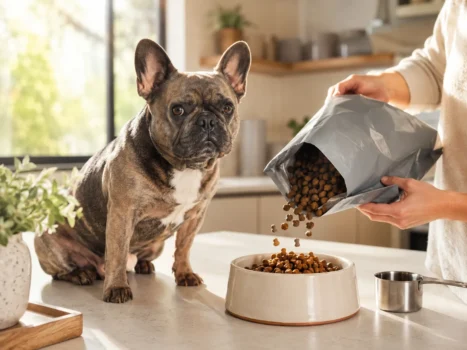
Watch a French Bulldog eat from a standard bowl. They don’t chew — they shovel. The same flat face and underbite that makes the breed adorable also makes it nearly impossible to pick up large, round kibble without gulping it whole. That gulping has a downstream effect most owners blame on diet without realizing the food shape is half the problem: swallowed air, gas, loose stools, and a dog who eats faster than their stomach can keep up.
The best dog food for French Bulldogs has to solve three problems at once — kibble your dog can actually pick up and chew, ingredients gentle enough to not aggravate this breed’s well-documented skin and digestive sensitivities, and calorie control tight enough to keep a low-activity dog from putting on weight. Most “best Frenchie food” lists ignore the first one entirely. Below are six vet-formulated picks, each matched to a specific Frenchie problem, with an honest take on where each one falls short.
- Best Overall → Royal Canin French Bulldog Adult — ~$1.05–$1.35/day
- Best for Sensitive Skin & Allergies → Purina Pro Plan Sensitive Skin & Stomach Salmon & Rice Small Breed — ~$0.85–$1.00/day
- Best for Weight Management → Hill’s Science Diet Perfect Weight Small & Mini — ~$0.90–$1.10/day
- Best Budget Pick → Diamond Naturals Small Breed Adult — ~$0.40–$0.55/day
- Best for Joint Support → Hill’s Science Diet Perfect Weight & Joint Support — ~$1.10–$1.30/day
- Best Puppy Formula → Royal Canin French Bulldog Puppy — ~$1.20–$1.45/day
Why Kibble Shape Matters for French Bulldogs?
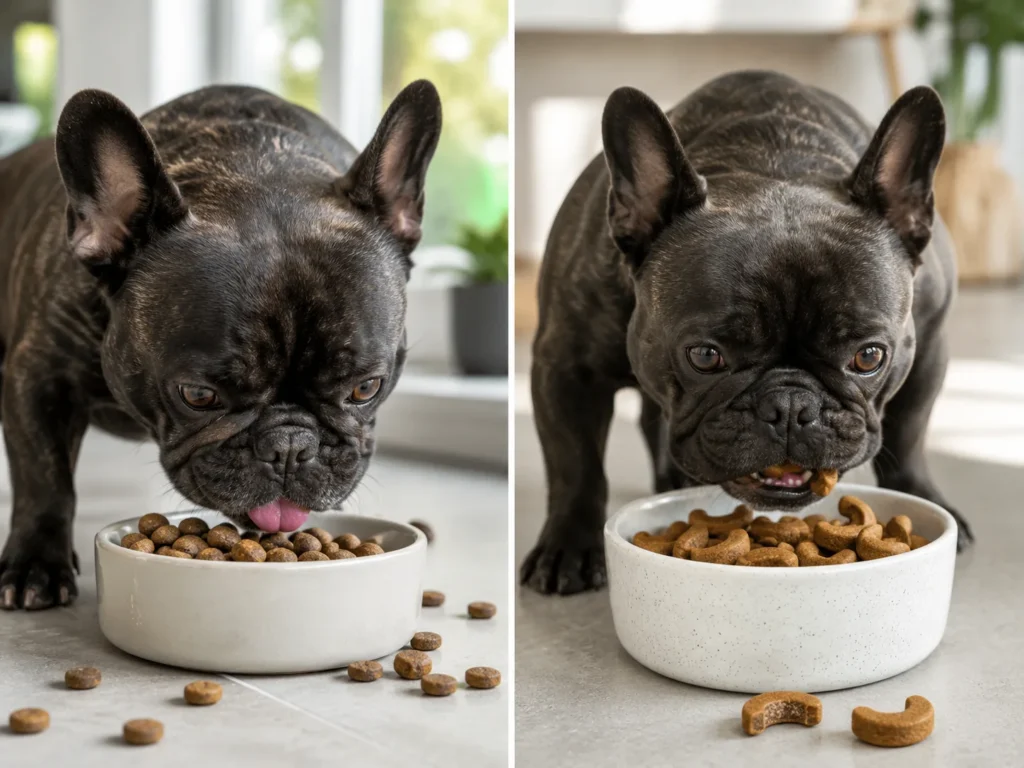
Most articles about the best dog food for French Bulldogs talk about ingredients and skip the part that actually causes the daily problems Frenchie owners complain about.
Here’s what’s happening at the food bowl. Brachycephalic dogs have a shortened upper jaw and a pronounced underbite. A standard round kibble — designed for a dog with a normal muzzle — is hard to grip with their teeth.
So Frenchies scoop food with their tongue and swallow without chewing. This swallowing-without-chewing pattern is called aerophagia when air is swallowed alongside food, and it’s one of the biggest reasons Frenchies are famously gassy.
The food isn’t always the issue. The shape is.
This is why Royal Canin engineered a curved kibble specifically for the French Bulldog jaw. It’s paired with their L.I.P. (Low Indigestible Protein) standard — protein sources selected for high digestibility — rather than sold as separate features.
It also explains why a “small breed” formula isn’t automatically right for a Frenchie. Small kibble is sized down, but most aren’t shaped down for a brachycephalic mouth.
A few other Frenchie-specific food considerations worth knowing:
- Skin and allergies: Chicken, beef, dairy, and wheat are the four most commonly reported triggers in Frenchies — leading to itchy paws, ear infections, and skin fold inflammation
- Weight gain: Frenchies tolerate heat poorly and exercise less than most breeds their size, so calorie density matters as much as ingredient quality
- Joints: Their short, stocky build and predisposition to IVDD and patellar luxation make glucosamine and EPA worth looking for, even in younger dogs
- Life stage: AAFCO classifies dog foods as “growth,” “adult maintenance,” or “all life stages” — a growth formula is required for Frenchie puppies under 12 months
If your Frenchie has ongoing skin, digestive, or weight issues that don’t resolve with a food switch, consult your vet — food alone won’t fix what’s actually an allergy panel or thyroid problem.
The 6 Best Dog Foods for French Bulldogs
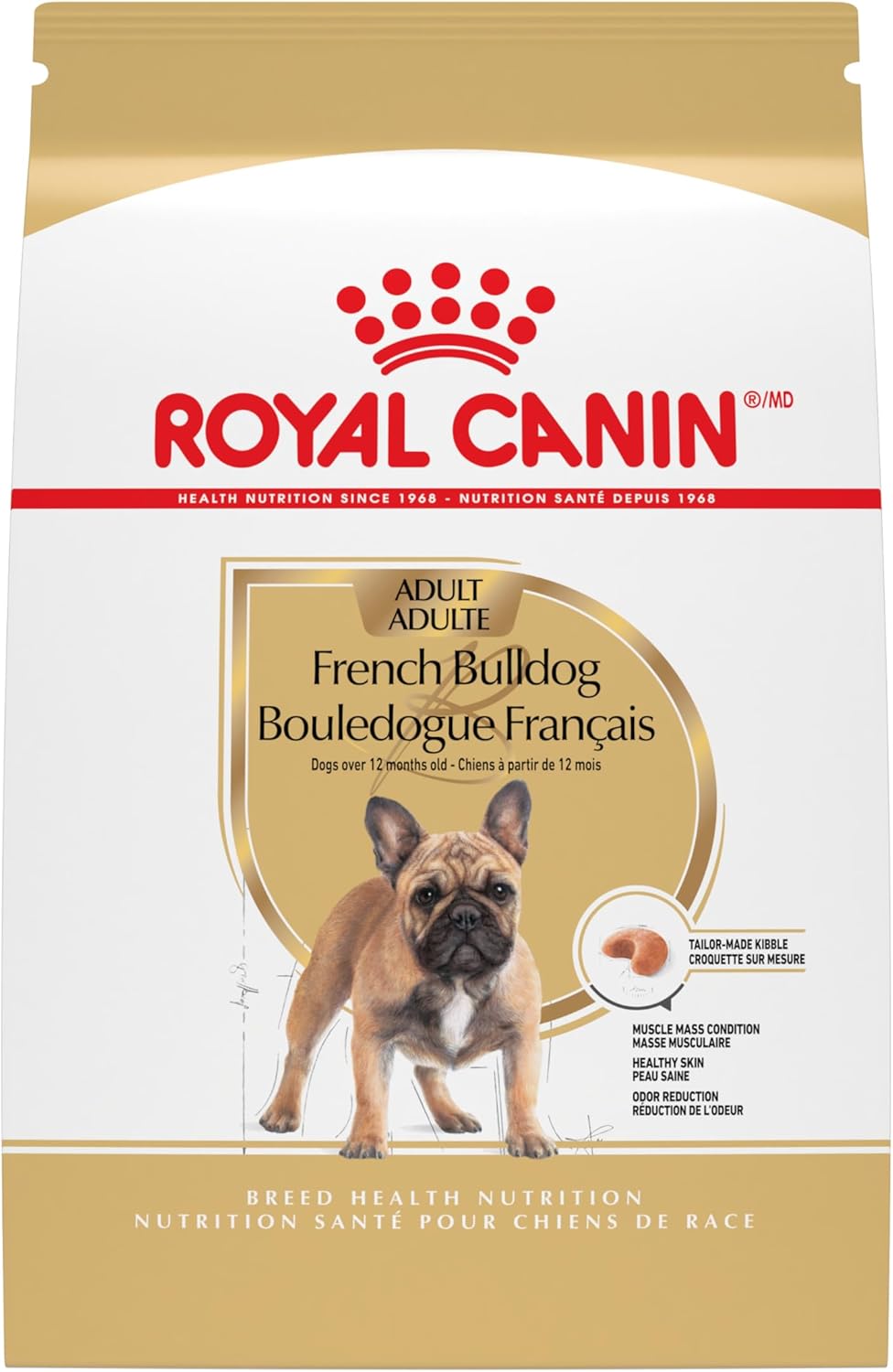
Best For: Owners who want the food shape engineered around their dog, not the other way around
Cost Per Day: ~$1.05–$1.35/day
Why It Made the List
- The only kibble on the market with a curved shape engineered specifically for the brachycephalic French Bulldog jaw — this isn’t marketing, it’s a measurable design difference
- Uses Royal Canin’s L.I.P. (Low Indigestible Protein) standard for digestibility, directly relevant to the breed’s flatulence and stool-odor reputation
- Includes 743 mg/kg glucosamine and added chondroitin for joint support, plus EPA/DHA for skin barrier function
Key Specs
- Protein 24% / Fat 16% / Fiber 3.3% max / 331 kcal per cup
- AAFCO: Formulated for adult maintenance
- First 5 ingredients: Brewers rice, wheat, chicken by-product meal, chicken fat, wheat gluten
Honest Take
- The first two ingredients are brewers rice and wheat, not whole meat — Royal Canin prioritizes amino acid profile and digestibility over marketing-friendly ingredient order
- Contains wheat and wheat gluten; skip this if your Frenchie has a confirmed grain sensitivity
- Most common owner report: noticeable reduction in gas within 2–3 weeks of switching. Most common complaint: price-per-pound is roughly 2–3x non-breed-specific small-breed formulas
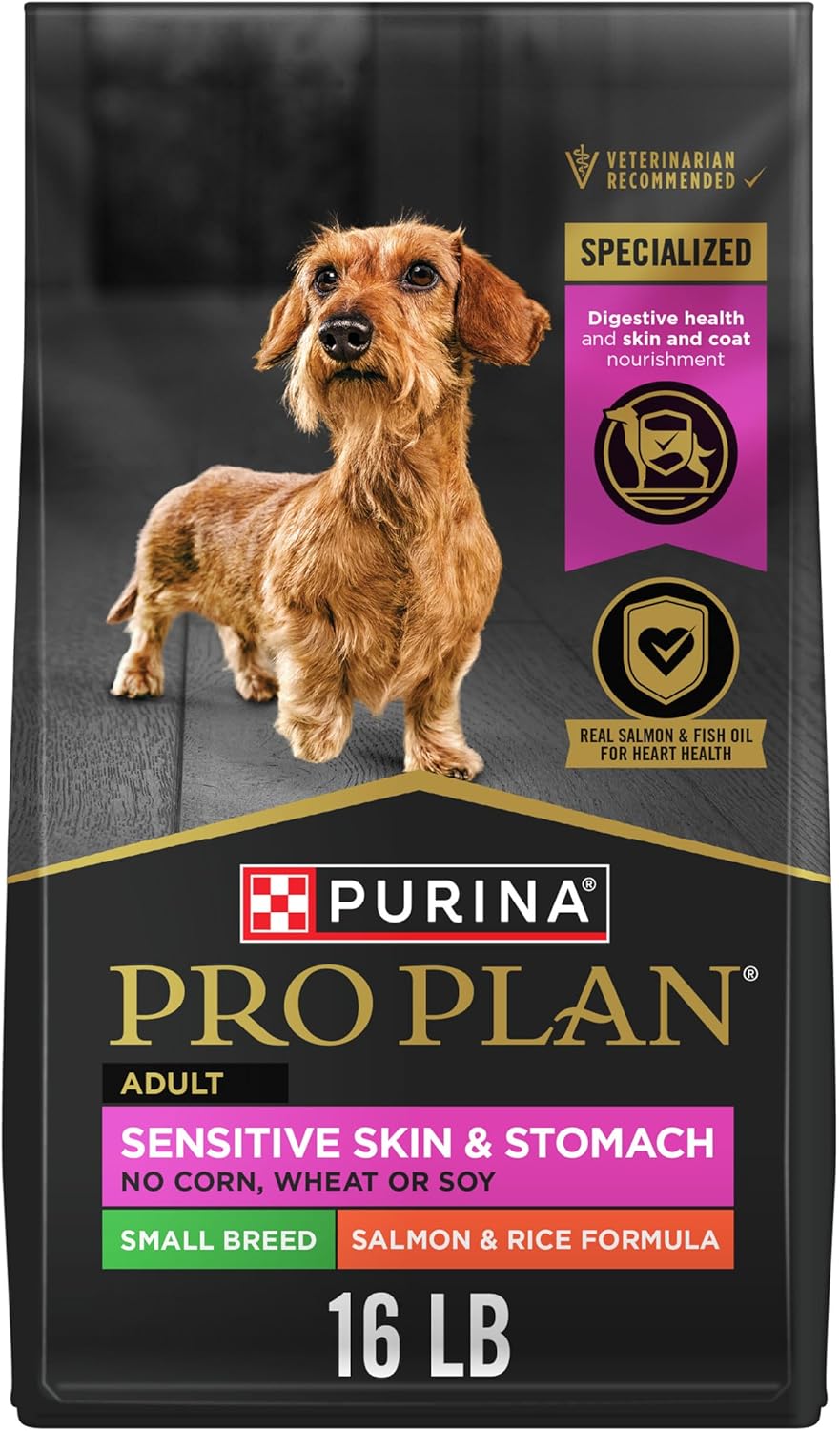
Best For: Frenchies with chronic itching, ear infections, or red paws
Cost Per Day: ~$0.85–$1.00/day
Why It Made the List
- Salmon-first formula avoids chicken and beef, the two protein sources most commonly linked to Frenchie skin reactions
- Small-breed kibble size appropriate for the breed (though not curved like Royal Canin’s)
- Frequently appears in veterinary dermatologist recommendations for food sensitivity trials, not just on marketing materials
Key Specs
- Protein 28% / Fat 17% / Fiber 3% max / 12% moisture
- EPA 0.1%, DHA 0.1%, Glucosamine 350 ppm
- AAFCO: Formulated for adult maintenance
- First 5 ingredients: Salmon, rice, barley, canola meal, fish meal
Honest Take
- This is not a true elimination diet — if your vet has flagged a salmon or fish allergy specifically, skip it
- 28% protein is on the higher side; pair with portion control for inactive Frenchies
- Most common owner report: visible coat and skin improvement around the 6–8 week mark. Most common complaint: results take patience — owners hoping for a 2-week turnaround are usually disappointed

Best For: Frenchies already carrying extra weight or showing food-motivated behavior
Cost Per Day: ~$0.90–$1.10/day
Why It Made the List
- AAFCO complete and balanced for adult maintenance, substantiated by animal feeding tests — a stricter standard than “formulated to meet” AAFCO profiles
- Hill’s published feeding trial data shows over 70% of dogs lost weight within 10 weeks
- Small & Mini bite size is appropriate for Frenchie mouths
Key Specs
- Protein 24% min / Fat 9% min / 289 kcal per 8 oz cup (3,192 kcal/kg)
- AAFCO: Feeding-trial substantiated for adult maintenance
- First 5 ingredients: Chicken, cracked pearled barley, brown rice, pea fiber, corn gluten meal
Honest Take
- Works only if you actually measure portions — free-feeding a Frenchie on any food undoes weight management instantly
- Corn gluten meal is in the top 5; not a deal-breaker nutritionally but worth flagging for owners who avoid corn
- Most common owner report: measurable weight loss within 8–10 weeks when portions are followed. Most common complaint: some dogs act hungry on the reduced calorie portion, especially during the first 2 weeks
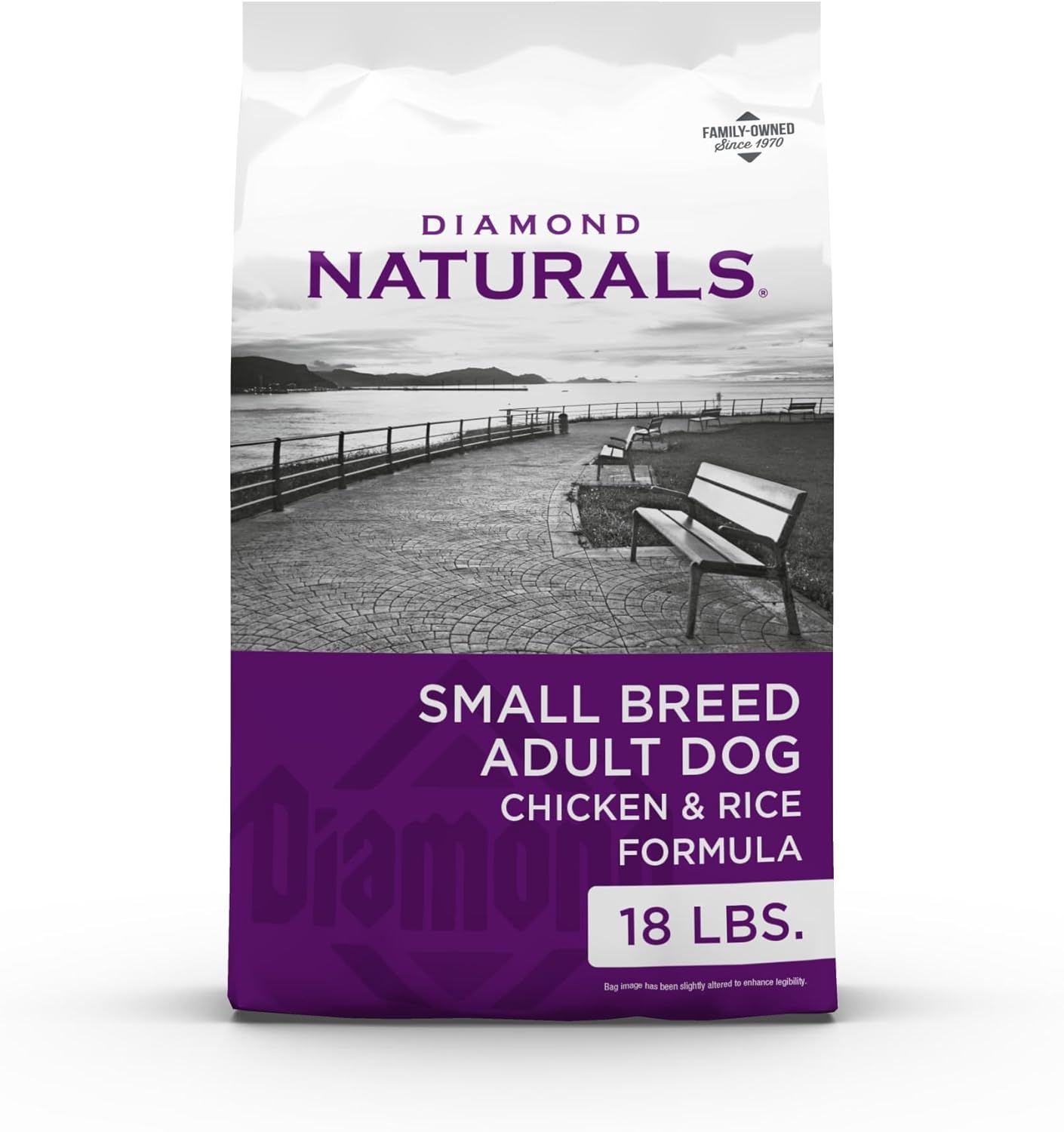
Best For: Owners on a tight budget who refuse to compromise on chicken as the first ingredient
Cost Per Day: ~$0.40–$0.55/day
Why It Made the List
- Real cage-free chicken as ingredient #1 at roughly one-third the per-pound cost of Royal Canin
- Includes K9 Strain probiotics — guaranteed live cultures, useful for the digestive sensitivity Frenchies are known for
- Small kibble size, made in the USA, formulated to meet AAFCO Dog Food Nutrient Profiles for adult maintenance
Key Specs
- Protein 27% / Fat 16% / kcal [VERIFY]
- AAFCO: Formulated for adult maintenance
- First 5 ingredients: Chicken, chicken meal, cracked pearled barley, whole grain brown rice, egg product
Honest Take
- Not breed-specific — no curved kibble, no L.I.P. protein selection
- 27% protein is higher than most adult formulas; pair with portion control for inactive Frenchies
- Most common owner report: strong value for the price; dogs accept the transition easily. Most common complaint: occasional shipping damage to the bag — worth checking on arrival

Best For: Frenchies your vet has flagged for both weight and joint concerns at the same visit
Cost Per Day: ~$1.10–$1.30/day
Why It Made the List
- Combines clinically tested weight management with added fish oil EPA for joint function
- Glucosamine (591 ppm) and chondroitin sulfate (1,299 ppm) built into the formula
- AAFCO complete and balanced via animal feeding tests — stricter than formulation-only compliance
Key Specs
- Protein 23% min / Fat 10.5% min / Fiber 4%–18%
- AAFCO: Feeding-trial substantiated for adult maintenance
- First 5 ingredients: Chicken, brown rice, chicken meal, corn gluten meal, powdered cellulose
Honest Take
- This SKU is not labeled as Small Bites — kibble size is not confirmed appropriate for the Frenchie jaw. Verify kibble dimensions on the product listing before ordering, or stick with the Small & Mini Perfect Weight pick (above) if kibble size matters more than the added EPA
- Powdered cellulose at #5 is a fiber filler — included intentionally for satiety, but worth knowing
- Most common owner report: noticeable mobility improvement in older or heavier dogs within a month. Most common complaint: kibble size larger than expected for small breeds — confirming the structural caveat above

Best For: French Bulldog puppies between 8 weeks and 12 months
Cost Per Day: ~$1.20–$1.45/day
Why It Made the List
- AAFCO growth life stage formula — required nutrition for any dog under 12 months, not interchangeable with adult formulas
- Same curved kibble shape as the adult formula, scaled down for puppy jaws
- DHA from marine microalgae oil supports cognitive and visual development during the growth window
Key Specs
- AAFCO: Growth (8 weeks–12 months)
- First 5 ingredients: Brewers rice, chicken by-product meal, wheat, chicken fat, chicken meal
- GA: [VERIFY at SKU level]
Honest Take
- Same wheat and wheat-gluten consideration as the adult formula
- Expensive per pound, but the breed-specific kibble shape is most impactful during the gulping-prone puppy stage
- Most common owner report: puppies pick up and chew this kibble easily where they struggled with previous foods. Most common complaint: transition window — owners should switch to the adult French Bulldog formula at 12 months, which uses the same curved shape, so dogs adjust easily
Full Comparison Table
| Product | Best For | Protein | Fat | Kcal/Cup | AAFCO Life Stage |
|---|---|---|---|---|---|
| Royal Canin French Bulldog Adult | Overall | 24% | 16% | 331 | Adult maintenance |
| Purina Pro Plan Sensitive Skin & Stomach Salmon & Rice | Allergies | 28% | 17% | [VERIFY] | Adult maintenance |
| Hill’s Perfect Weight Small & Mini | Weight | 24% | 9% | 289 | Adult (feeding trial) |
| Diamond Naturals Small Breed Adult | Budget | 27% | 16% | [VERIFY] | Adult maintenance |
| Hill’s Perfect Weight & Joint Support | Joints | 23% | 10.5% | ~300 | Adult (feeding trial) |
| Royal Canin French Bulldog Puppy | Puppies | [VERIFY] | [VERIFY] | [VERIFY] | Growth |
Which Dog Food Is Best for Your French Bulldog’s Situation?
If your Frenchie has itchy skin, ear infections, or red paws →
Skin issues in Frenchies are usually a specific protein reaction — and chicken and beef are the two most common culprits. Switching to a salmon-first formula removes both at once. Give it 6–8 weeks before judging results.
If your Frenchie is overweight or constantly food-motivated →
Frenchies burn fewer calories than other dogs their size due to limited exercise tolerance. A clinically tested weight formula plus measured portions is more effective than switching to a “lighter” version of the same food.
If you’re feeding on a tight budget →
You don’t need breed-specific kibble to feed well. Real chicken as the first ingredient and small-breed kibble sizing covers most of what matters at a fraction of the cost.
If your Frenchie has early joint concerns or vet-flagged mobility issues →
Short legs carrying a stocky build wear joints down faster than other breeds. Added EPA alongside weight control addresses both at once — but confirm kibble size before committing.
If you’re bringing home a Frenchie puppy →
AAFCO growth-stage nutrition isn’t optional under 12 months. Pair that with a kibble shape sized for a puppy’s even smaller jaw and you’ve solved the two biggest puppy feeding problems at once.
How Much Does Dog Food for a French Bulldog Cost?
For a 20–28 lb adult Frenchie, here’s how the spread shakes out per day and per year:
| Pick | Daily Cost | Annual Cost |
|---|---|---|
| Diamond Naturals Small Breed Adult | $0.40–$0.55 | ~$145–$200 |
| Purina Pro Plan Sensitive Skin & Stomach Salmon & Rice | $0.85–$1.00 | ~$310–$365 |
| Hill’s Perfect Weight Small & Mini | $0.90–$1.10 | ~$330–$400 |
| Royal Canin French Bulldog Adult | $1.05–$1.35 | ~$385–$490 |
| Hill’s Perfect Weight & Joint Support | $1.10–$1.30 | ~$400–$475 |
| Royal Canin French Bulldog Puppy | $1.20–$1.45 | ~$440–$530 |
The gap between budget and premium is roughly $240–$345 per year — real money, but not the only number that matters.
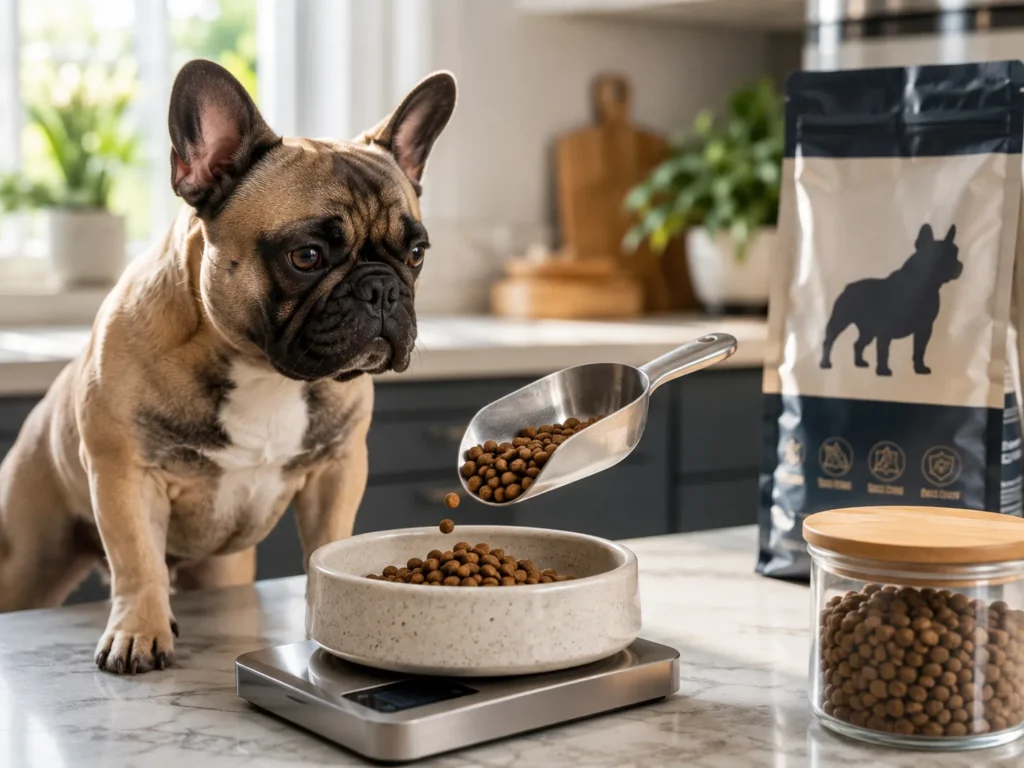
Portion control matters more than bag price for a French Bulldog. This breed will gain weight on excess calories of any food, regardless of how premium the ingredients are. The cheapest version of correctly portioned feeding beats the most expensive version of overfeeding every time.
Whichever bag you choose, follow your vet’s recommended portion — not the upper end of the bag’s feeding chart.
Why We Didn’t Include Some Popular French Bulldog Picks
Several Frenchie food articles recommend Wellness CORE, Orijen, Open Farm, or The Farmer’s Dog. These are quality brands, but each has a specific reason it didn’t make this list:
- Orijen and similar ultra-high-protein formulas push protein over 38% — too high for an inactive breed prone to weight gain
- Wellness CORE Digestive Health competes directly with Royal Canin on similar pricing without offering breed-specific kibble engineering
- Fresh food subscriptions like The Farmer’s Dog are a legitimate option, but at $4–$8/day for a Frenchie they sit in a different category than the dry food picks above
This list prioritizes Frenchie-specific design and AAFCO-compliant dry formulas at a range of price points. We cover fresh food subscriptions in a separate guide.
When to Switch Your French Bulldog’s Food
A food switch is usually overdue — not premature. Most Frenchie owners delay switching because the symptoms develop gradually. Here are the four signals it’s time to change bags:
- Chronic gas or stool issues lasting 2+ weeks despite no other diet changes — points to an ingredient your dog isn’t tolerating
- Itchy skin, recurring ear infections, or red paws that don’t resolve with regular grooming and ear cleaning — usually a food protein reaction
- Steady weight gain despite portion control — current food’s calorie density may be too high for your dog’s activity level
- Reduced energy or slower mobility in younger dogs — worth investigating before assuming it’s age-related
How to transition safely: switch over 7–10 days using a gradual ratio — 75% old food / 25% new on days 1–2, 50/50 on days 3–5, 25/75 on days 6–8, then 100% new from day 9. Skipping the transition is the #1 cause of “this food gave my dog diarrhea” reviews — it’s usually the switch itself, not the food.
When to involve your vet instead of switching: if symptoms are sudden, severe, or accompanied by lethargy, vomiting, or loss of appetite, the issue likely isn’t the food alone. Consult your vet before making changes.
Frequently Asked Questions
What is the best dog food for French Bulldogs with allergies?
The best dog food for French Bulldogs with allergies is Purina Pro Plan Sensitive Skin & Stomach Salmon & Rice Small Breed, because it removes both chicken and beef — the two most common Frenchie allergy triggers — and pairs a single fish protein source with easily digestible rice and barley. If symptoms don’t improve in 6–8 weeks, your vet may recommend a true hydrolyzed-protein elimination diet.
Why do French Bulldogs need small breed kibble?
French Bulldogs need small kibble because their brachycephalic skull and underbite make standard-sized kibble hard to grip and chew. This causes gulping and swallowed air (aerophagia), which is one of the main reasons the breed is known for excessive gas. Curved kibble shapes engineered for the breed (like Royal Canin’s) go a step further than just “small.”
What dog food helps with French Bulldog gas?
Royal Canin French Bulldog Adult is the most directly engineered for this problem. The curved kibble slows down eating, and Royal Canin’s L.I.P. (Low Indigestible Protein) selection reduces intestinal fermentation — the actual biological process that causes flatulence and stool odor.
Is grain-free dog food good for French Bulldogs?
Not necessarily, and possibly not at all. The FDA investigated a link between certain grain-free diets and canine dilated cardiomyopathy (DCM) starting in 2018, with ongoing monitoring as of 2024. Unless your Frenchie has a confirmed grain allergy (rare), grain-inclusive formulas are the safer default. Consult your vet before going grain-free.
How much should I feed my French Bulldog to avoid weight gain?
Feed to your vet’s recommended portion using a measuring cup, not by eye. Most adult Frenchies need 1–1.5 cups of dry food per day total, split into two meals. Frenchies will eat whatever you put in front of them, so portion control matters more than which bag you buy.
What should French Bulldog puppies eat?
French Bulldog puppies need an AAFCO growth-stage formula until 12 months — adult food doesn’t meet the calorie, calcium, or DHA requirements for development. Look for small-breed or breed-specific puppy kibble sized appropriately for a puppy jaw.
Our Verdict: Best Dog Food for French Bulldogs
For most French Bulldog owners, Royal Canin French Bulldog Adult is the right starting point. No other formula on the market is engineered around this breed’s actual anatomy — the curved kibble shape and L.I.P. protein selection together solve the gulping-and-gas problem that food alone usually can’t.
But “best overall” doesn’t mean “best for your dog.” Use this decision framework instead:
- Allergies or skin issues → Purina Pro Plan Sensitive Skin & Stomach Salmon & Rice
- Overweight or food-motivated → Hill’s Science Diet Perfect Weight Small & Mini Chicken
- Want quality at half the price → Diamond Naturals Small Breed Adult
- Vet has flagged both weight and joint concerns → Hill’s Perfect Weight & Joint Support Chicken
- French Bulldog puppy under 12 months → Royal Canin French Bulldog Puppy
- No specific concerns, just want the best fit → Royal Canin French Bulldog Adult
Whichever pick fits your dog, transition over 7–10 days to avoid digestive upset, and consult your vet if skin, weight, or stool issues persist after 6–8 weeks on a new food.