 Marco Williams
Both Taste of the Wild and Blue Buffalo sit in the same “premium but affordable” price range, and both show up on every dog food recommendation list. But when it’s time to actually pick one, the differences matter more than most comparison articles admit.
Taste of the Wild vs Blue Buffalo isn’t just a brand preference — it’s a choice between two fundamentally different approaches to feeding your dog. TOTW builds its formulas around grain-free, novel proteins like bison and venison, with built-in probiotics. Blue Buffalo leads with grain-inclusive, chicken-first recipes backed by WSAVA veterinary standards and their signature LifeSource Bits.
The price per pound is nearly identical. The protein content is not. And the grain-free vs grain-inclusive question carries real weight now that the FDA has weighed in on the DCM debate.
For most healthy adult dogs, one brand delivers significantly more protein per dollar — but the better choice depends on whether your dog needs grains, has food sensitivities, or is still a puppy.
- Best for most adult dogs → Taste of the Wild High Prairie — 32% protein from bison and venison at ~$2.00/lb with guaranteed probiotics
- Best for puppies → Blue Buffalo Life Protection Puppy — WSAVA-backed formula with transparent DHA/ARA levels and a dedicated large-breed variant
- Best for sensitive stomachs → Blue Buffalo Basics Salmon & Potato — single animal protein, free of chicken, beef, dairy, and eggs
- Best value (protein per dollar) → Taste of the Wild High Prairie — highest protein-per-dollar ratio in this comparison at ~$2.00/lb
Daily cost estimates based on a 50 lb adult dog. Confirm live Amazon pricing before purchasing.
Taste of the Wild vs Blue Buffalo: What’s Actually Different?
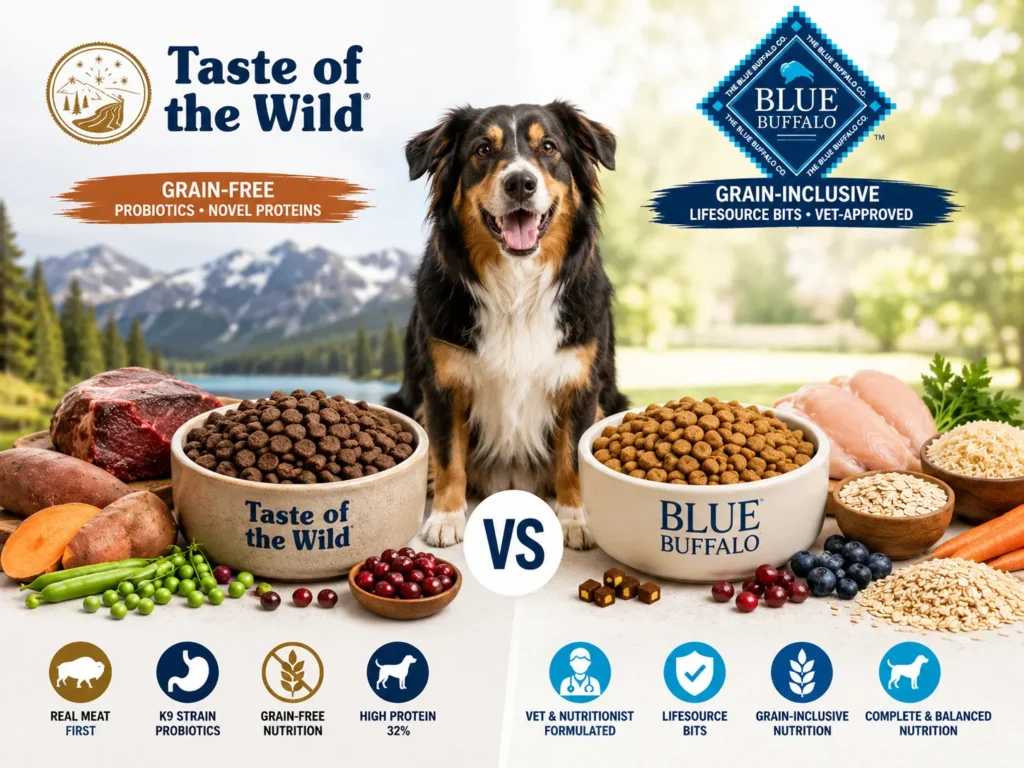
Taste of the Wild and Blue Buffalo are built on different philosophies, even though they compete at the same price point. Understanding the split helps you pick the right one faster than reading every ingredient panel.
Taste of the Wild is made by Diamond Pet Foods (owned by Schell & Kampeter, Inc.), a family-owned company founded in 1970. The brand launched in 2007 with a focus on ancestral-diet formulas — grain-free kibble featuring novel proteins like bison, venison, wild boar, and roasted duck. Their core differentiator is K9 Strain Probiotics, a proprietary blend of 80 million CFU per pound added after cooking to stay viable.
All TOTW recipes are manufactured across six U.S.-based facilities in California, Kansas, South Carolina, Missouri, and Arkansas.
Blue Buffalo was founded in 2003 after the Bishop family’s Airedale terrier, Blue, was diagnosed with cancer. General Mills acquired the brand in 2018 for $8 billion. BB follows WSAVA guidelines — their formulas are developed by veterinarians and PhD animal nutritionists, and they conduct feeding trials.
The brand’s signature is LifeSource Bits, cold-formed kibble pieces containing a precise antioxidant-vitamin-mineral blend. BB owns two U.S. plants (Joplin, MO and Richmond, IN) and contracts with additional facilities, including some in Thailand.
The lineup size is dramatically different. TOTW offers roughly 25 recipes across 4 lines. Blue Buffalo has 187+ recipes spanning 7+ product lines.
| Factor | Taste of the Wild | Blue Buffalo |
|---|---|---|
| Parent company | Diamond Pet Foods (Schell & Kampeter) | General Mills |
| Founded | 2007 | 2003 |
| Manufacturing | 6 U.S. plants | 2 owned + contracted (U.S. + Thailand) |
| WSAVA compliant | No | Yes |
| Product lines | 4 | 7+ |
| Total recipes | ~25 | 187+ |
| Grain-free options | Yes (original line + PREY) | Yes (Wilderness, Freedom) |
| Grain-inclusive options | Yes (Ancient Grains) | Yes (Life Protection — flagship) |
| Signature feature | K9 Strain Probiotics (80M CFU/lb) | LifeSource Bits (cold-formed antioxidants) |
| Avg protein (dry adult) | 30–32% | 24–26% |
| Price range (28–30 lb bag) | ~$55–60 | ~$55–65 |
| Recall history | 1 recall (2012) | 4 recalls (2007–2017) |
Head-to-Head: 3 Product Matchups That Actually Matter
Instead of comparing 200+ products across both brands, we matched the specific formulas real buyers are choosing between — the adult flagship, puppy formula, and sensitive stomach option from each brand. These three pairs cover the scenarios that drive 90% of purchase decisions.
Pair 1: Adult Flagship — High Prairie vs Life Protection

Best For: Healthy, active adult dogs who thrive on grain-free, high-protein nutrition. Cost Per Day: ~$1.85–$2.15 for a 50 lb dog
Key Specs
- Macros: 32% protein, 18% fat, 4% fiber, 370 kcal/cup — one of the highest protein percentages in its price tier
- AAFCO: Formulated to meet AAFCO Dog Food Nutrient Profiles for Adult Maintenance
- First 5 Ingredients: Buffalo, lamb meal, chicken meal, sweet potatoes, peas
What Sets It Apart
- K9 Strain Probiotics — 80 million CFU per pound of proprietary probiotics added after cooking to stay viable, supporting both digestive and immune health
- Novel protein profile with bison, venison, and lamb alongside water buffalo — offers more protein diversity than chicken-first competitors at a comparable price
- Chelated minerals for better nutrient absorption, plus omega-6 and omega-3 fatty acids from salmon oil for skin and coat support
Honest Take
- The first listed ingredient “buffalo” is water buffalo (sourced from India), not American bison — bison and venison appear lower in the ingredient list. This is a transparency issue worth knowing, though the overall protein quality remains strong.
- This is a grain-free formula using peas and sweet potatoes as carbohydrate sources. The FDA’s 2019 DCM investigation flagged grain-free diets with legumes as a potential concern — consult your vet if your breed has known DCM predisposition.
- Most common owner report: Dogs love the taste, noticeably shinier coat within 2–4 weeks, and improved stool consistency. Most common complaint: Kibble size too large for small breeds, occasional reports of gas during transition.

Best For: Adult dogs whose owners want WSAVA-backed, vet-formulated, grain-inclusive nutrition. Cost Per Day: ~$1.90–$2.25 for a 50 lb dog
Key Specs
- Macros: 24% protein, 14% fat, 5% fiber, 367 kcal/cup — moderate protein with added glucosamine (400 mg/kg) for joint support
- AAFCO: Formulated to meet AAFCO Dog Food Nutrient Profiles for Adult Maintenance — backed by WSAVA feeding trials
- First 5 Ingredients: Deboned chicken, chicken meal, brown rice, oatmeal, barley
What Sets It Apart
- LifeSource Bits — cold-formed kibble pieces containing a precise blend of antioxidants, vitamins, and minerals selected by veterinarians. The cold-forming process retains nutrient potency that standard high-heat processing destroys.
- WSAVA-compliant formulation — developed by veterinarians and PhD animal nutritionists with feeding trials conducted. This is the gold standard vets reference when recommending food brands.
- Glucosamine (400 mg/kg) included for joint health support — a notable add at this price point that competitors like TOTW don’t include in their adult formulas.
Honest Take
- At 24% protein, this is significantly lower than TOTW High Prairie’s 32%. For active or working dogs, the protein difference matters. For moderate-activity house dogs, 24% is adequate and within AAFCO guidelines.
- Chicken is the #1 protein source — effective and well-researched, but also the most common food allergen in dogs. If your dog has chicken sensitivity, this formula won’t work.
- Most common owner report: Noticeably shinier coat, easy transition from other brands, dogs eat it consistently. Most common complaint: Some dogs pick out and refuse the LifeSource Bits, and multiple owners report price increases over time.
The protein gap is the headline here. TOTW High Prairie delivers 32% protein compared to BB Life Protection’s 24% — that’s a 33% protein advantage at a comparable price per pound. For active adult dogs who need sustained energy, that difference is meaningful.
TOTW uses novel proteins — buffalo (water buffalo), lamb meal, and chicken meal alongside roasted bison and venison. Blue Buffalo leads with deboned chicken and chicken meal, the most common protein source in dog food.
That matters because chicken is also the most frequently reported food allergen in dogs. If your dog tolerates chicken well, BB’s approach is fine. If not, TOTW’s multi-protein formula gives you more options.
Verdict for this pair: For a healthy, active adult dog with no grain sensitivities, TOTW High Prairie offers more protein, more diverse proteins, and included probiotics at a lower or comparable price. BB Life Protection wins if you want WSAVA-backed formulation or your vet recommends grain-inclusive food.
Pair 2: Puppy Formula — High Prairie Puppy vs Life Protection Puppy
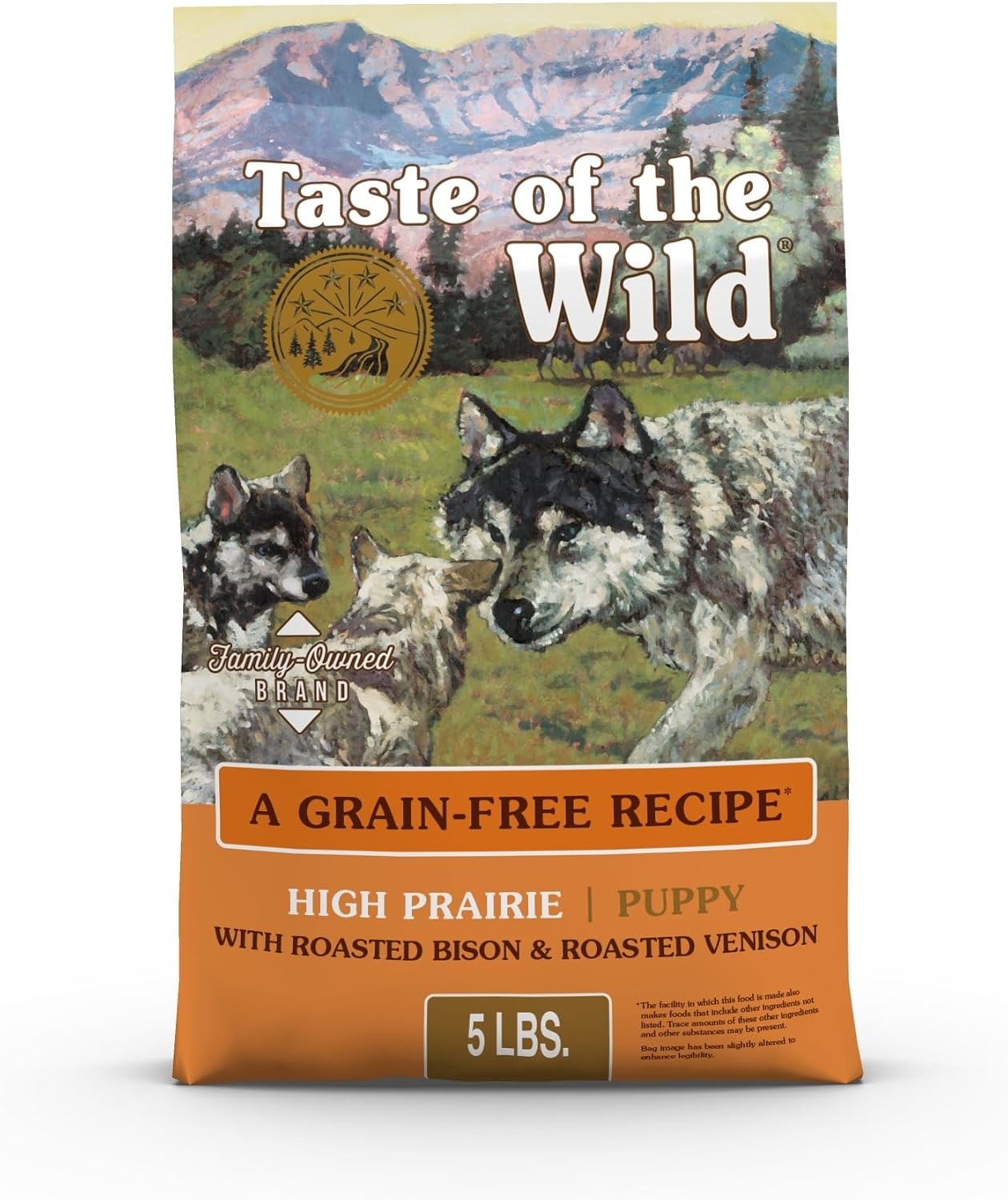
Best For: Puppies of all breeds, including large breeds (70 lbs+ as adult). Owners who want grain-free, high-protein puppy nutrition with probiotics.
Key Specs
- Macros: 28% protein, 17% fat, 5% fiber, 364 kcal/cup — higher protein than most puppy formulas in this price range
- AAFCO: All Life Stages including growth of large size dogs (70 lbs or more as an adult)
- First 5 Ingredients: Buffalo, lamb meal, chicken meal, sweet potatoes, peas — Dogster lists egg product instead of chicken meal]
What Sets It Apart
- DHA from salmon oil supports cognitive and retinal development — critical during the first 12–18 months of a puppy’s life
- K9 Strain Probiotics included (same 80M CFU/lb as adult formula), giving puppies digestive support during the sensitive transition from mother’s milk to solid food
- Small kibble size designed specifically for puppy mouths, with a crunchy texture that helps keep developing teeth clean
Honest Take
- TOTW doesn’t publish minimum DHA percentages on the guaranteed analysis — the DHA is present via salmon oil but the exact level isn’t transparent. BB Puppy explicitly lists DHA at 0.10% min.
- While labeled for “growth of large size dogs,” this is the same single formula for all breeds — no separate large-breed-specific SKU with adjusted calcium/phosphorus like BB offers.
- Most common owner report: Puppies love the taste immediately, good energy levels and healthy stool from week one. Most common complaint: Despite being labeled a puppy food, kibble size can still be challenging for very small toy breed puppies.

Best For: First-time puppy owners, large-breed puppies, and anyone who wants vet-aligned, WSAVA-backed puppy nutrition with transparent DHA/ARA levels.
Key Specs
- Macros: 27% protein, 16% fat, 5% fiber | DHA: 0.10% min, ARA: 0.04% min — both explicitly listed on the guaranteed analysis
- AAFCO: Growth | Calcium: 1.3% min, Phosphorus: 1.0% min — separate Large Breed Puppy SKU also available with controlled Ca:P ratios
- First 5 Ingredients: Deboned chicken, chicken meal, brown rice, oatmeal, barley (+ menhaden fish meal as 6th)
What Sets It Apart
- Transparent DHA + ARA reporting — both percentages listed on the bag, not just “from salmon oil.” This lets you verify your puppy is getting adequate brain-development nutrients.
- Dedicated Large Breed Puppy variant with L-Carnitine and controlled calcium — critical for Goldens, Labs, German Shepherds, and other breeds prone to developmental orthopedic issues from excess calcium
- WSAVA-backed formulation with feeding trials conducted — the highest level of nutritional validation available. Most vets specifically recommend WSAVA-compliant brands for puppies.
Honest Take
- Protein is slightly lower than TOTW Puppy (27% vs 28%) — a minor difference that won’t impact most puppies. The bigger trade-off is grain-inclusive vs grain-free.
- Starting a puppy on Blue Buffalo often means staying with BB through the Life Protection adult and senior lines. This is a brand-commitment decision as much as a single-product choice.
- Most common owner report: Easy transition, consistent stools, puppies grow well on it. Most common complaint: LifeSource Bits sometimes picked out by picky puppies, and the formula contains chicken — an issue if your puppy develops chicken sensitivity later.
Both formulas include DHA for cognitive development, and both meet AAFCO Growth standards. Blue Buffalo explicitly lists DHA and ARA percentages — for first-time puppy owners who want transparency, BB’s approach is more reassuring.
BB also offers a separate Large Breed Puppy SKU with controlled calcium-to-phosphorus ratios and added L-Carnitine. TOTW’s puppy formula is labeled for “all life stages including growth of large size dogs,” which technically meets AAFCO’s nutrient ceiling but isn’t a purpose-built large-breed recipe.
Verdict for this pair: Blue Buffalo Life Protection Puppy is the safer, more transparent choice for most puppy owners — especially large-breed puppies. TOTW Puppy is the better pick for experienced owners who want higher protein and probiotics from day one. Consult your vet before choosing a puppy food, particularly for large and giant breeds.
Pair 3: Sensitive Stomach / Limited Ingredient
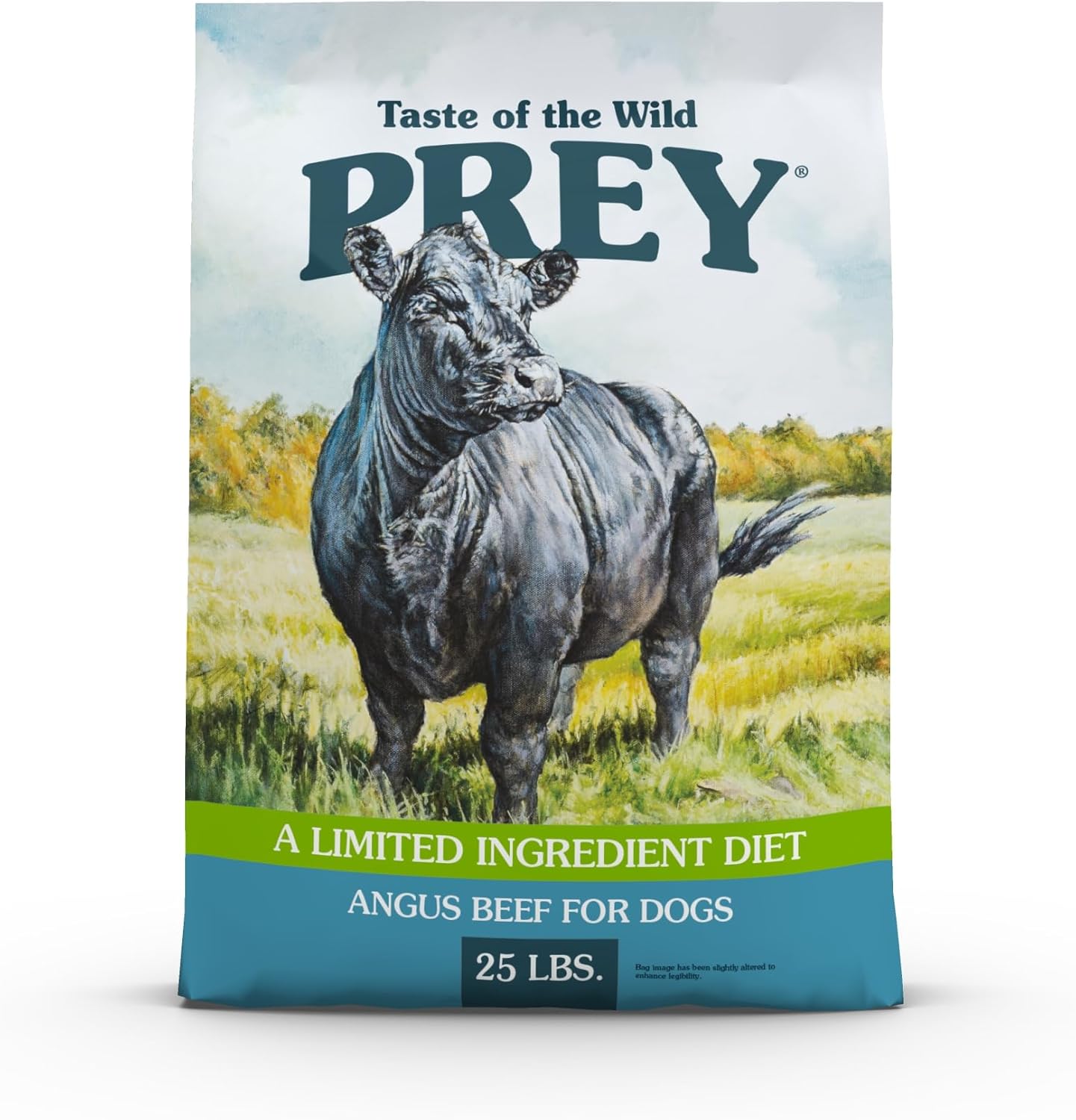
Best For: Dogs with food sensitivities who react to fish, grains, or complex ingredient decks. Dogs on elimination diets.
Key Specs
- Macros: 29% protein, 16% fat, 4% fiber — high protein for a limited ingredient formula
- AAFCO: All Life Stages — can be fed to puppies, adults, and seniors
- 4 Key Ingredients: Pasture-raised Angus beef, lentils, tomato pomace, chicken fat (preserved with mixed tocopherols)
What Sets It Apart
- Only 4 core ingredients — the simplest formula in this entire comparison. Fewer ingredients means fewer potential allergen triggers, which makes this useful for elimination diets.
- Pasture-raised Angus beef as the sole animal protein — a novel protein for dogs who’ve only eaten chicken or fish-based formulas
- All Life Stages AAFCO rating means you can feed this to puppies, adults, or seniors without switching formulas — useful for multi-dog households with sensitive stomachs
Honest Take
- Contains chicken fat — while chicken fat has minimal protein and rarely triggers allergies, dogs with severe chicken sensitivities should be aware. This isn’t a truly chicken-free formula despite using beef as the named protein.
- Grain-free with lentils as the primary carbohydrate — this puts it in the category of formulas flagged by the FDA’s 2019 DCM investigation. Consult your vet if your breed has DCM predisposition (Dobermans, Great Danes, Golden Retrievers).
- Most common owner report: Resolved itching and hot spots within 3–4 weeks, simple ingredient list gives peace of mind. Most common complaint: Kibble size too small for large breeds, some dogs refused the beef flavor entirely.

Best For: Dogs allergic to chicken, beef, dairy, or eggs. Dogs with chronic digestive issues or itchy skin who need a broad allergen-exclusion formula.
Key Specs
- Macros: 20% protein, 10% fat, 7% fiber — lower calorie density, suitable for less active or overweight dogs
- AAFCO: Adult Maintenance — WSAVA-compliant formulation
- First 5 Ingredients: Deboned salmon, oatmeal, brown rice, salmon meal, potatoes
What Sets It Apart
- Broadest allergen exclusion in this comparison — free of chicken, beef, corn, wheat, soy, dairy, AND eggs. This covers the majority of common food allergens in a single formula.
- Single animal protein (salmon) with grain-inclusive carbs (oatmeal and brown rice) — a combination that aligns with current veterinary recommendations for both allergy management and DCM avoidance
- Omega-3 and omega-6 fatty acids from salmon oil and flaxseed specifically included for skin and coat repair — this formula targets itchy skin as much as digestive issues
Honest Take
- At 20% protein and 10% fat, this is the lowest-calorie formula in the comparison. Active dogs or working breeds may need a higher-calorie option. For moderate-activity dogs with sensitivities, the lower density is actually a benefit.
- The grain-inclusive version (24 lb bag) and grain-free version (22 lb bag) look nearly identical on the shelf. Double-check the bag label before purchasing — the ingredients are different between the two SKUs.
- Most common owner report: Gas and bloating resolved within 2 weeks, coat became noticeably softer, good for French Bulldogs and other sensitive breeds. Most common complaint: Strong fish smell that some owners find unpleasant, and some dogs simply don’t like salmon-flavored kibble.
Verdict for this pair: BB Basics Salmon is the safer pick for most dogs with food sensitivities — its broader allergen exclusion list and grain-inclusive formula align with current veterinary guidance. TOTW PREY is better for dogs who react specifically to fish or grains and need an ultra-simplified formula.
Master Comparison Table: All 6 Products
| Factor | TOTW High Prairie | BB Life Protection | TOTW Puppy | BB Puppy | TOTW PREY LID | BB Basics |
|---|---|---|---|---|---|---|
| Protein | 32% | 24% | 28% | 27% | 29% | 20% |
| Fat | 18% | 14% | 17% | 16% | 16% | 10% |
| Fiber | 4% | 5% | 5% | 5% | 4% | 7% |
| Grain-free | Yes | No | Yes | No | Yes | No |
| WSAVA | No | Yes | No | Yes | No | Yes |
| Probiotics | Yes (80M CFU/lb) | No (prebiotic only) | Yes | No | Yes | No |
| Price/lb | ~$2.00 | ~$2.00 | ~$2.00 | ~$1.90 | ~$2.45 | ~$2.40 |
| AAFCO | Maintenance | Maintenance | All Life Stages (incl. large breed) | Growth | All Life Stages | Maintenance |
Which Brand Should You Actually Buy?
The right brand depends on your dog’s life stage, health status, and your comfort level with the grain-free question. Here are the five most common scenarios and the product we’d start with for each.
If your dog is a healthy, active adult →
Go with Taste of the Wild High Prairie. At 32% protein with bison and venison, it delivers the highest protein-per-dollar ratio in this comparison. The included K9 Strain Probiotics (80M CFU/lb) save you from buying a separate digestive supplement. For dogs without known allergies or grain sensitivities, this is the strongest all-around value.
If you’re buying for a puppy (especially large breed) →
Start with Blue Buffalo Life Protection Puppy. The WSAVA-backed formulation, transparent DHA/ARA percentages, and a dedicated large-breed variant with controlled calcium make this the most vet-aligned puppy option. Your breeder or veterinarian can confirm if it’s the right fit for your specific breed.
If your dog has skin allergies or a sensitive stomach →
Choose Blue Buffalo Basics Salmon & Potato if your dog reacts to chicken or beef — the single-protein, allergen-free formula covers the most common triggers. Choose Taste of the Wild PREY instead if your dog reacts to fish or grains.
If you’re unsure which allergen is the problem, ask your vet about an elimination diet before spending money on trial-and-error.
If you’re worried about the grain-free / DCM debate →
Stick with Blue Buffalo Life Protection — it’s grain-inclusive with brown rice, oatmeal, and barley. If you want TOTW’s protein quality without the grain-free question, look at the Taste of the Wild Ancient Grains line, which uses quinoa, millet, and chia seeds as grain sources instead of legumes.
If you’re on a tight budget →
Taste of the Wild High Prairie offers the best protein-per-dollar in this comparison. At ~$2.00/lb with 32% protein, you’re getting premium-tier nutrition at mid-tier pricing. Blue Buffalo frequently runs 35% first Subscribe & Save coupons on Amazon, which can close the gap on a single order — but TOTW’s baseline pricing is more consistent long-term.
No dog food is perfect for every dog. If your current food is working — consistent stools, healthy coat, good energy — switching brands just because of a comparison article isn’t always the right move. When in doubt, consult your vet before making changes.
Recall History: How Both Brands Compare
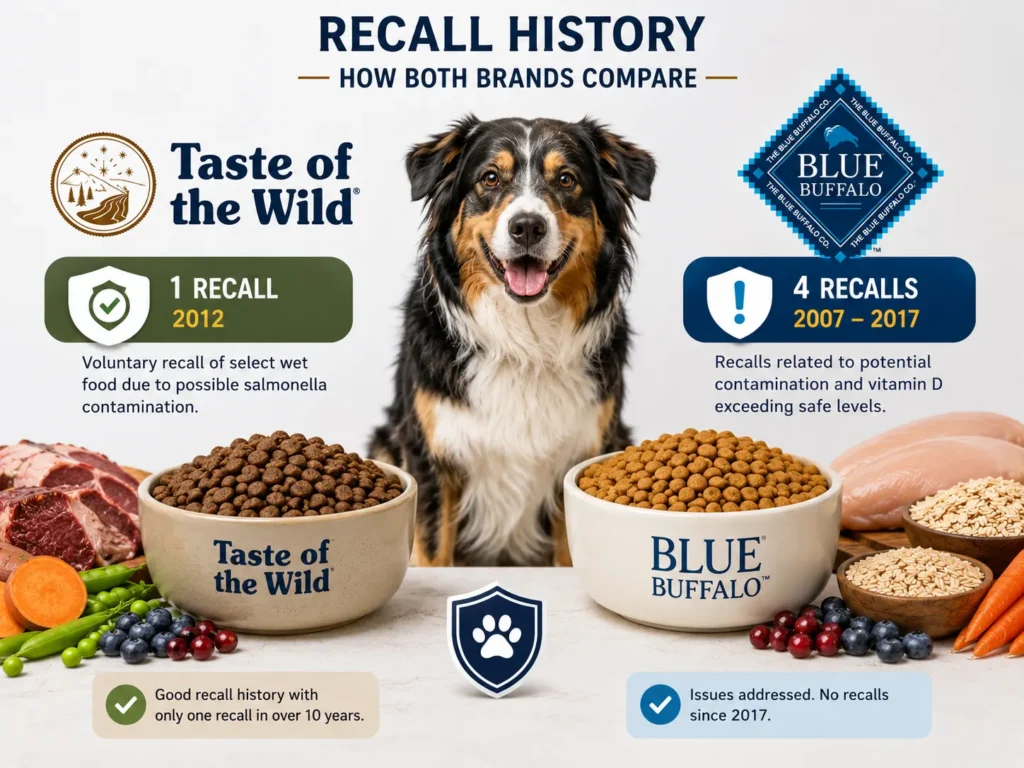
Both brands have been recall-free since at least 2017, but their histories differ. Taste of the Wild has had 1 recall; Blue Buffalo has had 4.
Taste of the Wild: One recall in 2012. Parent company Diamond Pet Foods recalled products across several brands due to potential Salmonella contamination at the Gaston, SC manufacturing facility. No recalls since 2012 — a 13+ year clean streak.
Blue Buffalo: Four recalls between 2007 and 2017. In 2007, the brand was caught in the industry-wide melamine contamination recall affecting hundreds of pet food brands. In 2016, BB voluntarily recalled limited BLUE Wilderness Wild Chews for potential Salmonella.
In 2017, the brand issued two separate recalls — one for possible elevated beef thyroid hormone in certain wet foods, and another for potential aluminum contamination in canned food. No recalls since 2017.
TOTW has a cleaner record by volume (1 vs 4), but BB’s most recent recalls were targeted and resolved quickly. Neither brand’s recall history should be a dealbreaker in 2026, but the information is worth knowing.
Frequently Asked Questions
Is Taste of the Wild better than Blue Buffalo?
Neither is universally better — it depends on what you prioritize. TOTW delivers higher protein (32% vs 24% in flagship formulas) at a comparable price, and includes guaranteed probiotics. BB offers WSAVA compliance, more product variety across life stages, and vet-formulated recipes. For healthy adult dogs, TOTW offers more nutritional value per dollar. For puppies and dogs with specific health needs, BB’s broader lineup is an advantage.
Is Taste of the Wild grain-free?
The original TOTW line and PREY line are grain-free. The Ancient Grains line is grain-inclusive, using quinoa, millet, chia seeds, and sorghum instead of corn, wheat, or soy. If you want TOTW’s protein quality with grains, the Ancient Grains line is the middle ground.
Has Blue Buffalo been recalled?
Yes — Blue Buffalo has had 4 recalls (2007, 2016, and 2017 × 2). The most recent was in 2017 for potential aluminum contamination in select canned foods. The brand has been recall-free since then. Taste of the Wild has had 1 recall (2012) and has also been clean since.
Can I mix Taste of the Wild and Blue Buffalo?
You can, but transition gradually over 7–10 days to avoid digestive upset. Some owners rotate brands monthly to diversify their dog’s nutrient profile. If your dog has a sensitive stomach, it’s better to stick with one formula and consult your vet before switching.
Is Blue Buffalo worth the price?
At $1.90–$2.20/lb for flagship formulas, Blue Buffalo is competitively priced against TOTW and other premium brands. BB’s WSAVA compliance, feeding trials, and broader product range justify the price for many owners. TOTW offers higher protein and probiotics at a similar or lower price, which may represent better nutritional value per dollar for adult dogs.
Which brand is better for dogs with allergies?
It depends on the specific allergen. BB Basics is formulated without chicken, beef, dairy, and eggs — covering the most common triggers. TOTW PREY uses only 4 core ingredients and avoids grains entirely, which is better for dogs who react to fish or grains. Consult your vet to identify your dog’s specific triggers through an elimination diet before choosing.
Our Final Verdict
For most healthy adult dogs, Taste of the Wild High Prairie is the better value in this comparison. It delivers 32% protein from novel sources (bison, venison, lamb) at roughly $2.00/lb, includes 80 million CFU of guaranteed K9 Strain Probiotics per pound, and has a cleaner recall history. If your dog tolerates grain-free food well, it’s the strongest all-around pick.
Blue Buffalo takes the lead in three specific situations. For puppy nutrition, the Life Protection Puppy formula’s transparent DHA/ARA reporting and dedicated large-breed variant make it the more vet-aligned choice. For food sensitivities, BB Basics’ comprehensive allergen exclusion list (no chicken, beef, dairy, eggs) is more practical than TOTW PREY for most allergy-prone dogs.
And if your veterinarian recommends grain-inclusive food due to DCM concerns, BB Life Protection is the straightforward answer.
If you’re starting fresh and your adult dog has no known allergies, Taste of the Wild High Prairie is where we’d begin.
We update this comparison every 90 days as pricing, formulations, and recall statuses change. Last updated: June 2026.