 Marco Williams
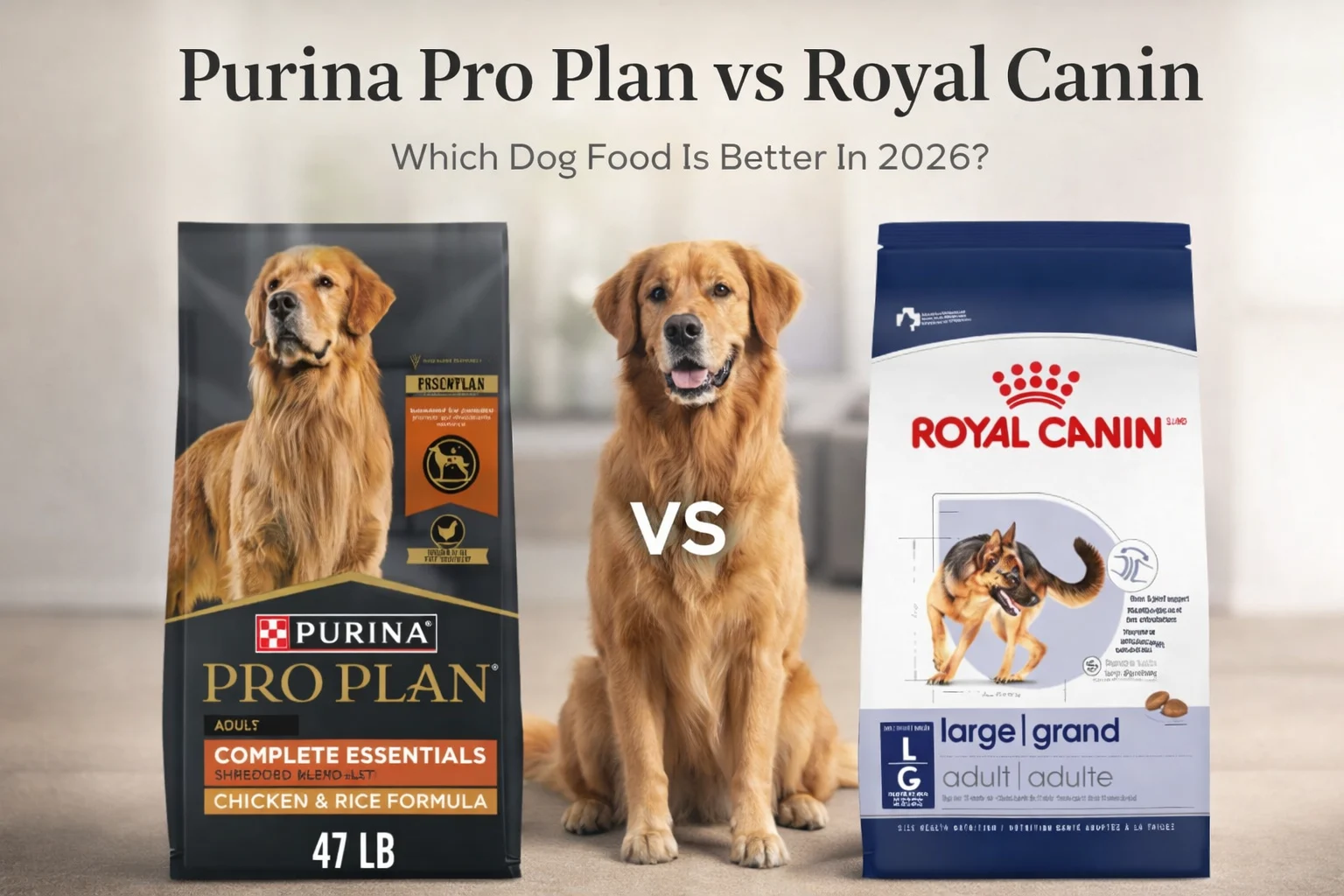
When choosing a premium dog food, most pet owners find themselves torn between two vet-recommended names that dominate the market. Both Purina Pro Plan and Royal Canin are backed by decades of research, widely stocked at pet retailers, and trusted by veterinarians and breeders alike — but they are built around different nutritional philosophies.
This article compares Purina Pro Plan or Royal Canin across protein levels, ingredients, sensitive stomach formulas, puppy nutrition, and daily cost — giving you a clear, data-driven breakdown to match the right brand to your dog’s needs.
📦 See current prices and availability before choosing. Compare both options based on your dog’s needs below.
Who Should Choose Purina Pro Plan
- Dogs needing higher protein and active muscle support
- Pet owners prioritizing whole meat first ingredients and live probiotics
- Budget-conscious buyers who want premium quality at a lower price per pound
Who Should Choose Royal Canin
- Large or giant breed dogs with size-specific nutritional needs
- Dogs with digestive sensitivity needing precise fiber and prebiotic balance
- Owners whose vet recommends breed- or condition-targeted formulas
Bottom Line: If your dog has no specific breed or condition requirements, Purina Pro Plan delivers strong all-round nutrition at better value. If your vet has flagged size, breed, or digestive concerns, Royal Canin’s targeted approach is worth the premium.
What Is the Difference Between Purina Pro Plan and Royal Canin?
Purina Pro Plan is positioned as a science-driven, performance-oriented brand. It emphasizes real meat as the first ingredient, live probiotics in many formulas, and broad nutritional coverage for most adult dogs and life stages.
Royal Canin takes a precision-nutrition approach. Its formulas are segmented by breed size, age bracket, and health condition — making it one of the most specialized commercial dog food brands available without a prescription.
On pricing, Purina Pro Plan typically falls in the mid-premium tier, while Royal Canin sits at the upper-premium level. The cost difference reflects Royal Canin’s narrower, more targeted formulation rather than a universal quality gap.
Key Differences Between Purina Pro Plan and Royal Canin
| Factor | Purina Pro Plan | Royal Canin |
|---|---|---|
| Protein Range | Around 26–30% (dry matter) | Around 23–26% (dry matter) |
| Calories | Typically higher per cup | Moderate; controlled for size |
| Ingredient Style | Whole meat first; probiotics included | By-products used; prebiotics & fibers |
| Price Level | Mid-premium | Upper-premium |
| Best For | Active, general adult dogs | Breed-size & digestive-specific dogs |
| AAFCO Status | Yes – complete & balanced | Yes – complete & balanced |
Purina Pro Plan vs Royal Canin: Protein, Fat and Calorie Comparison
📊 Product Comparison
Purina Pro Plan: Complete Essentials Shredded Blend Chicken & Rice with Probiotics (Adult Dry Dog Food)

- Protein: 26% min
- Fat: 16% min
- Fiber: 3% max
- kcal per cup: ~440 kcal
- Top 5 ingredients: Chicken, rice, whole grain wheat, poultry by-product meal, corn gluten meal
Royal Canin: Large Breed Adult Dry Dog Food (Size Health Nutrition line)

- Protein: 23% min
- Fat: 12% min
- Fiber: 3.8% max
- kcal per cup: ~360 kcal
- Top 5 ingredients: Brewers rice, chicken by-product meal, corn, wheat, chicken fat
Quick Insight: Purina Pro Plan delivers about 3% more protein and roughly 80 more kcal per cup. Royal Canin uses slightly higher fiber to support digestion and controlled weight in large breeds.
Decision Hook:
- ✅ Choose Purina Pro Plan if your dog is active, muscular, or needs higher caloric density
- ✅ Choose Royal Canin if your large breed dog needs controlled calories and structured fiber
Higher caloric density in Purina Pro Plan means smaller portions may suffice, especially for less active dogs. This can offset the price difference over time.
Royal Canin’s lower fat and controlled calorie profile suits large breeds prone to weight gain or joint stress. The higher fiber also supports satiety without excess calories.
For muscle maintenance, Purina Pro Plan’s higher protein minimum gives a measurable edge — particularly relevant for working dogs, sporting breeds, or dogs recovering from illness.
Which Is Better for Sensitive Stomach: Purina Pro Plan or Royal Canin?
📊 Product Comparison
Purina Pro Plan: Sensitive Skin & Stomach Salmon & Rice Formula (Adult Dry Dog Food)

- Protein: 26% min
- Fat: 16% min
- Fiber: 3% max
- kcal per cup: ~430 kcal
- Top 5 ingredients: Salmon, rice, barley, oatmeal, fish meal
Royal Canin: Digestive Care Adult Dry Dog Food (non-prescription)
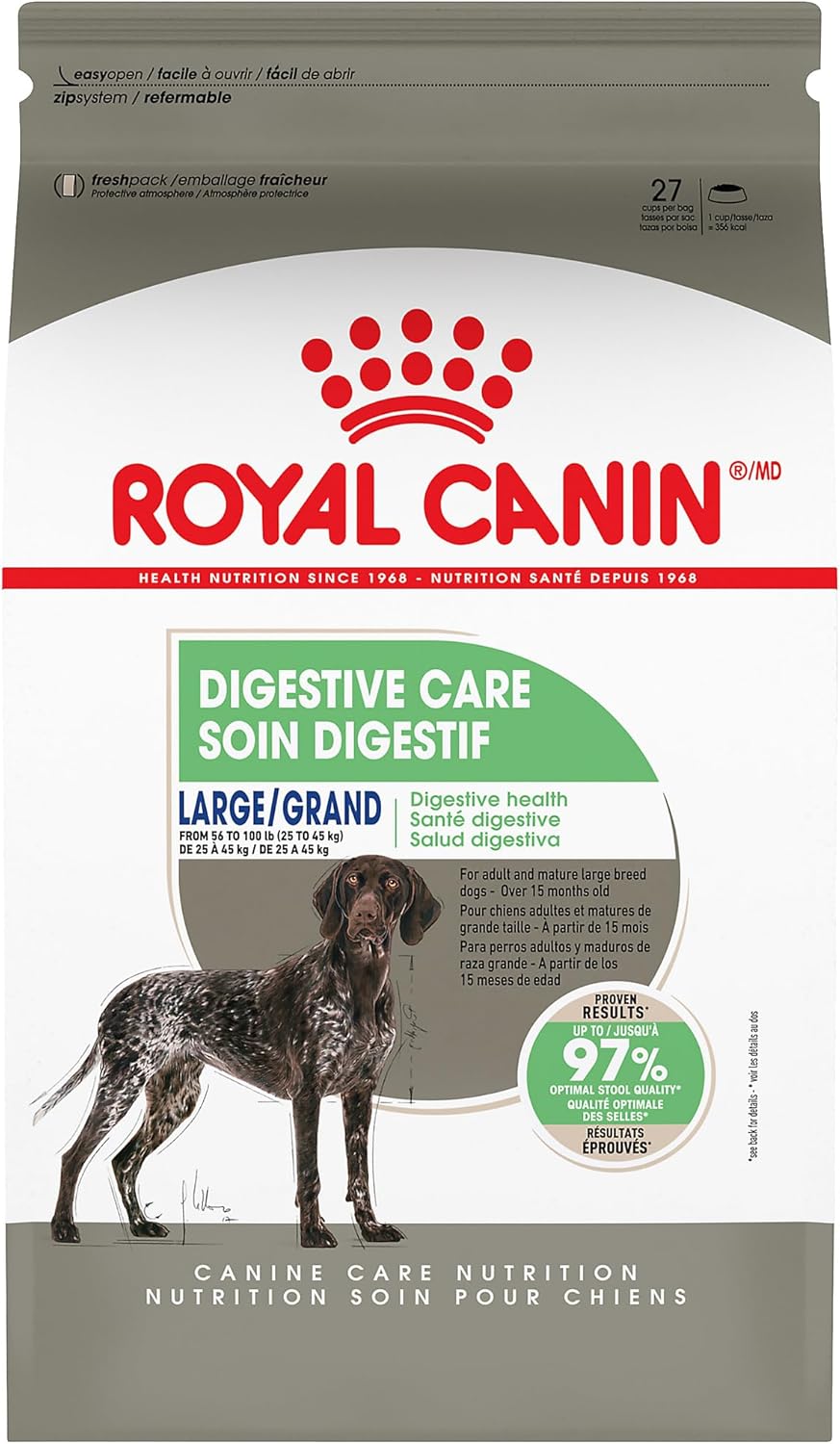
- Protein: 23% min
- Fat: 14% min
- Fiber: 6.7% max
- kcal per cup: ~371 kcal
- Top 5 ingredients: Brewers rice, chicken by-product meal, corn, wheat gluten, chicken fat
Quick Insight: Royal Canin Digestive Care contains about twice the fiber of Purina’s sensitive formula, targeting GI motility. Purina uses a limited novel protein (salmon) with oatmeal for skin and gut support.
Decision Hook:
- ✅ Choose Purina Pro Plan Sensitive if your dog reacts to common proteins or has skin-related sensitivity
- ✅ Choose Royal Canin Digestive Care if your vet identified slow gut motility or chronic loose stools
Purina’s sensitive formula focuses on ingredient simplicity — a single protein source with easily digestible grains. This suits dogs with food sensitivities or mild intolerances.
Royal Canin Digestive Care uses elevated fiber levels to regulate transit time and stool consistency. It targets dogs with documented digestive issues rather than general sensitivity.
Neither formula replaces a prescription gastrointestinal diet for dogs with IBD, EPI, or serious GI conditions.
Purina Pro Plan vs Royal Canin Ingredients: What’s Actually Different?
📊 Product Comparison – Adult
Purina Pro Plan: Complete Essentials Shredded Blend Chicken & Rice with Probiotics (Adult Dry Dog Food)
- Protein: 26% min
- Fat: 16% min
- Fiber: 3% max
- kcal per cup: ~440 kcal
- Top 5 ingredients: Chicken, rice, whole grain wheat, poultry by-product meal, corn gluten meal
Royal Canin: Large Breed Adult Dry Dog Food (Size Health Nutrition line)
- Protein: 23% min
- Fat: 12% min
- Fiber: 3.8% max
- kcal per cup: ~360 kcal
- Top 5 ingredients: Brewers rice, chicken by-product meal, corn, wheat, chicken fat
Quick Insight: Purina Pro Plan leads with whole chicken; Royal Canin leads with brewers rice and by-product meal. Both are AAFCO-compliant but differ in protein source priority.
Decision Hook:
- ✅ Choose Purina Pro Plan if whole meat as the first ingredient is a priority
- ✅ Choose Royal Canin if by-products are acceptable and size-calibrated nutrition is the focus
📊 Product Comparison – Puppy
Purina Pro Plan: Puppy Shredded Blend Chicken & Rice Formula (Dry Dog Food)

- Protein: 30% min
- Fat: 20% min
- Fiber: 3% max
- kcal per cup: ~475 kcal
- Top 5 ingredients: Chicken, rice, whole grain wheat, poultry by-product meal, corn gluten meal
Royal Canin: Large Breed Puppy Dry Dog Food (Size Health Nutrition line)

- Protein: 30% min
- Fat: 13% min
- Fiber: 2.7% max
- kcal per cup: ~356 kcal
- Top 5 ingredients: Brewers rice, chicken by-product meal, brown rice, oat groats, chicken fat
Quick Insight: Both puppy formulas match at around 30% protein. Purina Pro Plan delivers significantly more fat and kcal per cup. Royal Canin controls fat to manage growth rate in large breeds.
Decision Hook:
- ✅ Choose Purina Pro Plan Puppy for standard or small-to-medium breed puppies needing energy-dense food
- ✅ Choose Royal Canin Large Breed Puppy for breeds over about 50 lbs at maturity, where controlled growth protects joints
By-products vs. whole meat: Poultry by-product meal is a concentrated protein source and not nutritionally inferior — but whole chicken as a first ingredient indicates higher moisture-adjusted meat content.
Carb sources: Purina uses rice and whole grain wheat; Royal Canin leans on brewers rice and corn. Both are digestible but differ in fiber profile and glycemic response.
Calcium in puppies: Royal Canin’s large breed puppy formula is specifically calibrated for calcium-to-phosphorus ratio — critical for preventing developmental orthopedic disease in fast-growing breeds.
Purina Pro Plan vs Royal Canin: Cost Comparison Per Da
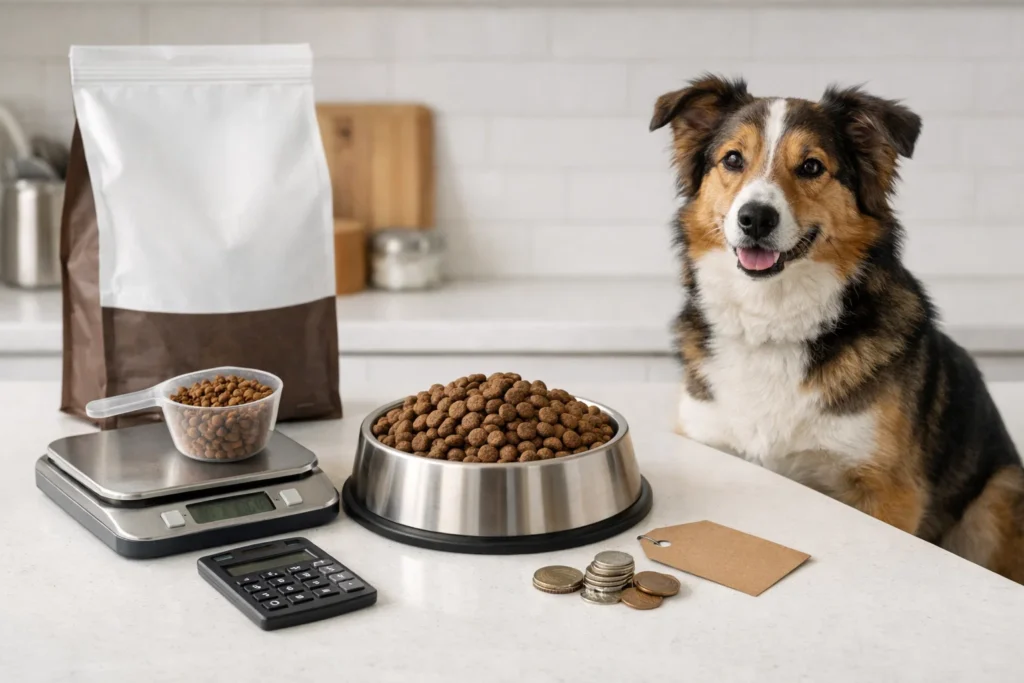
Purina Pro Plan typically costs around $2.00–$2.50 per pound depending on bag size and retailer. Royal Canin typically runs about $2.80–$3.50 per pound for comparable formulas.
For a 50 lb dog eating around 3 cups per day, daily feeding cost on Purina Pro Plan runs roughly $1.80–$2.20. On Royal Canin, the same dog costs about $2.40–$3.00 per day.
Annually, the gap can reach $200–$400 depending on formula and sourcing. Buying larger bags reduces per-pound cost for both brands.
Decision: For budget-conscious owners, Purina Pro Plan offers comparable nutrition at a lower annual cost. Royal Canin’s premium is justified when breed-size or condition-specific formulation is genuinely needed.
Is Purina Pro Plan or Royal Canin Better for Active Dogs?

Active and working dogs have higher caloric and protein demands. Purina Pro Plan’s adult formula delivers about 440 kcal per cup and around 26% protein — supporting sustained energy and muscle recovery.
Royal Canin’s large breed adult formula provides roughly 360 kcal per cup. This suits moderately active large breeds but may require larger portions for highly active dogs, increasing daily cost.
Feeding volume matters for active dogs. A calorie-dense food means fewer cups per day, which reduces digestive load during high-output activity periods.
Decision Hook:
- ✅ Choose Purina Pro Plan for working dogs, sporting breeds, or dogs with high daily activity
- ✅ Choose Royal Canin if your active dog is a large breed where controlled growth or joint health is also a factor
Who Should Avoid Purina Pro Plan and Royal Canin?
Avoid both for:
- Dogs with confirmed food allergies requiring a hydrolyzed or single-novel-protein prescription diet
- Dogs diagnosed with IBD, EPI, or pancreatitis needing prescription GI food
- Dogs on vet-managed post-surgery or recovery nutrition protocols
Avoid Purina Pro Plan specifically for:
- Very large breeds where calorie density may accelerate unhealthy weight gain
- Dogs with documented grain sensitivity (though grain-free options exist within the line)
Avoid Royal Canin specifically for:
- Owners requiring whole meat as the primary protein source
- Dogs that don’t fall into Royal Canin’s size or condition categories, where general formulas offer less value for the premium price
Purina Pro Plan vs Royal Canin: Frequently Asked Questions
Is Purina Pro Plan better than Royal Canin?
Neither brand is universally better — both are vet-recommended and AAFCO-compliant. Purina Pro Plan typically offers higher protein, whole meat first ingredients, and better value per pound. Royal Canin excels in breed-size and digestive precision. The right choice depends on your dog’s size, activity level, and health history. For general healthy adult dogs, Purina Pro Plan is often sufficient. For large breeds or dogs with documented digestive issues, Royal Canin’s targeted formulas provide a measurable advantage.
How does protein compare between Purina Pro Plan and Royal Canin?
Purina Pro Plan’s adult formulas typically start at around 26% protein, while Royal Canin’s large breed adult sits at about 23%. In puppy formulas, both brands hit around 30% protein — but Purina delivers significantly more fat and energy per cup. Protein source also differs: Purina leads with whole chicken, while Royal Canin leads with chicken by-product meal, which is nutritionally concentrated but less preferred by some owners on ingredient grounds.
Which is better for a dog with a sensitive stomach?
For dogs with protein-related sensitivity or skin issues, Purina Pro Plan’s Sensitive Skin & Stomach Salmon formula provides a simpler ingredient list with a novel protein source. For chronic digestive issues like loose stools or irregular motility, Royal Canin Digestive Care’s elevated fiber content is more targeted. Neither replaces a prescription diet for severe GI conditions. Consulting your vet before switching to either sensitive formula is advisable, especially for dogs with a diagnosed condition.
What is the cost difference between Purina Pro Plan and Royal Canin?
Purina Pro Plan typically costs around $2.00–$2.50 per pound, while Royal Canin runs about $2.80–$3.50 per pound. For a medium-to-large dog, this translates to a difference of roughly $200–$400 per year. The gap narrows when buying large bags on sale. If your dog has no specific breed-size or health needs, the additional cost of Royal Canin may not deliver proportional nutritional benefit over Purina Pro Plan.
Is it safe to switch between Purina Pro Plan and Royal Canin?
Yes, switching is safe when done gradually over about 7–10 days. Start by mixing around 25% of the new food with 75% of the current food, then slowly increase the ratio every few days. Sudden switches can cause temporary digestive upset in sensitive dogs. If your dog has a history of GI issues, extend the transition to around 2 weeks. Monitor stool consistency and appetite throughout the transition and consult your vet if symptoms persist beyond a few days.
Are both Purina Pro Plan and Royal Canin AAFCO compliant?
Yes. Both Purina Pro Plan and Royal Canin meet AAFCO nutritional standards for complete and balanced dog food. Most formulas are verified through feeding trials or nutrient profile analysis. AAFCO compliance confirms the food meets minimum standards for the life stage indicated on the label. Both brands exceed minimum standards in protein and micronutrient profiles across their core product lines, making either a nutritionally sound choice for healthy dogs when matched to the appropriate formula.
Make Your Final Decision
For most dogs, Purina Pro Plan delivers balanced nutrition, higher protein, and stronger everyday value. For breed-specific needs and digestive precision, Royal Canin is the stronger option.
Check latest prices and availability before making your final decision.