 Marco Williams

If your dog has been diagnosed with pancreatitis, you’ve probably heard “low fat” more times than you can count. What you probably haven’t heard is what that actually means on a label — “low fat” isn’t a regulated term, and two products wearing that phrase can land at very different fat levels.
This article compares verified fat content, real calorie-adjusted cost, and actual owner feedback across seven options: three prescription diets and four over-the-counter alternatives. The goal is to give you accurate numbers for your next vet conversation, not to replace that conversation. Any diet change for a dog managing pancreatitis should go through your veterinarian first.
- Best Overall (Prescription) → Hill’s Prescription Diet i/d Low Fat — ~$4.76/day
- Best Overall (Over-the-Counter) → SquarePet VFS Low Fat Formula — ~$4.86/day
- Best Value → Eagle Pack Natural Reduced Fat Formula — ~$1.68/day
- Best for Picky Eaters or Reduced Appetite → Royal Canin Gastrointestinal Low Fat — ~$4.99/day
What to Look for in a Dog Food for Pancreatitis?
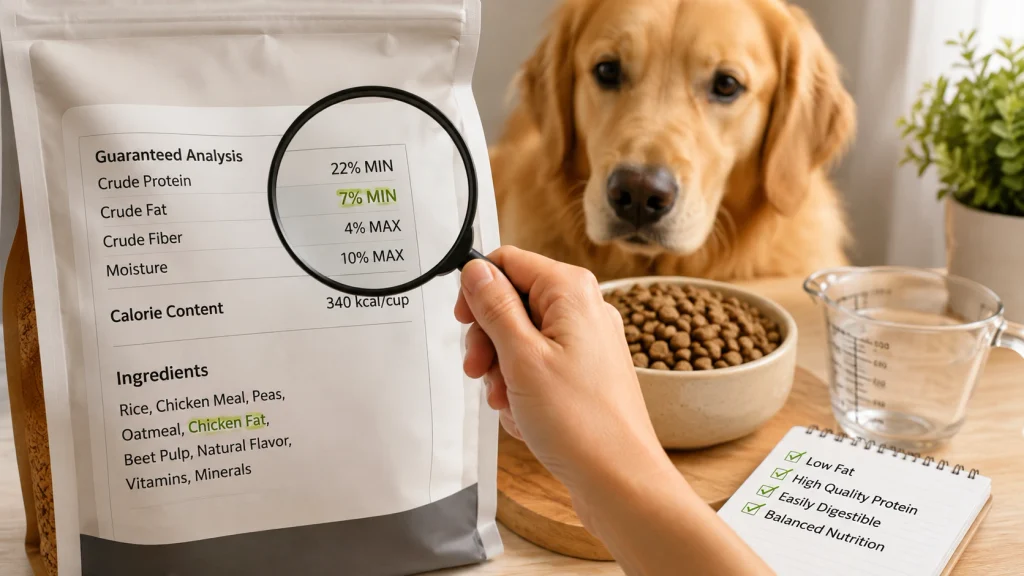
The Fat Threshold That Actually Matters
Most veterinary sources recommend keeping fat under roughly 10% on a dry matter basis for dogs managing pancreatitis, with prescription-tier diets typically landing between 6% and 9%. That dry matter distinction matters more than most labels let on.
Every bag or can lists fat as a percentage “as fed,” meaning the number includes moisture. A dry kibble with little moisture and a canned food that’s 78% water can show very different as-fed numbers while actually containing similar fat once the water is stripped out. To compare fairly, convert to a dry matter basis:
Dry matter fat % = (fat % as fed ÷ (100 − moisture %)) × 100
Here’s why this matters: a wet food listing 3% fat “as fed” sounds impressively low. But if that food is 78% moisture, the dry matter fat works out to about 13.6% — higher than most prescription diets allow. Bring this formula to your vet appointment if you’re comparing a wet food against a dry one; it’s the only way the comparison holds up.
Prescription vs Over-the-Counter: What’s the Real Difference?
All three prescription diets in this article — Hill’s, Royal Canin, and Purina — require veterinary authorization, even when purchased through Amazon. Checkout collects your vet’s information and confirms the order within about 72 hours.
Two of the four over-the-counter options here, SquarePet and Annamaet, are formulated at fat levels that match or come close to the prescription tier without that authorization step. That’s why both tiers appear side by side in this article: for many dogs, the real difference isn’t “prescription vs. not” — it’s the actual fat number on the label.
A Note on Dog Size
Pancreatitis shows up disproportionately in small breeds — Miniature Schnauzers, Yorkshire Terriers, and Dachshunds appear frequently in veterinary literature as higher-risk. The cost-per-day figures in this article use a standard 50-pound, moderately active dog as the reference point. If your dog is considerably smaller, expect your actual daily cost to run lower than what’s listed here.
Other Ingredient Signals to Check
- Named lean protein vs. by-product or meal-first formulas. Neither is unsafe, but it’s good to know which you’re buying.
- Fiber level, which affects stool quality alongside fat restriction.
- Format. Wet food can matter more than expected during recovery, when a dog with a reduced appetite may refuse dry kibble entirely.
Best Prescription Dog Foods for Pancreatitis
These three diets require veterinary sign-off. On Amazon, the order won’t ship until your vet confirms it, so plan for that extra step if your dog needs food quickly. This is also the right moment to raise a direct question with your vet: whether your dog needs a prescription-tier diet during an acute flare, or whether a well-formulated OTC option fits once things have stabilized.

Best For: Dogs needing the lowest fat ceiling available in the prescription tier.
Cost Per Day: About $4.76, based on the 8.5 lb bag (333 kcal per cup, 4.6 cups per pound).
Why It Made the List?
- Lowest dry matter fat among the three major prescription diets (6% minimum, as fed)
- Most frequently cited by independent veterinary and consumer sources for pancreatitis management
- 2,107 reviews at 4.8 stars with an Amazon’s Choice badge — the strongest review base in this roundup
Key Specs
- Protein 20% min, Fat 6% min, ~333 kcal/cup (1,531.8 kcal/lb)
- AAFCO: formulated for adult maintenance, feeding trials substantiated
- First 5 ingredients: Brewers Rice, Corn Gluten Meal, Chicken Meal, Chicken By-Product Meal, Hydrolyzed Chicken Flavor
Honest Take
- Ingredient list leads with brewers rice, corn gluten meal, and chicken meal rather than a named whole-meat protein, despite the premium positioning
- Strongest review base in this roundup, with a rating that has held steady across thousands of ratings
- Most common owner report: resolved pancreatitis symptoms and strong palatability, including for previously picky eaters.
- Most common complaint: crushed or damaged cans on the wet-food line during shipping — not relevant to this dry bag.

Best For: Dogs with reduced appetite during recovery, since this line comes in canned and loaf formats.
Cost Per Day: About $4.99, based on the 6.61 lb bag (3,210 kcal per kilogram).
Why It Made the List?
- Available in canned and loaf format, which matters clinically when a dog’s appetite drops during recovery
- Fat range (5–9%) matches prescription-tier restriction
- Formulated with EPA and DHA from fish oil specifically to support digestive health
Key Specs
- Protein 20% min, Fat 5.0–9.0%, Fiber 4.8% max, 3,210 kcal/kg
- AAFCO: formulated for adult maintenance
- First 5 ingredients: Brewers Rice, Chicken By-Product Meal, Barley, Natural Flavors, Pork Digest
Honest Take
- Kibble size runs larger than Royal Canin’s standard lines, worth noting for small-breed owners
- A handful of recent reviews mention the canned/loaf version turning thinner than in past years, though this isn’t confirmed as an ongoing formula change
- Most common owner report: resolved diarrhea and vomiting in dogs managing pancreatitis, with strong palatability even for picky eaters.
- Most common complaint: larger kibble size, difficult for some small or senior dogs to chew.

Best For: Owners who need a vet-authorized diet without the highest price tag.
Cost Per Day: About $3.60, based on the 16.5 lb bag (3,209 kcal per kilogram, confirmed against Purina’s official label documentation) — the cheapest per day among all three prescription options.
Why It Made the List?
- Fat range (5–9%) matches the other two prescription diets
- Cheapest cost per day ($3.60) among all three prescription options
- Formulated through a collaboration between Purina nutritionists, researchers, and veterinarians specifically for GI conditions
Key Specs
- Protein 25% min, Fat 5.0–9.0%, Fiber 3.0% max, 3,209 kcal/kg (295 kcal/cup)
- AAFCO: formulated for adult maintenance
- First 5 ingredients: Brewers Rice, Barley, Corn Protein Meal, Poultry By-Product Meal, Animal Digest
Honest Take
- Actually the cheapest per-day cost of the three prescription options, despite frequent owner comments calling it expensive
- A 2022 FDA recall affected the wet, canned 13.4 oz version of this line due to a labeling mix-up — does not affect the dry bag linked here
- Most common owner report: dogs recovering from acute pancreatitis flares and thriving long-term.
- Most common complaint: perceived high price, despite this being the least expensive prescription option per day in this roundup.
Best Over-the-Counter Dog Foods for Pancreatitis (No Prescription Required)
None of these four require veterinary authorization to purchase, but two — SquarePet and Annamaet — are formulated close enough to prescription-tier fat restriction to warrant serious consideration for a maintenance phase. Moving from a prescription diet to an OTC option is still a conversation for your vet, especially early in recovery from an acute flare.

Best For: Owners who want prescription-level fat restriction without the vet-authorization step.
Cost Per Day: About $4.86, based on the 4.4 lb bag (3,295 kcal per kilogram).
Why It Made the List?
- Manufacturer explicitly formulates and markets this food for pancreatitis-prone dogs
- Fat ceiling (6–8% dry matter) matches the low end of the prescription tier
- Pacific cod and ocean whitefish meal lead the ingredient list — a named, identifiable protein source
Key Specs
- Protein 25% min, Fat 6.0–8.0% (dry matter, per manufacturer), Fiber 3.0% max, 3,295 kcal/kg
- AAFCO: formulated for adult maintenance
- First 5 ingredients: Pacific Cod, Brown Rice, Ocean Whitefish Meal, Tapioca, Natural Flavor
Honest Take
- Only product in this roundup, prescription or OTC, with a clearly named protein source leading the ingredient list
- Smaller review base (295) than Annamaet — a newer, less widely known brand despite fitting this exact use case well
- Most common owner report: successful switch away from a prescription diet, with easier access and comparable or better palatability.
- Most common complaint: an isolated report of lethargy in one of two dogs fed this food — not a pattern across reviews.

Best For: Owners who want a longer independent track record before trying an OTC option.
Cost Per Day: About $3.53, based on the 5 lb bag (3,242 kcal per kilogram).
Why It Made the List?
- Chicken meal is the first ingredient
- Manufacturer directly states this formula’s suitability for dogs with pancreatitis
- Most independently corroborated OTC pick found across broader research into this category
Key Specs
- Protein 30% min, Fat 7.0–9.0%, Fiber 3.5% max, 1,474 kcal/lb (3,242 kcal/kg)
- AAFCO: formulated for adult maintenance
- First 5 ingredients: Chicken Meal, Field Peas, Chickpeas, Potato, Tapioca
Honest Take
- Calorie-dense at 1,474 kcal per pound despite the “Lean” name, so portion control matters more than the branding suggests
- Grain-free formulation, which won’t suit every dog
- Most common owner report: successful full replacement of a prescription diet with no return of pancreatitis symptoms.
- Most common complaint: unexpected weight gain when portions weren’t adjusted for the food’s calorie density.

Best For: Dogs who need to avoid chicken or poultry alongside their fat restriction.
Cost Per Day: About $2.45, based on the 24 lb bag (roughly 3,030–3,122 kcal per kilogram — two independent sources show a slight variation, likely reflecting a label update between production batches).
Why It Made the List?
- Deboned cod leads the ingredient list, confirmed against manufacturer and independent retailer data
- L-carnitine included specifically to support fat metabolism
- Maximum fat ceiling of 9%, in line with prescription-tier restriction
Key Specs
- Protein 30% min, Fat 7.0–9.0%, Fiber 6.0% max, ~3,030–3,122 kcal/kg
- AAFCO: formulated for adult maintenance
- First 5 ingredients: Deboned Cod, Turkey Meal, Salmon Meal, Lentils, Yellow Peas
Honest Take
- Second-cheapest cost per day in the entire roundup, a genuine value angle beyond the alternative-protein positioning
- Calorie density varies slightly between two independent retailer sources, likely reflecting a label update between production batches
- Most common owner report: positive results for dogs managing pancreatitis and related low-fat needs, including one long-term case spanning nearly a year.
- Most common complaint: outright flavor rejection in some dogs.

Best For: Multi-dog households or anyone managing a chronic low-fat diet on a budget over the long term.
Cost Per Day: About $1.68, based on the 30 lb bag (3,240 kcal per kilogram) — the lowest cost-per-day of all seven products by a wide margin.
Why It Made the List?
- Lowest cost per day ($1.68) of all seven products in this roundup
- Amazon’s Choice badge with a 4.5-star rating across 524 reviews
- Fat range (6–9%) sits within the therapeutic threshold at a fraction of the cost of Rx-tier options
Key Specs
- Protein 24% min, Fat 6.0–9.0%, Fiber 4.0% max, 3,240 kcal/kg (343 kcal/cup)
- AAFCO: formulated for adult maintenance
- First 5 ingredients: Pork Meal, Dehulled Barley, Peas, Ground Brown Rice, Oatmeal
Honest Take
- Lowest cost per day of all seven products in this roundup by a wide margin
- Manufactured by Diamond Pet Food, which has recalled other brands it produces (including Taste of the Wild in 2012) — Eagle Pack itself has no recall history
- Most common owner report: general satisfaction on value and quality, though pancreatitis-specific testimony is thinner here than for the other six products.
- Most common complaint: ingredient-quality critique citing meat meal instead of a named whole meat — a point raised consistently across the value tier.
Best Dog Food for Pancreatitis — Fat Comparison at a Glance
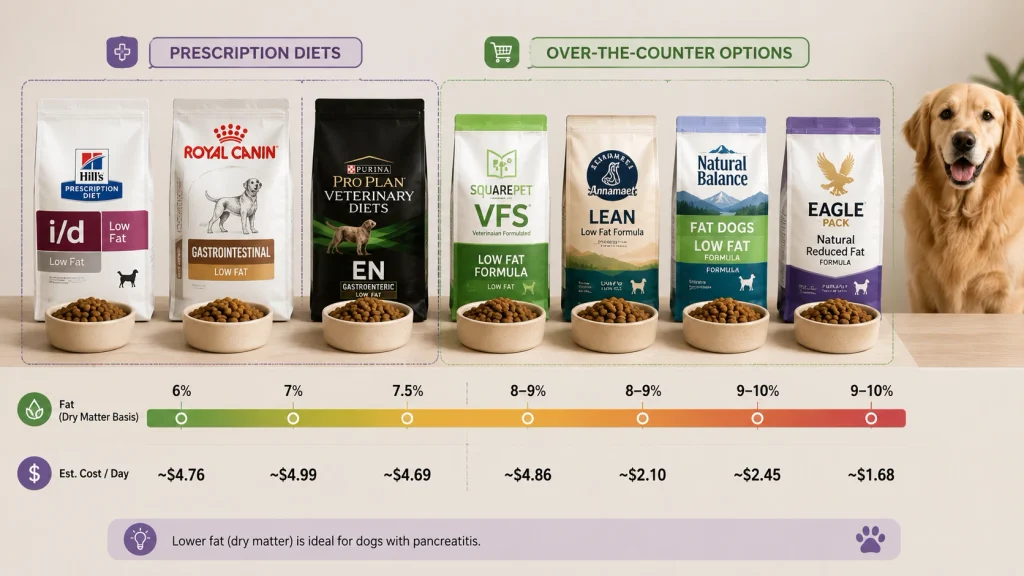
| Product | Tier | Crude Fat (as-fed, dry formula) | Est. Dry Matter Fat % | Cost/Day | Prescription Required? |
|---|---|---|---|---|---|
| Hill’s i/d Low Fat | Rx | 6.0% min | ~6.7% | $4.76 | Yes |
| Royal Canin GI Low Fat | Rx | 5.0–9.0% | ~5.6–10.1% | $4.99 | Yes |
| Purina EN Gastroenteric Low Fat | Rx | 5.0–9.0% | ~5.7–10.2% | $3.60 | Yes |
| SquarePet VFS Low Fat | OTC | 6.0–8.0% | 6.0–8.0% (label states DM directly) | $4.86 | No |
| Annamaet Lean | OTC | 7.0–9.0% | 7.8% (verified) | $3.53 | No |
| Nulo Freestyle Adult Trim | OTC | 7.0–9.0% | ~7.8–10.0% | $2.45 | No |
| Eagle Pack Reduced Fat | OTC | 6.0–9.0% | ~6.7–10.0% | $1.68 | No |
Fat percentages above reflect the specific dry-food product linked in this article. Canned or wet versions of these same product lines carry different fat percentages due to moisture content — see each product’s section above for details.
How to Transition Your Dog to a Low-Fat Diet?
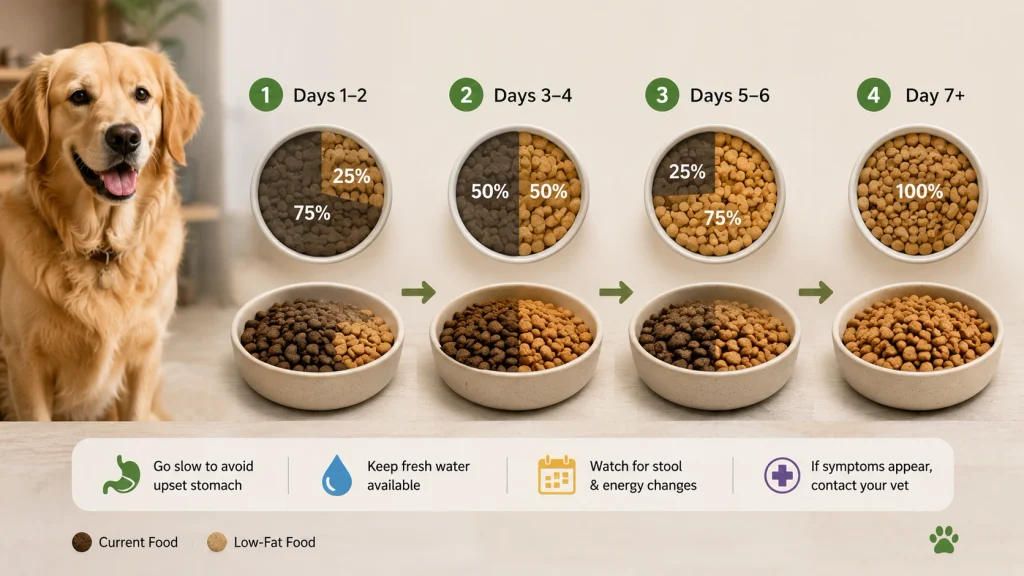
Switching foods too quickly can cause its own digestive upset — the last thing a dog managing pancreatitis needs. A gradual transition over about seven days, mixing in increasing amounts of the new food while decreasing the old, is the standard approach. Smaller, more frequent meals help too, and it’s worth staying strict about high-fat treats or table scraps during the switch, since even a small amount of fat can undo the point of the new diet. Consult your vet before starting any transition if your dog is currently in an acute pancreatitis flare.
Frequently Asked Questions
What fat percentage is safe for a dog with pancreatitis?
Most veterinary sources recommend staying under roughly 10% fat on a dry matter basis, with prescription-tier diets often formulated lower still, in the 6–9% range. Your vet can help set the right target for your specific dog.
Can I feed my dog OTC low-fat food instead of a prescription diet?
Some over-the-counter formulas, like SquarePet and Annamaet in this article, are made at fat levels close to or matching the prescription tier. Whether that fits your dog — particularly during an active flare versus long-term maintenance — is a decision for your veterinarian.
Do I need a vet’s permission to buy prescription dog food on Amazon?
Yes. Amazon collects your veterinarian’s information at checkout and confirms the order with your vet, typically within about 72 hours, before shipping.
What breeds are most prone to pancreatitis?
Miniature Schnauzers, Yorkshire Terriers, and Dachshunds appear frequently in veterinary literature as higher-risk breeds, though pancreatitis can affect any dog.
Can wet food cause more fat intake than dry food?
Not necessarily, but it can look that way if you only compare as-fed numbers. Wet food’s high moisture content dilutes the fat percentage on the label, so a can showing 3% fat as fed might actually carry more fat than it appears once you run the dry matter conversion.
How long does a dog need to stay on a low-fat diet after pancreatitis?
This varies by case. Some dogs need a low-fat diet for life, particularly with chronic or recurring pancreatitis, while others may transition back to a normal diet after recovery. Your vet should make this call based on your dog’s history.
Final Recommendation
For dogs starting vet-directed therapeutic nutrition, Hill’s Prescription Diet i/d Low Fat remains the strongest overall pick in the prescription tier, with the lowest fat ceiling and the deepest track record of the three options here. If your vet has cleared an over-the-counter option, SquarePet VFS Low Fat Formula stands out as a genuine alternative to prescription diets, matching their fat restriction without the authorization step. And if cost matters for a long-term management plan, Eagle Pack Reduced Fat runs meaningfully cheaper per day than every other option here — a real difference when you’re feeding a dog this way for months or years.
Whichever direction you go, confirm any diet change with your veterinarian first, especially for a dog with a history of pancreatitis.