 Marco Williams
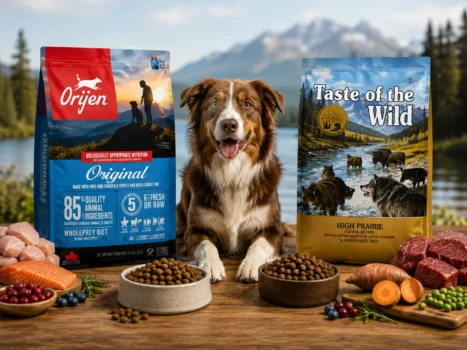
If you’ve been comparing premium grain-free dog foods, you’ve almost certainly landed on these two names. Both brands promise high-protein, biologically inspired nutrition, but Orijen typically costs about twice as much per pound as Taste of the Wild. Does that price gap actually hold up, or are you paying mostly for marketing?
This guide compares both brands SKU by SKU — flagship recipes, fish-based formulas, and puppy options — using verified pricing, ingredients, and manufacturer data, so you can decide which one fits your dog and your budget.
- Best for high-protein/active dogs → Orijen Original — ~$1.60–$3.61/day
- Best value pick → Taste of the Wild High Prairie — ~$0.92–$1.78/day
Orijen vs Taste of the Wild: Quick Comparison
| Orijen | Taste of the Wild | |
|---|---|---|
| Manufacturer | Champion Petfoods | Diamond Pet Foods |
| Ownership | Owned by Mars Incorporated (since 2023) | Independently, family-owned |
| Manufactured in | Alberta, Canada & Kentucky, USA | Missouri, USA |
| Price tier | Premium | Value-premium |
| Protein (flagship SKU) | 38% min | 32% min |
| Recall history | None on record through 2026 | One recall (2012, Salmonella) |
| Best for | High-protein needs, fresh-ingredient sourcing | Budget-conscious owners, multi-dog households |
Who Makes Orijen?
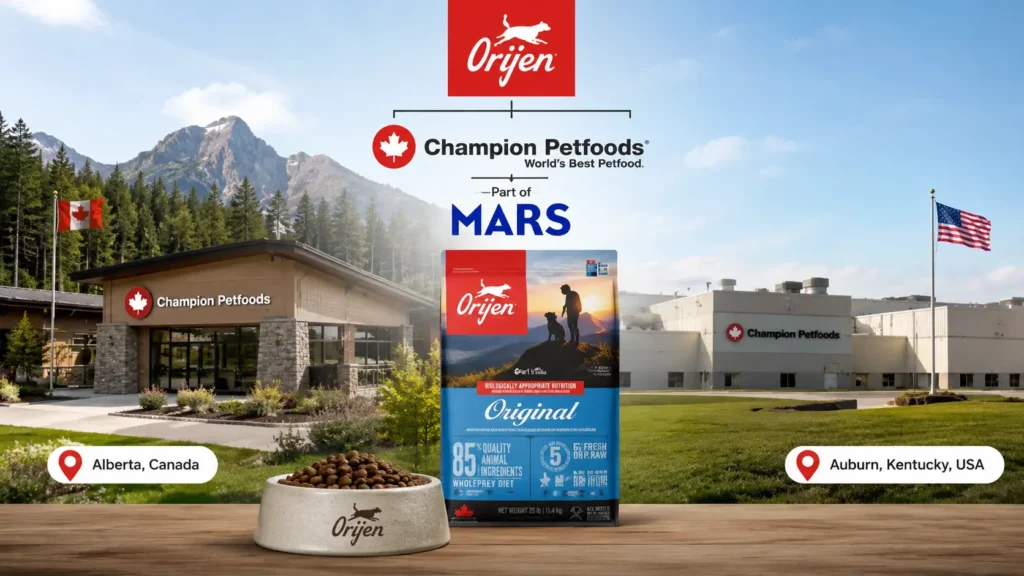
Orijen is made by Champion Petfoods, founded in 1985 in Alberta, Canada. In 2023, Champion Petfoods was acquired by Mars Incorporated — a detail that matters if brand independence factors into your decision, since Mars also owns several other major pet food lines.
Despite its Canadian roots, Orijen isn’t exclusively made in Canada. Champion operates manufacturing kitchens in both Alberta, Canada and Auburn, Kentucky, which explains why some Orijen bags carry a “Made in the USA” label even though the parent company is Canadian. Orijen has no recall history on record through 2026.
Who Makes Taste of the Wild?
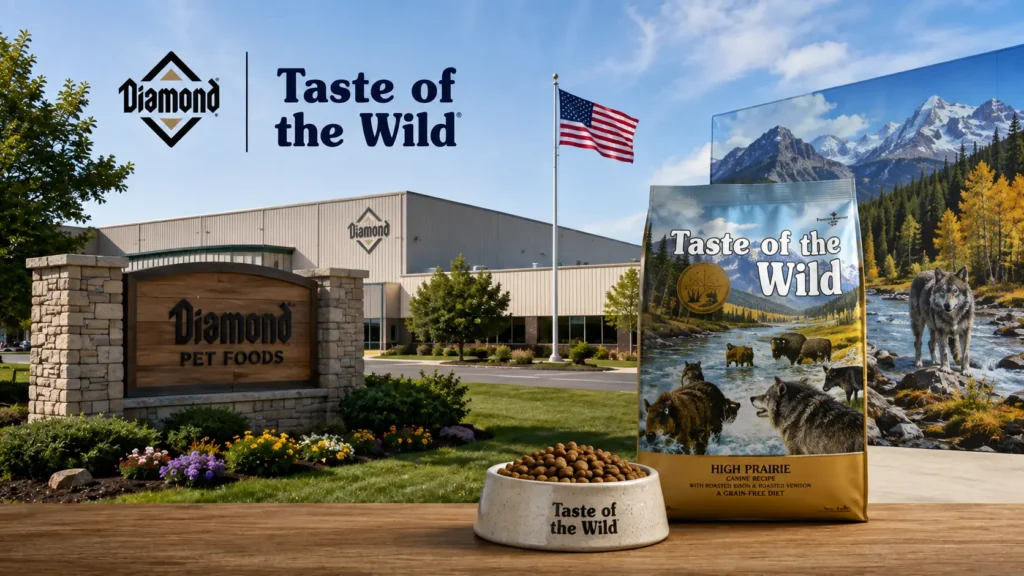
Taste of the Wild is made by Diamond Pet Foods, a family-owned company based in Missouri. Unlike Orijen, its parent company remains independently owned; it hasn’t been acquired by a larger conglomerate.
Taste of the Wild’s most recent recall was in 2012, tied to potential Salmonella contamination. None have followed.
A Note on Grain-Free Diets and Heart Health
Both brands have come up in a broader conversation about grain-free diets and dilated cardiomyopathy (DCM) in dogs. The FDA’s investigation into a potential link between certain diets and canine DCM tracked which brands were most frequently named in reports submitted between 2014 and 2019. Taste of the Wild was named 53 times; Orijen was named 12 times.
To be precise: the FDA has not established a causal link between grain-free diets and DCM, and it hasn’t issued further public updates since December 2022, citing a lack of new scientific information. Being named in a report isn’t the same as being confirmed as a cause.
If you have concerns about grain-free feeding, especially for large or giant-breed dogs, consult your vet before switching. This is one decision where a short conversation with a professional beats anything you’ll read online, including this article.
Orijen vs Taste of the Wild: Flagship Recipe Comparison
Orijen Original vs Taste of the Wild High Prairie
This is the core matchup: each brand’s flagship recipe, formulated to feed dogs across all life stages.
| Spec | Orijen Original | TOTW High Prairie |
|---|---|---|
| Crude Protein (min) | 38% | 32% |
| Crude Fat (min) | 18% | 18% |
| Crude Fiber (max) | 4% | 4% |
| Moisture (max) | 12% | 10% |
| Calories | 473 kcal/cup | 370 kcal/cup |
| First 5 Ingredients | Chicken, turkey, salmon, whole herring, chicken liver | Water buffalo, lamb meal, chicken meal, sweet potatoes, peas |
| Life Stage | All Life Stages | Adult |
| Price | $106.99 (23.5lb) — $4.55/lb | $58.99 (28lb) — $2.11/lb |
Orijen Original delivers substantially more protein from fresh, named animal sources, and its whole-prey approach includes organs and cartilage most kibbles skip. That density comes at a cost: more than double the price per pound.
Taste of the Wild High Prairie still clears a respectable 32% minimum protein floor, built primarily from meals rather than fresh meat, and layers in novel proteins like bison and venison. For the average adult dog that isn’t working, training heavily, or highly active, the extra protein in Orijen often goes unused — which is where Taste of the Wild’s value case gets hard to argue with.
Bottom line: working breeds, highly active dogs, or owners who simply want the highest protein density available should lean toward Orijen Original. Typical house pets do just as well on High Prairie, without the premium price tag.

Price: $106.99 ($4.55/lb) | Cost per day: $1.60–$3.61 depending on dog size
Why It Made the List?
- 38% minimum crude protein from fresh, named animal sources — no rendered meals in the top 5 ingredients
- WholePrey formulation includes organs and cartilage, not just muscle meat
- AAFCO-certified for All Life Stages, including large-breed growth
Key Specs
- 38% protein / 18% fat / 4% fiber / 473 kcal per cup
- AAFCO: All Life Stages, including growth of large-size dogs (70lb+)
- First 5 ingredients: chicken, turkey, salmon, whole herring, chicken liver
Honest Take
- Amazon’s Choice with 3K+ bought in past month and a 4.6-star rating across 4,315 reviews
- More than double the cost per pound of Taste of the Wild’s flagship recipe
- Most common owner report: visibly better coat condition and smaller stool volume within weeks.
- Most common complaint: price, especially for multi-dog households

Price: $58.99 ($2.11/lb) | Cost per day: $0.92–$1.78 depending on dog size
Why It Made the List?
- 32% minimum crude protein with novel proteins (bison, venison) at less than half Orijen’s price per pound
- K9 Strain proprietary probiotics added post-cooking for guaranteed live cultures
- Highest review volume of any SKU in this comparison — 12,894 ratings
Key Specs
- 32% protein / 18% fat / 4% fiber / 370 kcal per cup
- AAFCO: Adult maintenance
- First 5 ingredients: water buffalo, lamb meal, chicken meal, sweet potatoes, peas
Honest Take
- Amazon’s Choice with 8K+ bought in past month and a 4.6-star rating across 12,894 reviews
- Meal-based protein sourcing rather than fresh named meat as the primary source
- Most common owner report: firm stools and steady weight maintenance across multiple dogs.
- Most common complaint: occasional bag-to-bag kibble size inconsistency
Fish & Alternative Protein Formulas
Orijen Six Fish vs Taste of the Wild Pacific Stream
If your dog has a poultry sensitivity, or you simply want to rotate proteins, both brands offer a fish-forward alternative.
| Spec | Orijen Six Fish | TOTW Pacific Stream |
|---|---|---|
| Crude Protein (min) | 38% | 25% |
| First 5 Ingredients | Whole herring, salmon, monkfish, Acadian redfish, flounder | Salmon, fish meal, sweet potatoes, peas, pea flour |
| Life Stage | All Life Stages | Adult |
| Price | $126.99 (23.5lb) — $5.08/lb | $58.99 (28lb) — $2.11/lb |
Here’s where the price gap widens the most: Six Fish is Orijen’s priciest core dry recipe. You’re paying for six named, mostly fresh fish sources with no poultry at all, which matters for dogs with confirmed poultry allergies rather than general sensitivity.
Pacific Stream runs a lower protein floor than Orijen’s fish option, but it’s still a fully egg-free, chicken-free formula built around real salmon and fish meal — a budget-friendly choice for dogs who do better on fish than red meat or poultry.

Price: $126.99 ($5.08/lb) | Best for: dogs with confirmed poultry allergies
Why It Made the List?
- Completely poultry-free — all 6 named proteins are fish, sourced fresh or raw
- Same 38% protein floor as Orijen Original, just from a different protein base
- Freeze-dried liver coating for palatability without added fillers
Key Specs
- 38% protein / 18% fat / 4% fiber
- AAFCO: All Life Stages
- First 5 ingredients: whole herring, salmon, monkfish, Acadian redfish, flounder
Honest Take
- Amazon’s Choice, but lower purchase volume (800+/month) than Orijen Original
- Orijen’s most expensive core dry recipe at $5.08/lb
- Most common owner report: noticeable reduction in itching for poultry-sensitive dogs.
- Most common complaint: strong fish smell compared to poultry-based formulas

Price: $58.99 ($2.11/lb) | Best for: budget-conscious owners of fish-preferring dogs
Why It Made the List?
- Egg-free and chicken-free — all animal protein comes from salmon and fish meal
- Highest-rated SKU in this entire comparison at 4.7 stars across 10,146 reviews
- Same K9 Strain probiotics included across the whole Taste of the Wild line
Key Specs
- 25% protein / 15% fat / 3% fiber / 360 kcal per cup
- AAFCO: Adult maintenance
- First 5 ingredients: salmon, fish meal, sweet potatoes, peas, pea flour
Honest Take
- Amazon’s Choice with 7K+ bought in past month
- Noticeably lower protein floor than Orijen Six Fish (25% vs 38%)
- Most common owner report: works well for dogs with both poultry and general food sensitivities.
- Most common complaint: smoke-flavored scent is polarizing for some owners
Puppy Formula Comparison
Orijen Puppy vs Taste of the Wild High Prairie Puppy
Feeding a growing puppy the wrong nutrient balance is one of the more consequential diet mistakes you can make, so this comparison deserves extra care.
| Spec | Orijen Puppy | TOTW High Prairie Puppy |
|---|---|---|
| Crude Protein (min) | 38% | 28% |
| First 5 Ingredients | Chicken, turkey, chicken liver, salmon, whole herring | Water buffalo, lamb meal, sweet potatoes, egg product, garbanzo beans |
| AAFCO Life Stage | Puppy (dedicated formula) | All Life Stages, including growth of large-size dogs (70lb+) |
| Price | $106.99 (23.5lb) — $4.55/lb | $59.99 (28lb) — $2.14/lb |
These two brands take genuinely different approaches, and both hold up. Orijen built a dedicated Puppy-only recipe formulated specifically for growth. Taste of the Wild instead formulated High Prairie Puppy to meet AAFCO‘s “All Life Stages” nutrient profile, which by definition is built to the same nutrient floor required for growth — so it works across every life stage rather than puppyhood specifically.
Neither approach is wrong. But if you have a large-breed puppy (an adult weight of 70lb or more), check the AAFCO statement on the bag closely. Both formulas here are labeled appropriate for large-breed growth, but not every “puppy” formula on the market carries that specific statement, and getting it wrong matters for skeletal development. Consult your vet on this one, particularly for large or giant breeds.

Price: $106.99 ($4.55/lb) | Best for: puppies needing a growth-specific formula
Why It Made the List?
- Dedicated puppy-only formula, not a repurposed all-life-stages recipe
- Same 38% protein floor and fresh-ingredient sourcing as Orijen’s adult lines
- Formulated to support brain development alongside muscle growth
Key Specs
- 38% protein / high fat for growth energy needs
- AAFCO: Puppy (dedicated growth formula)
- First 5 ingredients: chicken, turkey, chicken liver, salmon, whole herring
Honest Take
- Amazon’s Choice with a 4.7-star rating across 3,017 reviews
- Same $4.55/lb pricing as Orijen Original — consistent across the brand’s life-stage lineup
- Most common owner report: steady, healthy weight gain during the growth phase.
- Most common complaint: price for larger-breed puppies eating through bags quickly

Price: $59.99 ($2.14/lb) | Best for: puppy owners who also feed adult dogs from the same bag
Why It Made the List?
- AAFCO-certified for All Life Stages, including large-breed puppy growth (70lb+ as adult)
- Guaranteed DHA levels support brain and vision development
- Same formula works for nursing/pregnant adult dogs, not just puppies
Key Specs
- 28% protein / high DHA for growth needs
- AAFCO: All Life Stages, including growth of large-size dogs
- First 5 ingredients: water buffalo, lamb meal, sweet potatoes, egg product, garbanzo beans
Honest Take
- Amazon’s Choice with a 4.7-star rating across 5,037 reviews — highest review count of any puppy SKU compared here
- Lower protein floor than Orijen Puppy (28% vs 38%)
- Most common owner report: easy transition food for households feeding both puppies and adults.
- Most common complaint: kibble size runs slightly large for toy-breed puppies
Also Worth Considering: Orijen Regional Red
If your dog needs to avoid poultry entirely but doesn’t do well on fish either, Orijen Regional Red fills that gap. It’s a poultry-free recipe built around beef, wild boar, goat, and lamb.
One honest caveat: this SKU carries far fewer Amazon reviews than the rest of Orijen’s lineup and doesn’t currently show an Amazon’s Choice badge, suggesting lower sales volume than Original or Six Fish. It’s a legitimate option for the right dog, but less proven by purchase history than the others on this list.

Price: $129.99 ($9.85/lb) | Best for: dogs needing a poultry-free, non-fish option
Why It Made the List?
- Completely poultry-free red-meat formula — beef, wild boar, goat, and lamb
- Fills the gap for dogs allergic to both poultry and fish
- Same WholePrey sourcing philosophy as Orijen’s other core recipes
Key Specs
- High-protein red-meat formula
- AAFCO: All Life Stages, except growth of large-size dogs as adult
- First 5 ingredients: beef, wild boar, goat, lamb, lamb liver
Honest Take
- No Amazon’s Choice badge and only 257 reviews — the least-established SKU in this comparison
- Highest price per pound of any product covered in this article at $9.85/lb
- Most common owner report: effective for dogs with confirmed multi-protein sensitivities.
- Most common complaint: price, even relative to other Orijen recipes
Which Brand Should You Choose?
Choose Orijen If:
- Your dog is highly active, working, or in heavy training
- You want the highest available protein density from fresh, named animal sources
- Budget isn’t a major constraint
- Your dog needs a dedicated puppy-specific formula
- Your dog has a poultry sensitivity, and you want an all-fish (Six Fish) or poultry-free red-meat (Regional Red) option
Choose Taste of the Wild If:
- You’re feeding multiple dogs and cost per pound matters
- Your dog is a typical, moderately active house pet that doesn’t need Orijen’s protein ceiling
- You want novel proteins like bison and venison without the premium price
- You want a puppy-safe formula that also works across your dog’s entire life
Cost Per Day Breakdown
Using each brand’s own published feeding guide, not flat estimates, here’s what daily and monthly costs look like at three common dog weights.
| Dog Size | Orijen $/day | Orijen $/month | TOTW $/day | TOTW $/month |
|---|---|---|---|---|
| Small (~22 lb) | $1.60 | ~$48 | $0.92 | ~$28 |
| Medium (~44 lb) | $2.71 | ~$81 | $1.41 | ~$42 |
| Large (~66 lb) | $3.61 | ~$108 | $1.78 | ~$53 |
At every size, Taste of the Wild costs roughly 40–45% of what Orijen costs to feed daily. For a large dog, that’s about $55 a month — a meaningful difference over a year of feeding.
Frequently Asked Questions
Is Taste of the Wild as good as Orijen?
Taste of the Wild meets AAFCO nutritional standards just as Orijen does, though with a lower protein floor (32% vs. 38% in the flagship recipes) and meal-based rather than fresh-ingredient protein sourcing. For most average dogs, it delivers comparable real-world results at a significantly lower cost.
Why is Orijen so much more expensive than Taste of the Wild?
Orijen uses a higher percentage of fresh and raw animal ingredients (whole-prey sourcing including organs), a higher minimum protein guarantee, and sources many ingredients regionally rather than relying on rendered meals. That sourcing and formulation approach costs more to produce, and the price reflects it.
Which is better for dogs with allergies?
It depends on the specific allergen. For poultry-sensitive dogs, Orijen Six Fish or Regional Red (both poultry-free) are strong options. Taste of the Wild Pacific Stream is a solid, more affordable fish-based alternative. Always confirm your dog’s specific triggers with your vet before switching, since both brands use complex ingredient lists that can include multiple allergen-prone items like eggs or legumes.
Do vets recommend Orijen or Taste of the Wild?
Neither brand is typically among the group of foods most commonly pointed to by veterinarians — that tier usually includes brands like Hill’s Science Diet, Purina Pro Plan, and Royal Canin, which employ in-house board-certified veterinary nutritionists and run formal AAFCO feeding trials rather than formulation-only compliance. Both Orijen and Taste of the Wild meet AAFCO’s nutritional standards, but research into grain-free diets and non-hereditary DCM is still ongoing. If you’re considering either brand, it’s worth a quick conversation with your vet, especially for large-breed puppies or dogs with existing health conditions.
Can I switch between Orijen and Taste of the Wild?
Yes, but transition gradually over 7–10 days by mixing increasing amounts of the new food with the old to avoid digestive upset. Given the protein and fat differences between the two brands, a slower transition is safer than a quick switch, particularly for dogs with sensitive stomachs.
Final Recommendation
Both Orijen and Taste of the Wild are AAFCO-compliant, with clean recall records worth trusting. The decision comes down to your dog’s actual needs and your budget, not brand prestige.
If fresh, whole-prey ingredient sourcing and maximum protein density matter to you, Orijen Original justifies its premium, especially for active or working dogs. If you’re feeding a typical house pet, managing multiple dogs, or want strong nutrition without the premium price, Taste of the Wild High Prairie delivers without cutting corners.
Neither brand is the wrong choice. Your dog’s activity level and your budget should make the call, not marketing.