 Marco Williams

If your dog has elevated liver enzymes, takes long-term medication, or you’re just trying to get ahead of age-related liver stress, there’s a good chance your vet — or a quick search — has pointed you toward milk thistle. It’s one of the most commonly recommended herbal supplements in veterinary medicine, but “commonly recommended” doesn’t mean “one-size-fits-all.”
Not every milk thistle product is dosed the same way, and not every dog needs it for the same reason. This guide breaks down what milk thistle actually does, when it makes sense, how much to give, and which supplements are worth considering.
- Best Overall → Pet Wellbeing Milk Thistle Liquid — ~$1.09/day
- Best for Precise Dosing → Animal Essentials Milk Thistle Capsules — ~$0.63–$1.27/day
- Best Multi-Ingredient Blend → Zesty Paws Liver Support Bites — ~$0.41–$0.82/day
- Best Budget/Unflavored → K9 Select Milk Thistle Capsules — ~$0.17–$0.33/day
What Is Milk Thistle?
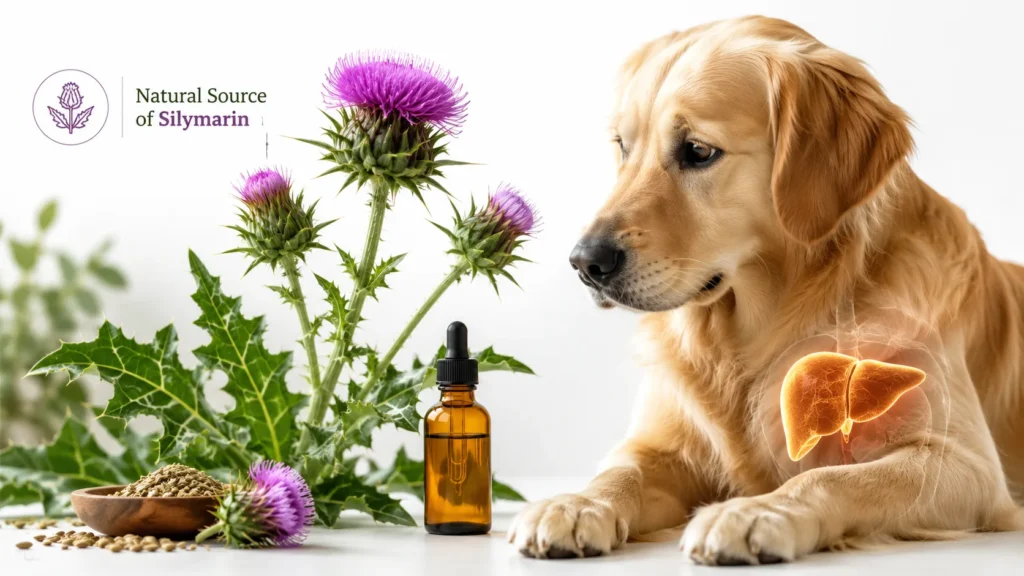
Milk thistle is a flowering herb, and its active compound is called silymarin. Silymarin is a mix of plant compounds known for antioxidant properties, and it’s the reason milk thistle shows up so often in liver-support products for both humans and animals.
In dogs, silymarin supports the liver’s normal detoxification process. It doesn’t replace the liver’s function — it eases the workload on liver cells and supports their natural repair process. This matters because the liver filters toxins, processes medications, and manages metabolism constantly, so anything that helps it work efficiently can be valuable, especially for dogs under extra strain.
Milk thistle has centuries of use in herbal medicine, but its role in veterinary care is more recent and research-backed rather than clinically exhaustive. That distinction matters: it’s a supportive supplement, not a proven cure for liver disease.
What Are the Benefits of Milk Thistle for Dogs?
Milk thistle for dogs is most often used to support liver health, but its benefits extend a bit further than that single use case. Here’s what it’s typically used for:
- Antioxidant support — Silymarin helps neutralize free radicals, which can reduce oxidative stress on liver cells over time.
- Liver cell support — It may help support the regeneration of healthy liver cells, which matters for dogs recovering from toxin exposure or liver stress.
- Detox support during medication use — Dogs on long-term medications (like certain anti-seizure drugs) process those drugs through the liver, and milk thistle is often used alongside them to support liver function.
- General wellness for aging dogs — Senior dogs naturally experience more wear on organ function, and some owners use milk thistle proactively as part of a broader wellness routine.
- Support after toxin exposure — This can include environmental toxins, certain foods, or accidental ingestion of something harmful.
It’s worth noting: these are supportive benefits, not guaranteed outcomes. Individual results vary by dog, dosage, and the underlying reason milk thistle is being used in the first place.
Milk Thistle for Liver Support in Dogs
Liver support is the number one reason owners look into milk thistle, and it’s also where the most confusion happens. Milk thistle isn’t a treatment for diagnosed liver disease — it’s a supplement that supports normal liver function, which is a meaningfully different thing.
Vets commonly recommend milk thistle in a few specific scenarios:
- Dogs with elevated liver enzyme levels found during routine bloodwork
- Dogs on long-term medications that are processed by the liver
- Dogs recovering from a toxin exposure event, once cleared by a vet
- Dogs with diagnosed liver conditions, where milk thistle is used as a complementary support alongside prescribed treatment — not a replacement for it
This last point matters most. If your dog has a diagnosed liver condition, milk thistle should be a conversation with your vet, not a decision made independently based on an online search. Always consult your vet before starting any supplement if your dog has an existing liver diagnosis or is on prescription medication, since interactions and appropriate dosing can vary significantly by condition.
For dogs without a diagnosed condition — say, a senior dog whose owner wants proactive support — milk thistle is generally considered a lower-risk addition, but “lower risk” still isn’t “no risk,” which is why safety is worth its own section.
Is Milk Thistle Safe for Dogs?

For most healthy dogs, milk thistle is considered safe when given at an appropriate dose. It’s a widely used herbal supplement with a long track record in veterinary use, and serious adverse reactions are uncommon. That said, “generally safe” isn’t the same as “safe for every dog in every situation.”
A few safety notes worth knowing:
- Milk thistle should not be used in pregnant or nursing dogs, as safety hasn’t been established for that population.
- Dogs on other medications — especially those metabolized by the liver — should only start milk thistle under veterinary guidance, since interactions are possible.
- Quality and concentration vary a lot between products, so a “safe dose” on one label may not translate directly to another brand.
Possible Side Effects
Milk thistle is generally well-tolerated, but side effects can occur, particularly at higher doses or in sensitive dogs:
- Mild digestive upset (loose stool, gas, or reduced appetite)
- Rare allergic reactions in dogs sensitive to plants in the ragweed family
- Interaction risk with certain liver-metabolized medications, which is why medical use should be vet-supervised
If your dog shows any unusual symptoms after starting milk thistle — vomiting, lethargy, appetite loss lasting more than a day — stop the supplement and consult your vet before restarting it. This is especially important if your dog is already being treated for a liver-related issue, where dosing and interactions need closer supervision.
How Much Milk Thistle Should You Give Your Dog?
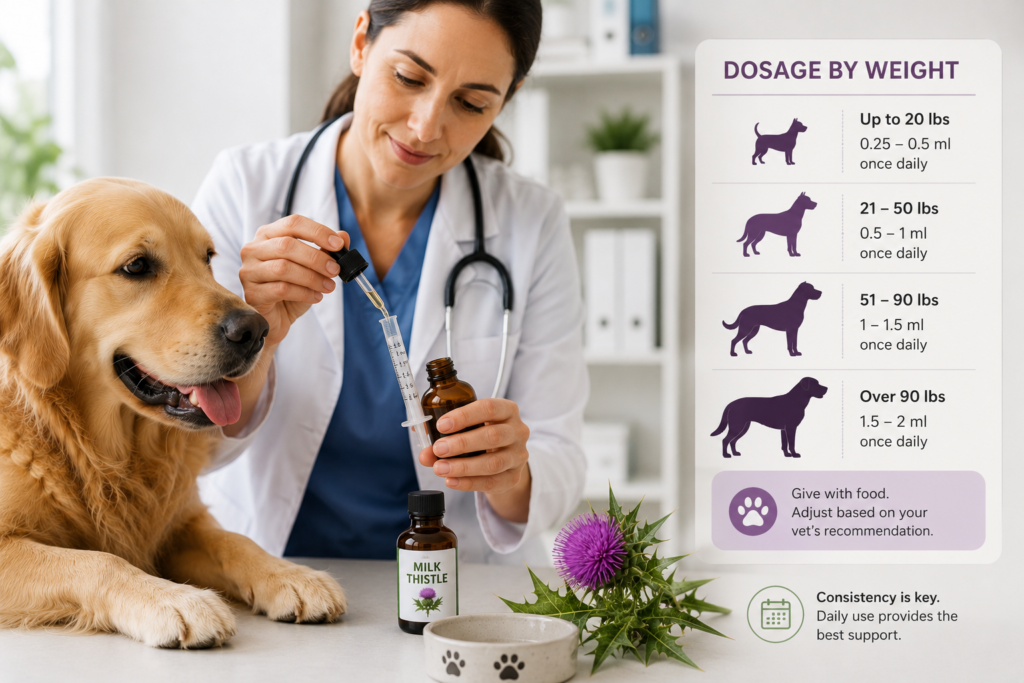
Dosage is where milk thistle gets more complicated than a lot of supplements, mainly because concentration varies so much by product. A liquid tincture, a standardized capsule, and a chew with multiple active ingredients will all have different dosing math, even if they’re all technically “milk thistle for dogs.”
As a general reference point, here’s a common weight-based dosing structure used by several vet-formulated liquid products:
| Dog Weight | Approximate Daily Dose (Liquid Form) |
|---|---|
| Under 10 lbs | 0.5 mL |
| 11–20 lbs | 1.0 mL |
| 21–40 lbs | 2.0 mL |
| 41–60 lbs | 2.5 mL |
| 61–80 lbs | 3.0 mL |
| 81–100 lbs | 3.5 mL |
| Over 100 lbs | 4.0 mL |
Always confirm dosing against the specific product label you’re using, since concentration differs between brands and forms (liquid vs. capsule vs. chew).
For capsule-based products, dosing is usually simpler — many are formulated as one capsule per day for dogs under 30 lbs, and two capsules per day for dogs over 30 lbs, based on a standardized silymarin content per capsule (commonly 150mg at 80% silymarin concentration).
The most reliable rule: follow the label of the specific product you’re using, not a general chart. If your dog has a liver condition or is on medication, loop your vet in before landing on a final dose.
Best Milk Thistle Supplements for Dogs
Once you’ve decided milk thistle makes sense for your dog, the next decision is which product fits your situation — a pure single-ingredient option, a multi-ingredient blend, or something budget-friendly and simple. Here’s how four well-regarded options compare.
| Product | Form | Milk Thistle Content | Best For | Price | Rating |
|---|---|---|---|---|---|
| Pet Wellbeing Milk Thistle Liquid | Liquid | Organic, standardized silymarin | Overall pick — precise weight-based dosing | $64.25 (4 oz) | 4.5★ (2,338) |
| Animal Essentials Milk Thistle Capsules | Capsule | 150mg, 80% silymarin | Dogs who take pills well, precise dosing | $18.99 (30ct) | 4.4★ (1,940) |
| Zesty Paws Liver Support Bites | Soft chew | 200mg milk thistle extract + turmeric, NAC, dandelion | Broader liver support beyond milk thistle alone | $36.97 (90ct) | 4.2★ (2,148) |
| K9 Select Milk Thistle Capsules | Capsule | 100mg, unflavored | Budget-conscious owners, flavor-sensitive dogs | $9.99 (60ct) | 4.5★ (546) |

Best For: Owners who want a single-ingredient, precisely dosed option. Cost Per Day: ~$1.09 (based on a 21–40 lb dog at 2 mL/day).
Why It Made the List
- Single-ingredient, organic milk thistle with no blended fillers
- NASC certified, meeting a recognized animal-supplement quality standard
- Weight-based dosing chart printed directly on the label
Key Specs
- Form: Liquid, organic milk thistle seed (Silybum marianum), 333mg per mL (20 drops/mL)
- Certification: NASC certified, vet-formulated
- Inactive ingredients: deionized water, natural bacon flavor, vegetable glycerin
Honest Take
- It’s the most expensive option in this roundup per bottle
- Liquid form is messier to administer than a chew or capsule
- Most common owner report: easy to dose precisely by weight. Most common complaint: some dogs resist the taste despite bacon flavoring.
At $64.25 for a 4 oz bottle, it’s the premium option in this lineup. The weight-based dosing printed clearly on the label removes a lot of guesswork, and with 2,338 ratings, it’s also the most-reviewed product here.

Best For: Dogs who take pills easily, owners who want exact repeatable dosing. Cost Per Day: ~$0.63–$1.27, depending on dog weight.
Why It Made the List
- 150mg of milk thistle extract standardized to 80% silymarin per capsule
- Simple two-tier weight-based dosing: 1 capsule/day under 30 lbs, 2 capsules/day over 30 lbs
- Alcohol-free, no synthetic additives
Key Specs
- Form: Vegetable capsule, 150mg milk thistle PE per capsule, standardized to 80% silymarin
- Dosage tier: under 30 lbs = 1 capsule/day; over 30 lbs = 1 capsule twice daily
- Inactive ingredients: vegetable gelatin (capsule shell)
Honest Take
- Requires a dog that will reliably take capsules whole
- Dose isn’t adjustable mid-way the way a liquid is
- Most common owner report: easy to track exact silymarin intake. Most common complaint: picky dogs may need the capsule hidden in food.
At $18.99 for 30 capsules, this sits in the middle of the price range and holds a strong 4.4-star rating across 1,940 reviews.

Best For: Owners who want broader liver support beyond isolated silymarin. Cost Per Day: ~$0.41–$0.82, depending on dog weight.
Why It Made the List
- Combines milk thistle with turmeric, NAC, and dandelion root for broader hepatic support
- Soft chew format, generally easier to administer than capsules
- Established brand with a large review base (2,148 ratings)
Key Specs
- Form: Soft chew — Silactive standardized milk thistle extract, Qmin+ curcumin (min. 95% curcuminoids), N-Acetyl Cysteine (NAC), choline bitartrate, dandelion root, BioPerine
- Dosage tier: up to 25 lbs = 1 chew/day; 26–75 lbs = 2 chews/day; over 75 lbs = 3 chews/day (start at half dose and increase gradually)
- Inactive ingredients: chicken, blueberry, cranberry, flaxseed, garbanzo flour, sunflower lecithin, natural flavoring
Honest Take
- Slightly lower average rating than the other three picks in this roundup
- Because it’s a blend, isolating the exact milk thistle dose is less precise than a single-ingredient product
- Most common owner report: easy to split and mix into food for picky eaters. Most common complaint: some dogs are reportedly picky about the flavor.
Dosing is straightforward and split by weight: up to 25 lbs gets 1 soft chew, 26–75 lbs gets 2, and dogs over 75 lbs get 3. The label recommends starting at half the suggested amount and increasing gradually rather than jumping straight to the full dose.

Best For: Budget-conscious owners or dogs with dietary sensitivities. Cost Per Day: ~$0.17–$0.33, depending on dog weight.
Why It Made the List
- Lowest cost per capsule of any product in this roundup
- Unflavored — useful for dogs on limited-ingredient or restricted diets
- Straightforward, single-ingredient formula from a small-business brand
Key Specs
- Form: Vegetable capsule, 100mg milk thistle per capsule
- Dosage: under 25 lbs = 1/2 capsule/day; 25–50 lbs = 1 capsule/day; over 50 lbs = 1.5–2 capsules/day
- Flavor: unflavored, vegetable-based capsule shell
Honest Take
- Lower per-capsule milk thistle content than some competitors (100mg vs. 150mg)
- Unflavored capsules may be harder to get some dogs to accept without disguising in food
- Most common owner report: good value for long-term daily use. Most common complaint: some dogs are hesitant to take the plain capsule without food.
At just $9.99 for 60 capsules, this is the most affordable option in the lineup — and it still holds a strong 4.5-star rating across 546 reviews.
Does milk thistle help dogs with liver problems?
Milk thistle can support normal liver function and may help with detoxification, but it isn’t a treatment for diagnosed liver disease. It works best as a complementary support alongside veterinary care, not as a replacement for it. Always consult your vet before using it to manage a diagnosed condition.
How long does it take milk thistle to work in dogs?
Some owners notice appetite or energy improvements within a couple of weeks, but full liver-support benefits typically take several weeks to months of consistent use to become noticeable.
Can I give my dog milk thistle every day?
Yes, most milk thistle supplements are formulated for daily use. Follow the specific product’s label dosing, and check with your vet if your dog has an existing health condition.
Is milk thistle safe for puppies?
Safety data for puppies is limited. It’s best to consult your vet before giving milk thistle to a puppy, since most dosing guidance is built around adult dogs.
Can milk thistle interact with medications?
Yes, particularly medications processed by the liver. If your dog takes prescription medication, talk to your vet before adding milk thistle to their routine.
What’s the difference between milk thistle and Denamarin?
Denamarin is a prescription liver-support product containing SAMe and silybin (a milk thistle derivative), typically used for diagnosed liver conditions. Milk thistle supplements are generally milder, over-the-counter options meant for general support rather than treating a specific diagnosis. Consult your vet to determine which is appropriate for your dog’s condition.
Our Verdict
Milk thistle is one of the more well-supported herbal supplements for canine liver health, but it works best when matched to the right situation and dosed correctly for the specific product you’re using.
For most healthy dogs, a single-ingredient option like Pet Wellbeing’s liquid or Animal Essentials’ capsules offers a clean, well-dosed starting point. If your dog needs broader liver support, a blend like Zesty Paws’ Liver Support Bites may be worth considering instead, and K9 Select’s capsules are a solid entry point if budget is the deciding factor.
Whatever you choose, consult your vet before starting milk thistle if your dog has a diagnosed liver condition, takes regular medication, or is pregnant or nursing. Used appropriately, milk thistle can be a useful, low-risk addition to a dog’s wellness routine — but it’s a support tool, not a substitute for veterinary care.