 Marco Williams
Ollie and The Farmer’s Dog are two leading brands in the fresh, human-grade dog food delivery market. Both companies offer subscription-based services that provide pre-portioned meals tailored to a dog’s specific needs, delivered directly to the consumer’s door. They operate on the premise that dogs thrive on diets made from real, whole ingredients, similar to human food, rather than heavily processed kibble.
For readers researching additional options, see our Best Fresh Dog Food Delivery roundup and detailed Ingredient Analysis: Fresh vs Kibble. You can also compare more top brands in our Fresh Dog Food Comparison 2026.
The core offering for both is gently cooked food, formulated to meet nutritional standards, using USDA-inspected meats and fresh produce. This comparison guide provides a data-driven analysis to help dog owners make an informed choice based on objective criteria. We will examine ingredient transparency, nutritional density, the depth of their customization process, and the real-world cost per day.
Furthermore, we will analyze manufacturing safety standards and any historical recalls associated with either brand. This article is not designed to declare a definitive winner. Instead, it serves as a tool to help you select the service that best aligns with your dog’s specific health requirements, your lifestyle, and your budget. The goal is to provide clarity and empower you with the information needed to choose between these premium options.
Quick Comparison Snapshot Table
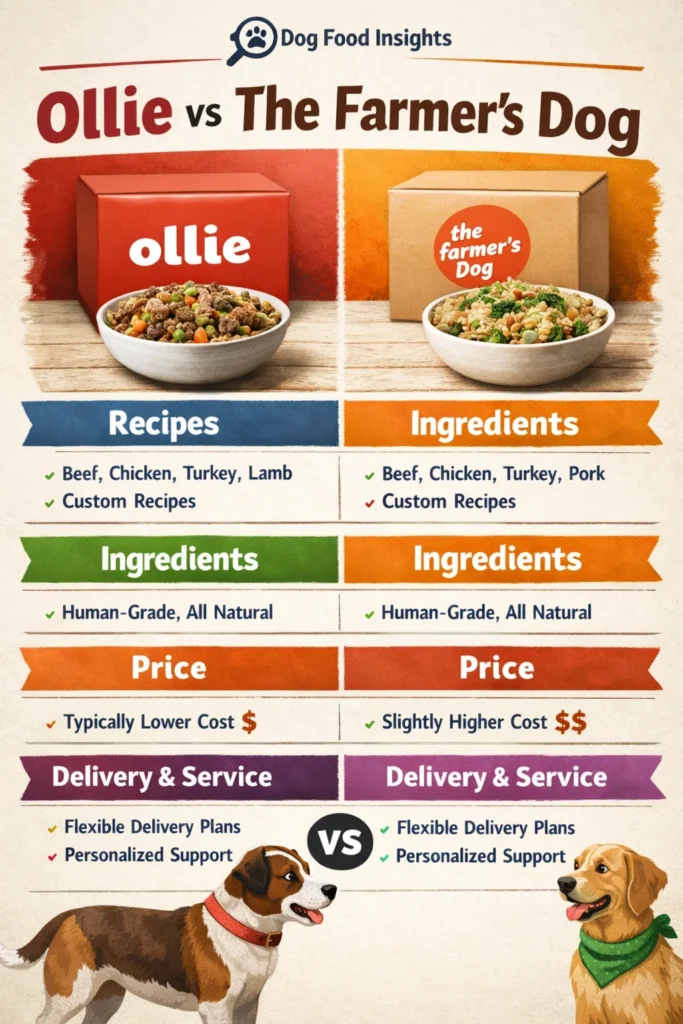
The table below provides a quick side-by-side comparison of Ollie and The Farmer’s Dog, highlighting their company background, meal options, pricing, and subscription features. It offers a convenient overview before exploring their recipes, ingredients, nutritional value, and overall performance in greater detail.
| Feature | Ollie | The Farmer’s Dog |
|---|---|---|
| Founded Year | 2016 | 2014 |
| Headquarters | New York, NY | New York, NY |
| Manufacturing Type | Third-party USDA kitchens | Owned & operated USDA kitchens |
| Number of Recipes | 5 (Beef, Chicken, Turkey, Lamb, Pork) | 4 (Beef, Chicken, Turkey, Pork) |
| AAFCO Compliance | Formulated to meet AAFCO standards | Formulated to meet AAFCO standards |
| Starting Price/Day | ~$2.50 (for a 5 lb dog) | ~$2.00 (for a 5 lb dog) |
| Estimated Monthly Cost (50 lb dog) | ~$270–$300 | ~$280–$315 |
| Subscription Flexibility | Adjustable delivery frequency | Adjustable delivery frequency |
| Shipping | Free | Free |
Overall, both brands follow a similar fresh dog food subscription model, but they differ slightly in manufacturing, recipe selection, and pricing. The Farmer’s Dog operates its own USDA-inspected kitchens, while Ollie partners with USDA-certified facilities. Both provide free shipping and flexible delivery schedules, making them convenient options for pet owners.
Ingredient Quality Breakdown
A detailed analysis of ingredient panels reveals the formulation philosophy of each brand. We will examine the first five ingredients from two popular recipes for both Ollie and The Farmer’s Dog to assess their approach to protein, carbohydrates, and micronutrients.
Ollie Ingredient Analysis

Ollie’s recipes consistently lead with a named muscle meat, followed by organ meats and whole-food carbohydrate sources.
Ollie’s Beef Recipe (First 5 Ingredients):
- Beef
- Beef Heart
- Sweet Potatoes
- Peas
- Beef Liver
Ollie’s Chicken Recipe (First 5 Ingredients):
- Chicken
- Carrots
- Chicken Liver
- Peas
- Rice
Analysis:
- Protein Sources: Ollie uses a combination of high-quality muscle meat (Beef, Chicken) and nutrient-rich organ meats (Heart, Liver). This provides a strong, natural source of amino acids and vitamins.
- Carbohydrate & Fiber: The brand relies on ingredients like sweet potatoes, peas, carrots, and rice. These provide digestible energy and dietary fiber.
- Nutrient Fortification: Ollie recipes include a supplemental vitamin and mineral premix to ensure they are complete and balanced according to AAFCO standards. This is a standard practice in commercially produced dog food.
- Omega-3s: Sources like cod liver oil are included further down the ingredient list to provide essential fatty acids.
The Farmer’s Dog Ingredient Analysis
The Farmer’s Dog also prioritizes named muscle meat as the first ingredient, supplemented by organ meats and vegetables.
The Farmer’s Dog Beef Recipe (First 5 Ingredients):
- USDA Beef
- Sweet Potatoes
- Lentils
- Carrots
- USDA Beef Liver
The Farmer’s Dog Chicken Recipe (First 5 Ingredients):
- USDA Chicken
- Brussels Sprouts
- USDA Chicken Liver
- Bok Choy
- Broccoli
Analysis:
- Protein Sources: The brand explicitly lists “USDA” before its meat sources, emphasizing its sourcing standards. Like Ollie, it combines muscle meat with organ meat (Beef Liver, Chicken Liver).
- Carbohydrate & Fiber: The Farmer’s Dog uses a mix of root vegetables (sweet potatoes, carrots) and legumes (lentils). Their chicken recipe notably features more green vegetables like Brussels sprouts and bok choy.
- Nutrient Fortification: Recipes are balanced using a “TFD Nutrient Blend,” which is their proprietary mix of vitamins and minerals. This serves the same function as Ollie’s premix.
- Omega-3s: Fish oil is included in all recipes to supply EPA and DHA.
Comparison Summary
- Meat-Forward Balance: Both brands are strongly meat-forward, with the first ingredient always being a named muscle meat.
- Whole-Food Reliance: Both prioritize whole-food ingredients. The Farmer’s Dog tends to use a slightly more diverse range of vegetables, especially leafy greens, in some recipes.
- Transparency: Both offer excellent transparency, with all ingredients clearly listed on their websites. The Farmer’s Dog’s use of “USDA” in its ingredient list is a marketing distinction, as both brands state they cook in USDA-compliant kitchens.
- Synthetic Reliance: Both use a synthetic vitamin and mineral premix to guarantee nutritional completeness, which is a responsible industry standard. Neither relies solely on whole foods for all micronutrients.
Nutritional Profile Comparison
The guaranteed analysis provides a quantitative look at the protein, fat, and fiber content of the food. These percentages are crucial for determining which food is best suited for a dog’s specific energy needs, life stage, and health status.
| Nutrient (Dry Matter Basis) | Ollie (Avg. Across Recipes) | The Farmer’s Dog (Avg. Across Recipes) |
|---|---|---|
| Protein % | 35-42% | 32-44% |
| Fat % | 20-28% | 22-32% |
| Fiber % | < 5% | < 5% |
| Moisture % (As Fed) | 70-75% | 72-76% |
| Calorie Density (kcal/kg) | ~1300-1600 | ~1400-1700 |
Note: Dry matter basis percentages are calculated from the guaranteed analysis to provide a more accurate comparison by removing moisture content.
Nutritional Implications
- For Active Dogs: Both brands offer recipes with high protein and fat content suitable for active or sporting dogs. The Farmer’s Dog recipes, on average, have a slightly higher ceiling for fat content and calorie density, which can be beneficial for dogs with very high energy requirements.
- For Weight Management: Both services customize portion sizes for weight loss goals. Ollie’s slightly lower average fat content in some recipes might offer a marginal advantage for sedentary or overweight dogs, though portion control remains the most critical factor.
- For Small Breeds: Small dogs have faster metabolisms and require calorie-dense food. Both brands are well-suited for small breeds due to their high nutritional density compared to kibble. The pre-portioned packs are particularly convenient for ensuring accurate feeding for tiny dogs.
- Calorie Density: The slightly higher calorie density in some of The Farmer’s Dog’s recipes means that a smaller volume of food is needed to meet a dog’s energy needs. This can be a factor for picky eaters or dogs with smaller appetites.
Personalization & Customization Depth
The primary appeal of these services is the promise of personalized meal plans. The depth and accuracy of this personalization depend on the onboarding questionnaire and the algorithm used to calculate portions.
Onboarding Questionnaire
Both Ollie and The Farmer’s Dog use a detailed online quiz to gather information about your dog. This includes:
- Age, breed, and sex
- Current and ideal body weight
- Activity level (e.g., couch potato, highly active)
- Known allergies and health issues
- Current food type
The Farmer’s Dog questionnaire is slightly more granular in some areas, asking about specific health conditions (like digestive or joint issues) with more detailed options.
Calorie Calculation and Portioning
Both companies use proprietary algorithms based on the data collected to calculate a dog’s daily caloric needs. They then translate this into pre-portioned packs.
- Ollie: Provides flexibility in adjusting portions directly from the customer dashboard if you notice weight changes or activity shifts.
- The Farmer’s Dog: Also allows for easy adjustments. Their system is highly responsive to feedback, and they often check in via email to see how a dog is responding to the initial plan.
Allergy & Life Stage Management
- Allergy Filtering: Both platforms allow you to exclude recipes containing specific allergens (e.g., chicken, beef) identified during the sign-up process.
- Life-Stage Adaptation: Plans are designed to adapt as your dog ages. Both services can adjust formulations and portioning for puppies, adults, and senior dogs, although puppy plans will require more frequent adjustments.
- Veterinary Involvement: The Farmer’s Dog often highlights that their formulations are developed with veterinary nutritionists. Ollie also consults with vet nutritionists to create its recipes. Both meet AAFCO standards, which is the key benchmark for nutritional adequacy.
Overall, both services offer robust customization. The Farmer’s Dog provides a slightly more detailed initial intake process, but both deliver a product that is well-tailored to the individual dog’s profile.
Cost Breakdown & Value Analysis
Cost is a significant factor when choosing a premium dog food subscription. We modeled the monthly and daily costs for three different dog sizes on a full-plan subscription. Partial plans, where fresh food is used as a topper, are also available and will cost significantly less.
10 lb Dog (e.g., Shih Tzu, Pomeranian)
- Ollie:
- Full Plan Monthly Cost: ~$85
- Cost Per Day: ~$2.80
- The Farmer’s Dog:
- Full Plan Monthly Cost: ~$70
- Cost Per Day: ~$2.30
30 lb Dog (e.g., Beagle, Corgi)
- Ollie:
- Full Plan Monthly Cost: ~$175
- Cost Per Day: ~$5.80
- The Farmer’s Dog:
- Full Plan Monthly Cost: ~$185
- Cost Per Day: ~$6.15
60 lb Dog (e.g., Golden Retriever, Labrador)
- Ollie:
- Full Plan Monthly Cost: ~$290
- Cost Per Day: ~$9.65
- The Farmer’s Dog:
- Full Plan Monthly Cost: ~$305
- Cost Per Day: ~$10.15
Note: Costs are estimates as of early 2026 and can vary based on recipe choice, activity level, and promotions.
Value and Cost Efficiency
- Small Dogs: For very small dogs, The Farmer’s Dog often presents a more budget-friendly option, with a lower daily cost.
- Medium to Large Dogs: For medium and large breeds, the costs are highly competitive. Depending on the specific recipe, Ollie can sometimes be slightly more cost-effective.
- Price-to-Nutrition Ratio: Both brands offer excellent value in terms of nutritional quality for the price. The cost reflects the use of human-grade ingredients, USDA-inspected kitchens, and the convenience of direct-to-consumer delivery.
- Cost Per 1,000 kcal Example (Ollie): For a 60 lb dog eating Ollie, a daily cost of ~$9.65 at a calorie need of ~1,300 kcal/day equates to ~$7.42 per 1,000 kcal.
- Cost Per 1,000 kcal Example (The Farmer’s Dog): For a 60 lb dog eating The Farmer’s Dog, a daily cost of ~$10.15 at a similar calorie need (~1,300 kcal/day) results in ~$7.81 per 1,000 kcal.
- Cost Per 1,000 kcal: When comparing cost per calorie, The Farmer’s Dog can sometimes appear more expensive due to its higher calorie density in certain recipes. However, the total daily cost is the more practical metric for most owners.
- Annual Cost Comparison: For a 50–60 lb dog, Ollie’s annual cost averages ~$3,500, while The Farmer’s Dog averages ~$3,650—an estimated $150/year difference.
Choosing based on cost requires getting a personalized quote from both companies. For smaller dogs, The Farmer’s Dog is often the more economical choice, while for larger dogs, the prices converge significantly.
Annual Cost Snapshot: For a 50–60 lb dog, Ollie’s estimated yearly cost is about $3,500, while The Farmer’s Dog averages around $3,650. This results in an approximate yearly difference of $150, with Ollie typically offering a slight cost advantage for larger breeds.
View Plans on The Farmer’s Dog
Safety, Recall & Manufacturing Transparency
Food safety is paramount for any dog owner. Both Ollie and The Farmer’s Dog emphasize their high standards for sourcing and production.
Recall History
- Ollie: To date, Ollie has had no recalls on any of its food products.
- The Farmer’s Dog: To date, The Farmer’s Dog has had no recalls on any of its food products.
This is a critical indicator of strong quality control and safety protocols for both brands.
Manufacturing and Quality Control
- Ollie: Ollie partners with third-party manufacturers. Their kitchens are USDA-inspected and human-grade, meaning they meet the same safety standards required for producing human food. They implement Hazard Analysis Critical Control Point (HACCP) safety protocols.
- The Farmer’s Dog: The Farmer’s Dog owns and operates its own manufacturing facilities. This allows them to have complete end-to-end control over the entire production process, from sourcing ingredients to cooking and packaging. Their kitchens are also USDA-inspected and human-grade.
Both approaches have merits. The Farmer’s Dog’s in-house production provides maximum control, while Ollie’s partnership model allows for scalability while still adhering to strict, third-party-verified USDA standards. Both brands claim to test their food batches for safety.
Pros & Cons
This side-by-side summary distills the key strengths and limitations of each service.
Ollie Strengths
- Excellent ingredient quality with named meats and organs.
- Slightly wider variety of protein options (5 vs. 4).
- Zero recall history.
- Can be slightly more cost-effective for larger dogs.
Ollie Limitations
- Uses third-party manufacturing facilities.
- Calorie density is slightly lower on average.
The Farmer’s Dog Strengths
- Owns and operates its own USDA kitchens for maximum quality control.
- Zero recall history.
- Often more affordable for very small dogs.
- Onboarding quiz is exceptionally detailed.
The Farmer’s Dog Limitations
- Slightly fewer protein choices.
- Can be marginally more expensive for larger dogs.
Decision Framework: Which Should You Choose?
Neither brand is universally “better.” The best choice depends entirely on your specific dog and your priorities as an owner.
- If your dog is extremely picky: The Farmer’s Dog might have an edge. Its higher calorie density and focus on simple, meat-first recipes can be very appealing to fussy eaters.
- If your dog is overweight: Both are excellent choices due to their precise portion control. Ollie’s slightly lower average fat content may be a minor plus, but the portioning algorithm is what matters most.
- If your dog is highly active: Either brand will work well. The Farmer’s Dog’s higher fat and calorie options could be beneficial for dogs with extreme energy needs, such as those involved in sports.
- If you own a large breed dog: Compare quotes directly. Ollie often comes out slightly cheaper for dogs over 50-60 lbs, which can lead to significant savings over time.
- If your dog has mild sensitivities: Ollie’s lamb recipe provides a good option for dogs with chicken or beef sensitivities. The Farmer’s Dog’s simple formulas are also great for allergy management.
- If your primary concern is the lowest possible cost: For small dogs, The Farmer’s Dog is frequently the cheaper option. For larger dogs, get a quote from both, as Ollie may have the advantage.
- If you value brand recognition and control: The Farmer’s Dog’s vertical integration (owning their kitchens) and slightly longer time on the market may appeal to owners who prioritize maximum process control.
Is Fresh Dog Food Worth It?
The shift toward fresh, human-grade dog food is driven by a desire for higher-quality nutrition and greater ingredient transparency. While gently cooked food offers benefits over traditional, high-heat extruded kibble, it’s important to evaluate these choices against recognized veterinary nutrition standards—such as those set by the AAFCO, WSAVA Global Nutrition Guidelines, or NRC recommendations.
Evidence suggests that fresh diets can be more digestible, leading to better nutrient absorption and smaller, firmer stools. The high moisture content (typically 70-75%) also helps keep dogs well-hydrated, which supports kidney and urinary tract health. The minimal processing helps preserve the natural integrity of the ingredients.
However, it is important to maintain a balanced perspective. There is currently a lack of long-term, peer-reviewed scientific studies definitively proving that fresh diets are superior to all other forms of feeding for longevity or disease prevention. A well-formulated kibble that meets AAFCO standards is a complete and healthy diet for most dogs.
The decision to switch to a fresh food service like Ollie or The Farmer’s Dog is often a choice based on a preference for whole ingredients, transparency, and the potential benefits of a less-processed diet.
Final Verdict Snapshot
Best for Small Dogs: The Farmer’s Dog (lower typical daily cost for small breeds)
Best for Large Dogs: Ollie (slightly better value for 50+ lb dogs)
Best Manufacturing Control: The Farmer’s Dog (company-owned USDA kitchens)
Best Recipe Variety: Ollie (offers five main recipes)
Frequently Asked Questions (FAQ)
Is Ollie better than The Farmer’s Dog?
Neither is definitively better; the best choice depends on your dog’s needs and your budget. The Farmer’s Dog offers superior manufacturing control by owning its kitchens, while Ollie provides more recipe variety and can be more cost-effective for larger breeds.
Which is cheaper, Ollie or The Farmer’s Dog?
For small dogs (under 15 lbs), The Farmer’s Dog is often cheaper. For medium to large dogs, the prices are very competitive, with Ollie sometimes being slightly more affordable. Always get a personalized quote from both websites for an accurate comparison.
Is The Farmer’s Dog vet recommended?
Many veterinarians support the principles of a fresh, balanced diet. The Farmer’s Dog works with board-certified veterinary nutritionists to formulate its recipes to meet AAFCO standards, a fact that vets view favorably.
Is Ollie AAFCO approved?
Ollie’s recipes are formulated to meet the nutritional levels established by the AAFCO Dog Food Nutrient Profiles for all life stages. This means they are complete and balanced. The term “approved” is not used by AAFCO, as they only set standards.
Can puppies eat these diets?
Yes, both Ollie and The Farmer’s Dog offer plans specifically formulated for growing puppies. Their algorithms adjust portion sizes and nutritional content to support healthy growth and development.
Is fresh dog food healthier than kibble?
Fresh food is more digestible, higher in moisture, and less processed than kibble, which many owners and vets believe is beneficial. However, a high-quality kibble is also a nutritionally complete option. The “healthiest” food is one that your specific dog thrives on.