
Freshpet vs The Farmer’s Dog (2026): Which Fresh Dog Food Is Better for Your Dog?
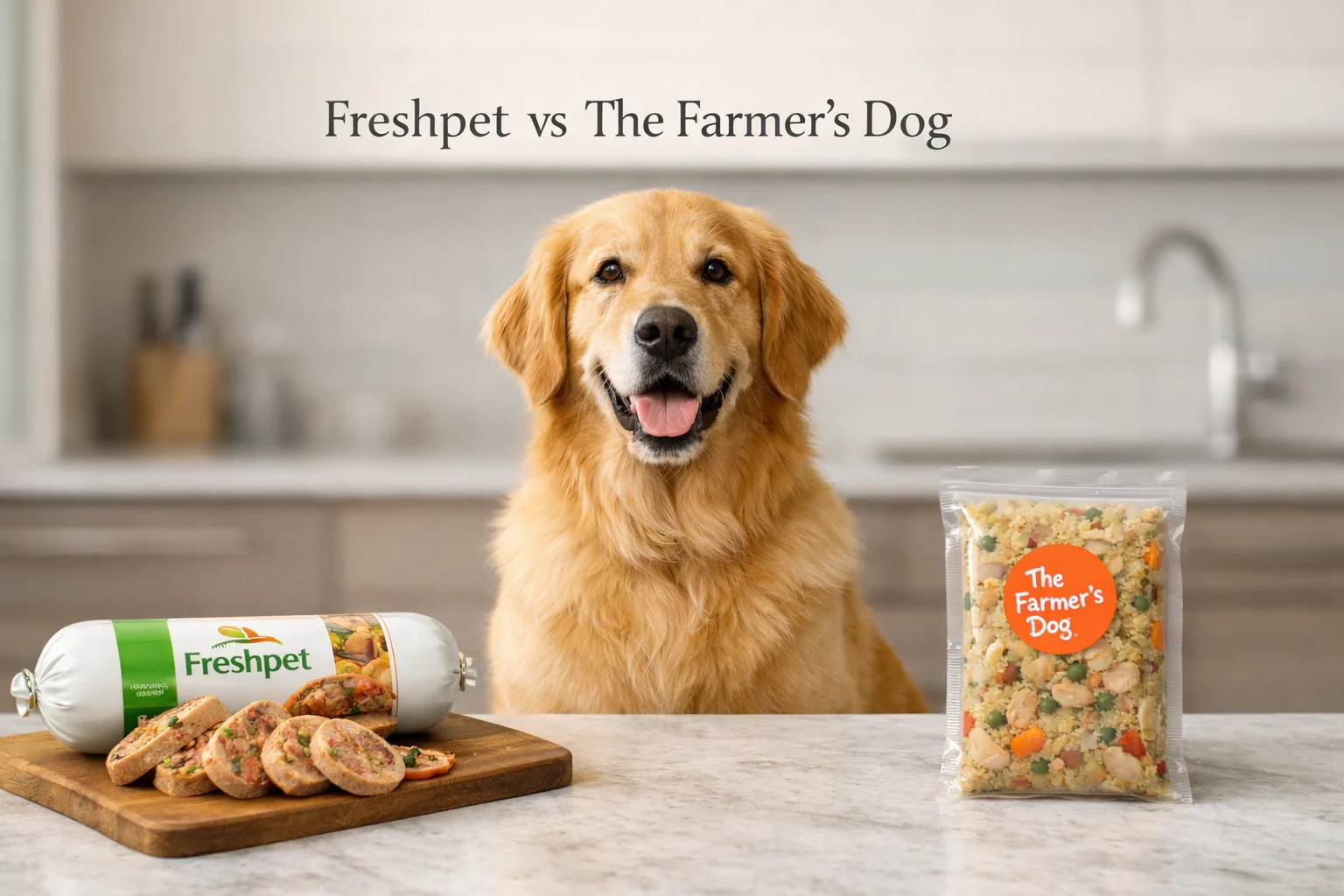
The dog food aisle used to be simple: kibble or cans. Today, the fridge is the new frontier. As pet parents become increasingly cautious of highly processed diets, interest in fresh food options continues to grow. Two major players commonly surface in this discussion: Freshpet, widely available in grocery fridges nationwide, and the direct-to-consumer subscription, The Farmer’s Dog.
But when you strip away the marketing budgets and cute commercials, what are you actually feeding your dog? Is the convenience of grabbing a roll at the grocery store worth it, or does the personalized subscription model offer better nutrition?
This guide breaks down the Freshpet vs Farmer’s Dog debate. We aren’t here to sell you a dream; we are here to help you decide which fresh option makes sense for your budget, your lifestyle, and your dog’s bowl.
Quick Verdict
If you are short on time, here is the bottom line on the Freshpet vs Farmer’s Dog comparison.
Freshpet is often preferred by budget-conscious owners and those looking for flexibility. Because you purchase it in stores, there are no subscriptions to manage. It can be especially practical for hybrid feeding (mixing fresh food with kibble) to help manage costs. It is generally more affordable but does require you to manage portion sizes yourself.
The Farmer’s Dog is often preferred for strict portion control and convenience. If you have a dog that tends to gain weight or you want a straightforward feeding solution, their personalized pouches may offer a significant advantage. However, this convenience typically comes at a higher price point, making it the most expensive option for large breeds.
Best for Budget: Freshpet
Best for Weight Management: The Farmer’s Dog
Best for Large Dogs: Freshpet (due to cost scaling)
Best for Convenience: The Farmer’s Dog
Freshpet vs Farmer’s Dog — What’s the Core Difference?
While both brands fall under the “fresh food” umbrella, their business models and feeding philosophies are drastically different. Understanding this core difference is the first step in making the right choice.
Freshpet operates on a retail model. You find it in a branded refrigerator in the pet aisle of grocery stores or big-box retailers. It’s mass-produced, packaged in rolls or bags, and pasteurized to stay safe in a fridge. You buy it just like you buy your own groceries—weekly or as needed. Because it isn’t custom-portioned, you have to measure (and chop) the food yourself at every meal. It is often treated as a high-value topper rather than a full meal for larger dogs.
The Farmer’s Dog operates on a subscription model. You fill out a profile for your dog online, and they ship frozen food directly to your door. The key difference here is personalization. They calculate your dog’s exact caloric needs and send pre-portioned packs labeled for your specific dog. The food arrives frozen, and you thaw it in the fridge before serving. It is designed primarily as a complete meal replacement, though you can use it as a topper if you adjust the subscription.
Ingredient & Formula Comparison
Let’s get into the details of what is actually inside these recipes. We will look at specific product lines to give you a fair comparison.
Freshpet Ingredients

Freshpet offers several lines, but the most common is their “Select” roll. The Freshpet Select Chicken Recipe Roll lists Chicken, Chicken Liver, Rice, Carrots, and Peas as the first five ingredients. It relies on rice as a binder and energy source, making it grain-inclusive.
For those avoiding grains, the Freshpet Vital Grain-Free Beef & Bison recipe swaps rice for potatoes and peas, featuring Beef, Beef Liver, and Bison upfront.
Nutritionally, Freshpet formulas are generally moderate in protein (around 32-34% on a dry matter basis) and moderate in fat (around 20-22%). This is a solid profile for most adult dogs, though some owners note the fat content can be a bit rich for sensitive stomachs.
The Farmer’s Dog Ingredients
The Farmer’s Dog focuses on human-grade whole foods with very transparent sourcing. Their Chicken Recipe features Chicken, Chicken Liver, Brussels Sprouts, Bok Choy, and Carrots. Notice the vegetable variety—ingredients like Bok Choy provide micronutrients you rarely see in mass-market pet food.
Their Beef Recipe includes Beef, Beef Liver, Sweet Potato, Lentils, and Carrots.
Protein levels for The Farmer’s Dog are comparable to Freshpet, sitting around 34-36% on a dry matter basis. However, the ingredient list feels slightly “cleaner” to many owners because it lacks the gums or carrageenan sometimes found in retail rolls. The Farmer’s Dog recipes are also heavily focused on palatability, with many owners reporting drastic improvements in their dogs’ excitement for mealtime.
For those considering these options, you can view the Freshpet Select Chicken Recipe Roll and Freshpet Vital Grain-Free Beef & Bison at many retailers—see current availability to compare which recipe may align best with your dog’s needs. If you prefer a subscription model with direct-to-door service, you may wish to check current pricing for The Farmer’s Dog Personalized Fresh Plan for the most up-to-date options.
Nutritional Density & Health Implications
When comparing Freshpet vs Farmer’s Dog, you have to look beyond the label and consider how the food impacts your dog’s long-term health.
Weight Management
The Farmer’s Dog has a distinct advantage here. Because every pouch is perfectly portioned for your dog’s calorie needs, it takes the guesswork out of feeding. If your dog needs to lose two pounds, their algorithm adjusts the portion size. Freshpet relies on you to slice the roll correctly. If you eyeball “half an inch” of a Freshpet Select Chicken Recipe Roll, you might be overfeeding by 10-20% without realizing it.
Active Dogs and Energy
Both brands offer sufficient protein and fat for active dogs. The protein density in the Freshpet Vital Grain-Free Beef & Bison (approx. 34% dry matter) supports lean muscle maintenance well. However, for extremely high-performance dogs, you might need to supplement to reach higher caloric targets without feeding massive volume.
Sensitive Stomachs
Freshpet is widely available and generally well-tolerated, though some formulas may be too rich for dogs with more sensitive digestion. The Freshpet Nature’s Fresh Chicken Recipe is often chosen for its slightly leaner fat profile, which some owners find gentler on the stomach. Both brands feature fat content in the moderate-to-higher range (20–22% dry matter), and their calorie densities are similar—Freshpet recipes range from approximately 360 to 395 kcal per pound, while The Farmer’s Dog recipes range from about 390 to 405 kcal per pound. This means both foods are calorie-dense, and precise feeding measurements are important, especially for less active or overweight dogs.
Owners of dogs with pancreatitis or those under veterinary advisement for fat-restricted diets should exercise particular caution. Moderate-to-high fat formulas, like those from Freshpet and The Farmer’s Dog, can be unsuitable for dogs requiring strict fat limitation; always consult your veterinarian before incorporating fresh food diets in such cases.
Small vs. Large Breed Practicality
For a 10lb Yorkie, The Farmer’s Dog is a dream—small, manageable packs. For a 90lb German Shepherd, storing a month’s worth of frozen food takes up significant freezer space. Freshpet rolls are denser and easier to stack in a fridge, making them slightly more practical for owners of large dogs who are short on freezer space.
Cost Breakdown — What You’ll Actually Spend
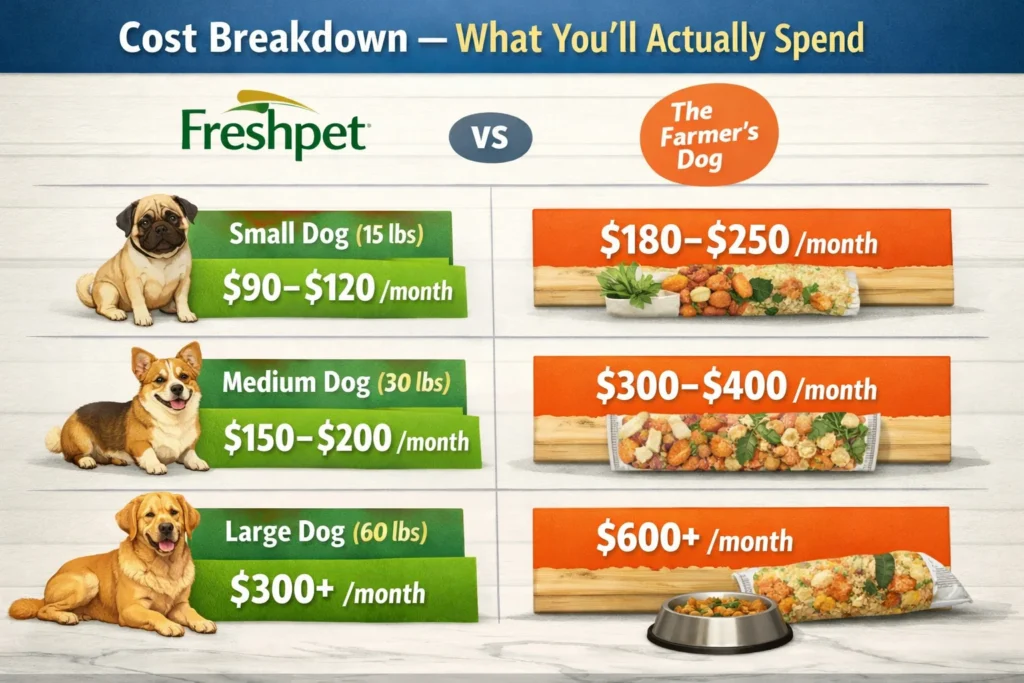
This is usually the deciding factor for most families. Is The Farmer’s Dog worth the money compared to Freshpet? Let’s look at the numbers.
15 lb Dog (e.g., Pug, Boston Terrier):
- Freshpet: You can expect to spend roughly $90–120 per month. This assumes you are feeding it as a complete meal.
- The Farmer’s Dog: The subscription will run approximately $180–250 per month. You are paying a premium for the pre-portioning and shipping.
30 lb Dog (e.g., Corgi, Beagle):
- Freshpet: Costs rise to about $150–200 per month.
- The Farmer’s Dog: The price jump is significant here, landing between $300–400 per month.
60 lb Dog (e.g., Golden Retriever, Boxer):
- Freshpet: A full fresh diet will cost $300+ per month.
- The Farmer’s Dog: You are looking at $600+ per month.
The Freshpet vs Farmer’s Dog cost gap widens as the dog gets bigger. For large breeds, feeding 100% The Farmer’s Dog is a luxury expense. This is why many large-dog owners opt for Freshpet as a topper rather than a full meal.
Who Should Choose Freshpet?
Freshpet is the “everyman’s” fresh food. It is accessible, reliable, and significantly cheaper than subscription services.
- Hybrid Feeders: If you want to mix fresh food with kibble to improve your dog’s bowl without breaking the bank, Freshpet rolls are easy to dice up and mix in.
- Moderate Budget: You get fresh meat benefits without the premium shipping and packaging costs.
- Kibble Transitioners: If you are nervous about raw food but want to move away from dry pellets, this is a safe, cooked middle ground.
- Small to Medium Breeds: The cost is very manageable for smaller dogs.
If this sounds like you, you may want to explore the Freshpet Nature’s Fresh Chicken Recipe or the classic Freshpet Select Chicken Recipe Roll at your local store or preferred online retailer—see current availability to compare options and plan your budget.
Who Should Choose Farmer’s Dog?
The Farmer’s Dog isn’t just selling food; they are selling a service. The value lies in the precision.
- Weight Watchers: If your dog is overweight, the pre-portioned packs are a game changer. You physically cannot overfeed if you stick to the packet.
- Small Breed Owners: The cost difference is negligible for tiny dogs, making the convenience of delivery very attractive.
- Convenience-First Households: If you hate grocery shopping or constantly forget to buy dog food, the subscription ensures you never run out.
- Picky Eaters: The palatability of the Farmer’s Dog Beef Recipe is exceptionally high.
For owners who want that level of tailored nutrition, the The Farmer’s Dog Personalized Fresh Plan offers a notable option—compare latest pricing to see if this subscription approach aligns with your needs.The Farmer’s Dog Personalized Fresh Plan is the industry standard.
Downsides of Fresh Dog Food
Before you switch, you need to be realistic about the cons. Fresh food is not as simple as pouring kibble into a bowl.
- Storage Space: Both brands require refrigeration. Freshpet takes up fridge shelf space; The Farmer’s Dog dominates your freezer. If you have a small apartment fridge, this is a real logistical hurdle.
- Spoilage: Once you cut into a Freshpet roll, you have 7 days to use it. If you have a small dog and buy a large roll to save money, you might end up throwing away spoiled food.
- Transition Stool: Switching from dry kibble to rich, high-moisture fresh food often causes loose stool for the first few days. You must transition slowly over 7-10 days.
- Not Prescription: Neither brand offers prescription diets for specific medical conditions like kidney disease or urinary stones.
Frequently Asked Questions
Is Freshpet healthier than Farmer’s Dog?
Not necessarily. Both provide complete and balanced nutrition that exceeds AAFCO standards. The Farmer’s Dog uses human-grade ingredients and fewer preservatives, which many nutritionists may prefer. Freshpet also offers advantages over standard kibble, particularly in ingredient quality and moisture content, making it an appealing option for those seeking less processed diets.
Is Farmer’s Dog worth the money?
For large dogs, it is difficult to justify the cost unless you have a high disposable income. For small dogs or dogs with specific weight issues, the portion control and health benefits often justify the price tag.
Can I mix Freshpet with kibble?
Yes, absolutely. In fact, this is how most people use Freshpet. It adds moisture and high-quality protein to the bowl while keeping the overall cost down. Just remember to reduce the amount of kibble you feed so you don’t overshoot the daily calorie count.
Is fresh dog food better than high-quality kibble?
Fresh dog food may offer advantages over high-quality kibble, particularly regarding ingredient integrity and moisture content. Because fresh options are made with less processing, some nutrients are retained more naturally. The higher moisture levels can be beneficial for kidney function and hydration, and many owners observe a positive change in coat quality and stool consistency after making the switch. However, the best choice will depend on your individual dog’s needs and your overall feeding goals.
Final Recommendation
The battle of Freshpet vs Farmer’s Dog ultimately comes down to convenience versus cost.
If you want a flexible, accessible fresh food that allows you to control your budget—especially if you have a larger dog or want to mix with kibble—Freshpet is the logical choice. It’s a massive step up from dry food and is easy to find.
If you want a premium, “white-glove” experience where the thinking is done for you, and you have a smaller dog or a dog that needs strict weight control, The Farmer’s Dog is superior. The personalization ensures your dog gets exactly what they need, nothing more, nothing less.
Recommendation: Begin by assessing your budget, your dog’s size, and your preferred feeding approach. If you value precise portioning and simplicity, and your dog is small or has specific dietary needs, The Farmer’s Dog may be worth considering. For those seeking a more flexible, cost-effective, and accessible fresh food—especially for larger breeds or hybrid feeding—Freshpet remains a practical choice. Ultimately, selecting the right option depends on what fits best with your household and your dog’s nutritional needs.

Written by Jessica Morgan
Jessica Morgan is a pet nutrition researcher at Dog Food Insight, specializing in ingredient analysis, food safety, and digestibility in commercial dog foods. Her work focuses on evidence-based evaluations and owner-reported outcomes to help dog owners make informed, unbiased nutrition decisions.