 Marco Williams
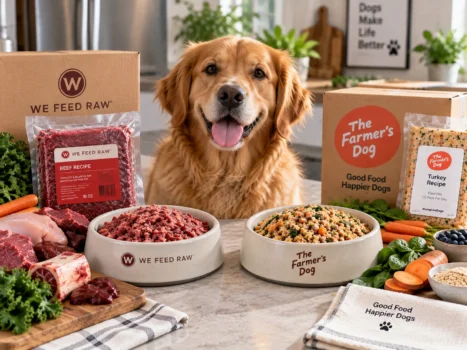
If you’ve made it past kibble and you’re down to these two, you’ve already done the hard part.
Both brands ship personalized, fresh food straight to your door. Both cost real money. Both get strong reviews from owners whose dogs finally started eating like they meant it.
But they’re not the same product in different packaging. We Feed Raw is uncooked, prey-model raw: meat, organ, and bone, pressure-treated for safety instead of heated. The Farmer’s Dog is gently cooked, built around whole meat plus vegetables, formulated by an in-house team with an outside research partnership behind it.
That’s the actual fork in the road. It should drive your decision more than price does.
Here’s what each brand actually gets you, where each one falls short, and how to figure out which side of that fork your dog belongs on. Everything below comes from each brand’s own site, a live pull of their Trustpilot data, and the actual court filing behind the lawsuit you’ll read about, not a rehash of what other comparison sites already say.
| We Feed Raw | The Farmer’s Dog | |
| Food type | Raw, high-pressure processed | Gently cooked |
| Recipes | 6 (beef, chicken, turkey, duck, lamb, venison) | 4 (beef, chicken, turkey, pork) |
| AAFCO status | All Life Stages (frozen); adult-only (freeze-dried) | All Life Stages, including large-breed growth |
| Price for a 50 lb dog | Roughly $4.50–$5.00/day | Roughly $7.25–$8.00/day |
| Trustpilot | 4.7/5 (2,113+ reviews) | 3.9/5 (1,696 reviews) |
| Known risk | Subscription pause/cancel bug | Billing complaints; pending fat-content lawsuit (unresolved) |
| Best for | Raw-feeding households, picky eaters, weight management | Owners who want cooked food with outcome data behind it |
Daily cost estimates assume a 50 lb, moderately active adult dog. Pricing on both sites is quiz-based and personalized — confirm live pricing before publishing.
We Feed Raw is currently offering 50% off your first order, applied instantly at checkout.
What’s the Real Difference Between We Feed Raw and The Farmer’s Dog?
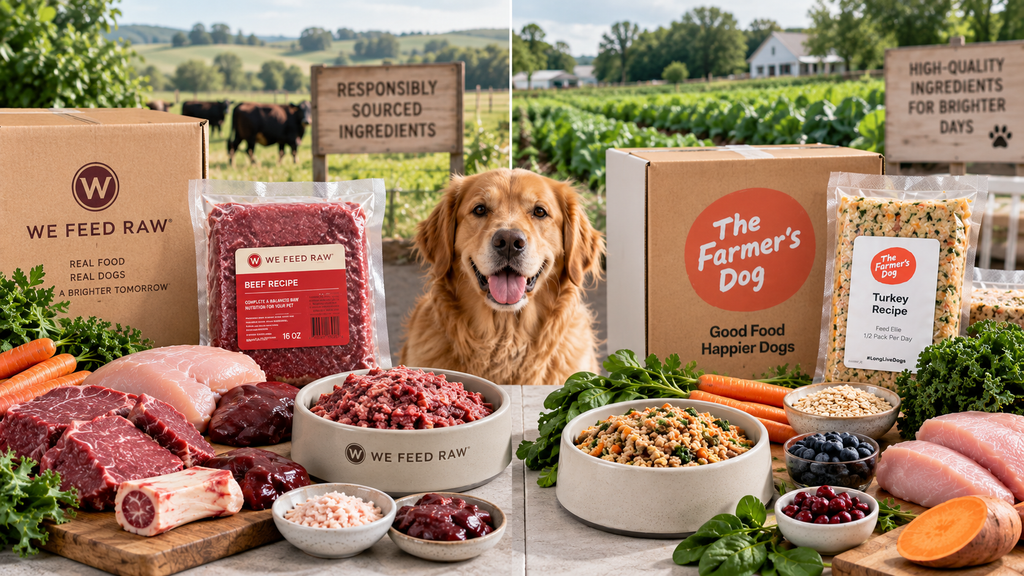
We Feed Raw is uncooked and pressure-treated for safety. The Farmer’s Dog is gently cooked. That’s the entire split, and everything else follows from it.
We Feed Raw uses high-pressure processing (HPP): cold water pressure, not heat, to knock down pathogens while leaving the raw nutrient profile intact. The Farmer’s Dog cooks at low temperature to eliminate pathogen risk the traditional way, then adds nutrients back through a fortified blend to replace what cooking degrades.
Neither approach is “wrong.” Raw-feeding advocates argue that skipping heat entirely preserves more of what’s naturally in the meat. Cooked-diet advocates point out that a properly formulated cooked diet is still complete, and that most vets are more comfortable recommending it.
This is a genuinely unsettled debate in pet nutrition, not a case where one side has the science and the other doesn’t. Treat any article that tells you it’s obviously settled with some skepticism.
We Feed Raw: Ingredients, Pricing & What You Get
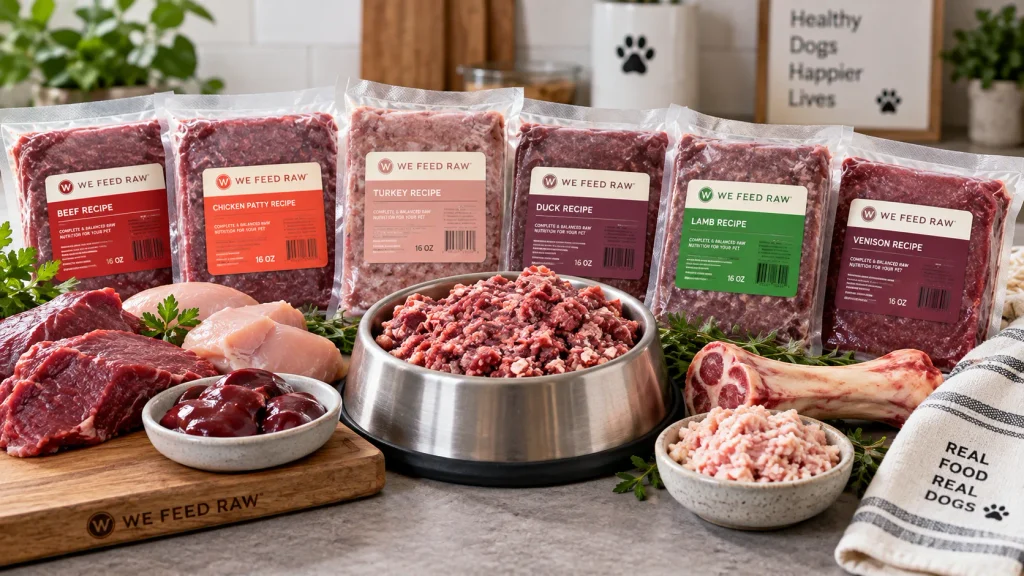
We Feed Raw’s bet is the opposite of the cooked-food approach: dogs do best on food that’s never been heated at all.
The company launched in 2018 out of Charleston, South Carolina, and has stayed direct-to-consumer only since. No retail shelf presence at Chewy, PetSmart, or anywhere else. That keeps the brand smaller and less recognizable than The Farmer’s Dog, but it also means every recipe ships fresh from the same operation instead of moving through a third-party distributor.
The company positions itself specifically within the raw-feeding movement, not as a general fresh-food alternative to kibble. Every recipe follows the same rough structure: 80% muscle meat, 10% organ, 10% ground bone. No grain fillers. No by-product meal.
Recipes & Nutrition
Six frozen recipes: beef, chicken, turkey, duck, lamb, and venison. Domestic proteins come from USDA-inspected U.S. suppliers. Lamb and venison are imported from grass-fed New Zealand farms.
There’s also a freeze-dried line in beef and chicken, launched in early 2025. It’s shelf-stable, but formulated for adult dogs only. The frozen line is what covers puppies through seniors.
The fat content swings more than you’d expect between recipes, which matters if your dog needs to watch it:
| Recipe | Protein | Fat | Best For |
|---|---|---|---|
| Turkey | 48.6% | 25.0% | Weight management, lower-fat needs |
| Chicken | 44.8% | 34.4% | Single-protein, allergy-sensitive dogs |
| Beef | ~46% | ~31% | Poultry-allergy alternative |
| Lamb | ~42–44.6% | ~30–33% | Novel protein, grass-fed sourcing |
| Duck | 44.2% | 37.1% | Not a fit for low-fat or pancreatitis diets |
| Venison | 41.1% | 33.8% | Novel protein, sensitive stomachs |
Turkey is the low-fat option here by a decent margin. Duck is the highest-fat recipe in the lineup, and the brand doesn’t flag that during the onboarding quiz. You have to know to look for it yourself.
One more thing worth knowing before you pick a “novel protein” recipe for an allergy-sensitive dog: the venison and lamb recipes both list beef as a secondary ingredient, and the duck recipe contains turkey. A verified Trustpilot reviewer ran into this directly. She was trying to find a single-protein option for a dog with suspected poultry and beef sensitivities, and discovered there isn’t one. If your dog has a confirmed allergy, consult your vet and read the full ingredient list, not just the recipe name.
Cost Per Day
For a 50 lb, moderately active dog, expect roughly $4.50 to $5.00 a day on the frozen plan. Smaller dogs cost less in absolute terms but more per pound of body weight, which is typical for this category.
The freeze-dried line runs roughly 15–20% cheaper at an equivalent size.
First-order discounts are common in this space. Check the current offer directly on We Feed Raw’s site — the exact percentage varies and [VERIFY] before publishing.
Safety Record
No recalls, no FDA warnings, no formal investigations, as of August 2026. That’s a solid track record for a brand that’s been shipping raw food since 2018.
The safety mechanism is HPP: a cold-water pressure process that neutralizes Salmonella, Listeria, and E. coli without cooking the food. It’s the same technology used in premium cold-pressed juices. It reduces bacterial risk significantly, though it doesn’t eliminate it entirely; normal raw-handling hygiene at home still matters.
Where It Falls Short
A few things are worth going in with your eyes open about.
The brand’s core credibility claim is that recipes are formulated by a PhD animal nutritionist. That claim can’t be independently verified, because the person isn’t named anywhere on the site. There’s no published feeding trial either. AAFCO compliance here is calculated, not outcome-tested against real dogs over time.
The more practical issue is the subscription itself. Multiple verified reviewers describe not being able to truly “pause” a subscription. The system only lets you reschedule the next ship date, not stop it outright, which becomes a headache if you’re trying to figure out whether your dog is reacting to the food.
A separate, related pattern shows up too: pause and cancel requests sometimes don’t register on the company’s end, resulting in unwanted charges. If you subscribe, confirm any change through live chat, not just the account portal.
Day-to-day handling is worth planning around too. Frozen patties need roughly 8 to 12 hours in the fridge to thaw, and multiple reviewers have reported deliveries arriving partially thawed in hot weather, particularly in warmer states. Once opened, a pouch is good in the fridge for three to four days. If you don’t have reliable freezer space, or you’re not home during typical delivery windows in summer, that’s something to factor in before you even get to the food itself.
We Feed Raw is worth a serious look if your dog does well on raw and you’re comfortable managing the freezer logistics. Right now, first orders get 50% off instantly, no code required.
The Farmer’s Dog: Ingredients, Pricing & What You Get
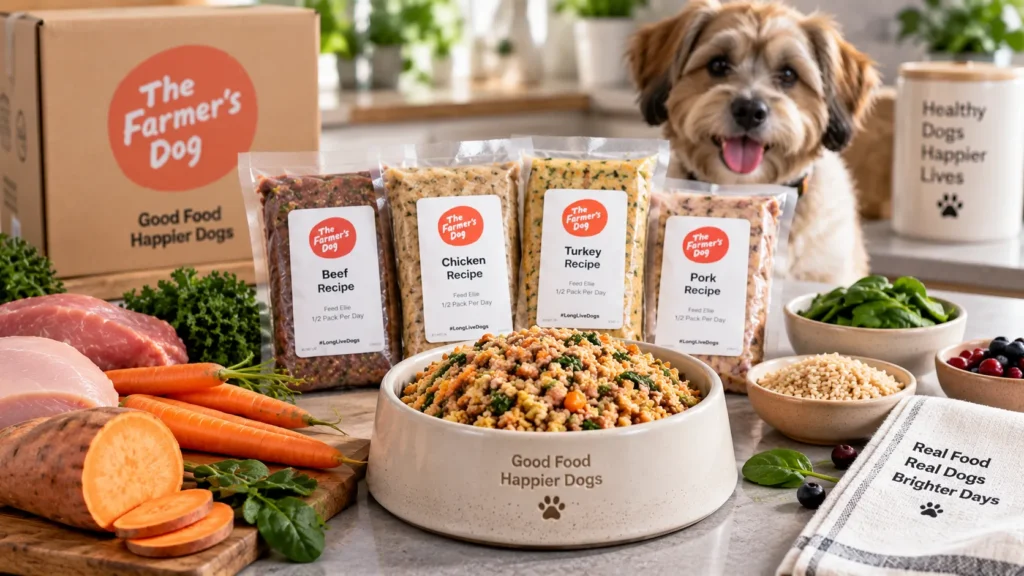
The Farmer’s Dog takes the opposite bet: fresh and human-grade, but gently cooked instead of raw. It’s made in USDA-approved facilities and formulated in-house by board-certified veterinary nutritionists, rather than outsourcing the work.
The company is headquartered in New York City and has grown into one of the most recognized names in the fresh-food subscription space, with national advertising and a customer base large enough to generate over 1,600 Trustpilot reviews on its own. It positions itself as a science-first alternative to kibble.
Recipes & Nutrition
Four proteins: turkey, beef, chicken, and pork. Both grain-inclusive and grain-free options are available, confirmed directly on the brand’s own site.
There’s no dedicated puppy formula, but beef is commonly recommended for growing dogs because of its higher protein content. Every recipe is formulated to meet AAFCO‘s complete-and-balanced standard for all life stages, including growth for large-size dogs over 70 lbs as adults. That’s a broader claim than most fresh-food competitors make.
Cost Per Day
Pricing is quiz-based, not published as a flat rate. But the pattern across independent trackers is consistent:
- A small dog runs closer to $2.60–$5 a day
- A 50 lb dog lands around $7.25–$8.00 a day, depending on protein choice
- One commonly cited example: an 11 lb Yorkshire terrier at about $2.80 a day, a 75 lb Labrador mix at roughly $10.39 a day
There’s also a DIY option: the Nutrient Blend. You supply and cook the protein and vegetables yourself, then add the brand’s premix. It runs closer to $1 a day for the blend portion alone. Nothing like that exists on the We Feed Raw side.
Safety, Trust & the Pending Lawsuit
The Farmer’s Dog has one credibility asset that stands out in this category: an active long-term feeding study partnership with Cornell University’s College of Veterinary Medicine, looking at whether fresh food supports healthier aging in dogs. That’s outcome data, not just formulation compliance. It’s a meaningful point of difference from a calculated-only AAFCO claim.
There’s also something you should know before switching, particularly if your dog has any history of pancreatitis or fat sensitivity.
In April 2026, a proposed class action was filed against the company: Trott v. The Farmer’s Dog, Inc., in the U.S. District Court for the Southern District of New York. It alleges the brand’s marketed fat content understates the actual fat levels in three of its four recipes, and that this creates an elevated pancreatitis risk.
These are allegations. The case hasn’t been decided, no class has been certified, and the company disputes the claims. There’s no FDA recall tied to this.
If your dog has a history of pancreatitis or a vet-managed low-fat diet, talk to your vet before switching to any fresh or raw food. Ask specifically about verified fat content for the recipe you’re considering. That applies whether you land on The Farmer’s Dog, We Feed Raw’s higher-fat recipes, or anything else in this category.
Where It Falls Short
Trustpilot paints a mixed picture: 3.9 out of 5 across 1,696 reviews, with 82% five-star and 9% one-star. That’s a wider spread than We Feed Raw’s numbers.
The positive reviews are warm, sometimes strikingly so. Multiple owners describe the company sending a plant or a handwritten note after a dog passed away.
But billing and cancellation complaints show up repeatedly and specifically: customers billed earlier than expected, charged after formally requesting cancellation, or caught in confusing multi-charge cycles. Delivery complaints cluster around one carrier in particular, OnTrac, with several reviewers describing missed or late deliveries that left their dog without food for days.
There’s a day-to-day logistics difference worth knowing about too: The Farmer’s Dog ships in larger, flexible tubes that take up continuous fridge space once opened, rather than individually thawed portions. That’s less freezer-dependent than We Feed Raw, but it also means less flexibility if your fridge space is already tight.
The Farmer’s Dog is the stronger case if cooked, vet-formulated food with documented longitudinal data behind it is what you’re after.
How to Transition Your Dog to Either Brand
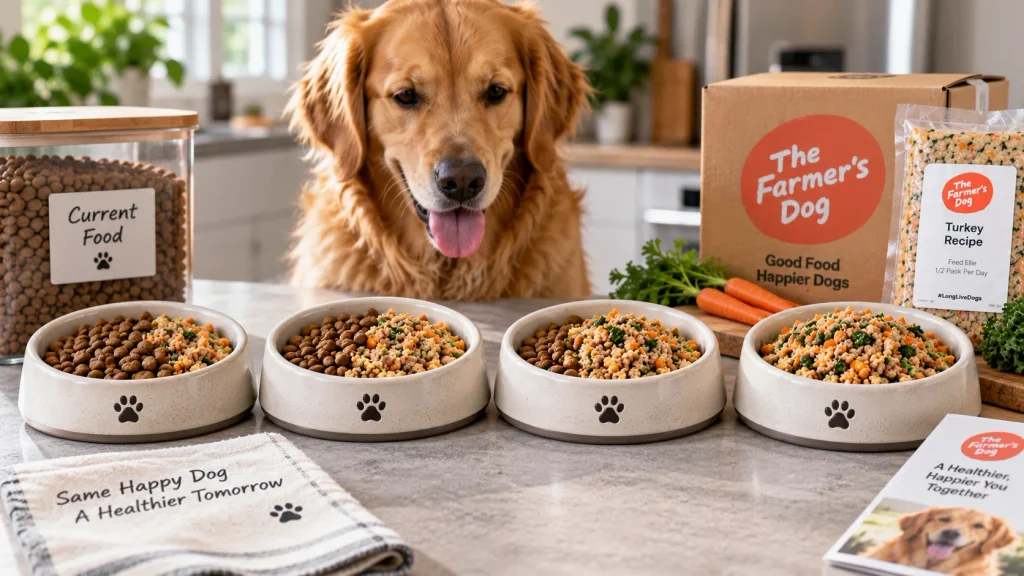
Don’t swap your dog’s food overnight. Fresh and raw diets are different enough from kibble that a fast switch commonly causes loose stools or vomiting, even in dogs that end up doing great long-term.
We Feed Raw publishes a specific protocol: 25% new food mixed with 75% old food for the first three days, a 50/50 split for days four through six, 75/25 for days seven through nine, and fully switched over from day ten on. For sensitive dogs, stretch each phase to five days instead of three.
The Farmer’s Dog doesn’t publish an equally detailed schedule, but the same gradual approach applies. Start with a small portion mixed into the current food and increase it over one to two weeks, watching stool quality as your guide.
Either way, if your dog has a sensitive stomach, a history of pancreatitis, or is currently on a prescription diet, talk to your vet before starting the transition, not after something goes wrong.
We Feed Raw vs The Farmer’s Dog: Side-by-Side Comparison
| We Feed Raw | The Farmer’s Dog | |
|---|---|---|
| Diet type | Raw (HPP) | Gently cooked |
| Recipes | 6 | 4 |
| AAFCO | All Life Stages (frozen) | All Life Stages, incl. large-breed growth |
| Outcome data | None published | Active Cornell feeding study |
| Price, 50 lb dog | ~$4.50–$5.00/day | ~$7.25–$8.00/day |
| DIY / lower-cost option | None | Nutrient Blend, ~$1/day |
| Trustpilot | 4.7/5, 2,113+ reviews | 3.9/5, 1,696 reviews |
| Recalls | None (as of Aug 2026) | None (lawsuit is separate from a recall) |
| Known risk | Subscription pause/cancel bug | Billing complaints; pending fat-content lawsuit |
How to Choose Between Them
Choose We Feed Raw If…
- You’re already committed to raw feeding, or you want to be. The low-carb, prey-model structure is built for that specifically.
- You’ve got a picky eater who’s turned up their nose at everything else. Picky-eater transformation is the single most consistent theme across We Feed Raw’s own reviews.
- Weight management is the goal. The turkey recipe’s 25% fat content is one of the lower-fat options in the raw category.
Choose The Farmer’s Dog If…
- You want cooked food specifically. Some owners are just more comfortable with that, and so are a lot of vets.
- You’re working with a small dog and a tighter budget. Entry-level pricing tends to run lower than We Feed Raw’s for a comparable size.
- Your dog has a history of pancreatitis, obesity, or any fat-sensitivity issue. This is exactly the point where a conversation with your vet matters more than anything either brand’s marketing says, whether you’re weighing the lawsuit allegations against The Farmer’s Dog or the naturally higher fat content in some of We Feed Raw’s own recipes, like duck.
One more scenario worth a vet check specifically: if you’re managing a confirmed food allergy and were hoping a “novel protein” recipe would solve it cleanly, run the exact ingredient list by your vet first. Both brands, and honestly most of the category, mix in secondary proteins that recipe names alone won’t tell you about.
Frequently Asked Questions
Is We Feed Raw or The Farmer’s Dog better for dogs?
Neither is universally better. It depends on whether your dog does well on raw or cooked food, and on your household’s ability to manage freezer space and raw-handling hygiene. We Feed Raw is the stronger fit for committed raw feeders and picky eaters. The Farmer’s Dog is the stronger fit for owners who want cooked food backed by outcome research.
Does either brand have puppy plans?
We Feed Raw’s frozen line, not the freeze-dried line, is AAFCO-formulated for all life stages, including puppies. The Farmer’s Dog doesn’t have a dedicated puppy formula, but its recipes meet AAFCO’s growth standard for large-breed puppies, and beef is the protein most commonly recommended for growing dogs. Talk to your vet before switching a growing puppy onto any new diet.
How does the quality actually compare?
Both use named, whole-meat protein as the primary ingredient and avoid by-product meal. The meaningful quality difference isn’t ingredient sourcing. It’s processing philosophy: raw and unheated versus cooked with added nutrients, plus the fact that The Farmer’s Dog has published, ongoing research behind its formulation in a way We Feed Raw currently doesn’t.
Which one is easier on digestion?
This varies by dog, and neither brand has published head-to-head digestion data. Anecdotally, both brands’ reviews mention firmer stools and improved digestion versus kibble. If your dog has an existing digestive condition, that’s a conversation for your vet rather than something to guess at from online reviews.
Which is cheaper, We Feed Raw or The Farmer’s Dog?
For a 50 lb dog, We Feed Raw typically runs less per day than The Farmer’s Dog. For smaller dogs, The Farmer’s Dog’s published low-end examples can actually come in lower. Both brands’ exact pricing is quiz-based and personalized, so the only way to get an exact number for your specific dog is to run each brand’s questionnaire.
Final Recommendation
There’s no single winner here. Any article that tells you otherwise is skipping the part where your dog’s actual needs matter more than a brand’s marketing budget.
If you’re set on raw feeding, want the lowest-carb option available, or you’re dealing with a dog that’s rejected everything else, We Feed Raw is the stronger case — and first orders currently get 50% off instantly, applied at checkout.
If you want cooked, vet-formulated food backed by ongoing research, and you’re comfortable factoring the pending lawsuit into your decision the way you’d factor in any pending litigation against any company, The Farmer’s Dog official website is worth the closer look.
Either way: if your dog has a history of pancreatitis, a diagnosed food allergy, or any other condition that makes diet changes higher-stakes, loop your vet in before you commit to a subscription. That’s not a disclaimer. It’s the actual right first step.