 Marco Williams

Choosing a food for a Golden Retriever isn’t really about finding the “best” bag on the shelf. It’s about deciding which of your dog’s known risk factors matters most right now.
More than half of pet Golden Retrievers are overweight or obese. Nearly a quarter show signs of hip dysplasia by the time they’re evaluated. Over half deal with skin issues or ear infections tied to their thick double coat. And Golden Retrievers show up specifically in the research behind one of the most talked-about pet food safety questions of the last decade: grain-free diets and heart disease. This list is organized around actual scenarios instead of a flat ranking — life stage, weight, joints, skin, and general maintenance.
- Breed-Specific Pick → Royal Canin Golden Retriever Adult — ~$2.09/day
- Puppies → Royal Canin Golden Retriever Puppy — ~$2.14/day
- Everyday Adult Formula → Purina Pro Plan Complete Essentials Chicken & Rice — ~$1.24/day
- Weight Management → Purina Pro Plan Weight Management Large Breed — ~$1.43/day
- Joint Support → Hill’s Science Diet Healthy Mobility Large Breed — ~$1.83/day
- Skin Allergies & Sensitive Stomach → Purina Pro Plan Sensitive Skin & Stomach Large Breed — ~$1.78/day
- Grain-Inclusive Alternative → Blue Buffalo Life Protection Formula Large Breed — ~$1.52/day
- Senior Goldens → Purina Pro Plan Large Breed Adult 7+ Senior — ~$1.31/day
What Golden Retrievers Actually Need From Their Food?

Generic “large breed” formulas aren’t wrong for a Golden, but they don’t account for the breed’s specific risk profile.
- Obesity is the #1 controllable risk. More than half of pet Golden Retrievers are overweight or obese. Excess weight accelerates joint deterioration and is linked to broader inflammation, a documented risk factor across chronic disease research.
- Hip and elbow dysplasia are common. OFA data shows roughly 19–24% of evaluated Golden Retrievers have abnormal or dysplastic hips. Genetics plays the largest role, but fast puppy growth and excess adult weight both make it worse.
- Skin and coat issues affect over half the breed. The dense double coat and a genetic predisposition to allergies mean skin conditions and ear infections are one of the most common reasons Golden owners end up at the vet.
- There’s a breed-specific heart consideration. Golden Retrievers have come up specifically in research on diet and heart health, covered in detail later in this article.
- Senior Goldens have different needs. Calorie needs typically drop, joint support becomes more important, and formulas built for adult maintenance aren’t always the right fit past age 7.
The 8 Best Dog Foods for Golden Retrievers

Best for: Golden Retrievers 15 months and older, general breed-specific maintenance.
Cost per day: $2.09 (1,000 kcal/day reference).
Royal Canin builds this formula around three things Golden Retrievers are known for: a straight muzzle that benefits from a specific kibble shape, a coat that needs skin-barrier support, and — per Royal Canin’s own product literature — a breed-level tendency toward “cardiac sensitivity.” The formula includes taurine, EPA, and DHA to support healthy cardiac function, along with calorie and fat levels calibrated for the breed’s weight tendency.
One thing to know before buying: the ingredient list opens with corn, chicken by-product meal, and wheat, not fresh chicken. That doesn’t make it a lower-quality food — by-product meal is a concentrated protein source, not filler — but if “real chicken first” matters to you, this isn’t that formula.
Why It Made the List?
- Formulated specifically for purebred Golden Retrievers 15 months and older, with taurine, EPA, and DHA for cardiac support
- Kibble shape and size engineered for the Golden Retriever’s straight muzzle and scissor bite
- Precise calorie and fat content designed for the breed’s known weight tendency
Key Specs
- 23% protein / 11% fat / 4.8% fiber (max) / 278 kcal per cup
- AAFCO: formulated to meet Dog Food Nutrient Profiles for adult maintenance
- First 5 ingredients: corn, chicken by-product meal, wheat, oat groats, brewers rice
Honest Take
- The only formula on this list engineered specifically around Golden Retriever cardiac, coat, and weight tendencies
- Not chicken-first — a good general pick, not a specialist pick for joints, skin, or weight
- Most common owner report: dogs maintain a healthy weight, coats stay shiny, and the food helps manage skin sensitivity.
- Most common complaint: price — repeatedly cited across Chewy and Walmart reviews as expensive relative to non-breed-specific alternatives.

Best for: Golden Retriever puppies, 8 weeks to 15 months.
Cost per day: $2.14 (1,000 kcal/day reference).
Large-breed puppies grow fast, and that speed raises the risk of developmental joint problems like hip dysplasia. This formula controls calcium and calorie density to slow the growth rate, rather than letting a fast-growing Golden puppy pack on weight faster than its joints can handle.
If your puppy is tracking above the typical weight curve for their age, talk to your vet about adjusting the growth rate. This is one of the few places where a small early correction meaningfully affects long-term joint health.
Why It Made the List?
- Controlled calcium and calorie density to slow large-breed growth rate and reduce developmental joint risk
- EPA and DHA included for skin barrier support and coat development
- Breed-specific kibble shape designed for a Golden puppy’s straight muzzle and scissor bite
Key Specs
- 27% protein / 14% fat / 5.9% fiber (max) / 339 kcal per cup
- AAFCO: formulated to meet Dog Food Nutrient Profiles for growth, including growth of large-size dogs (70 lb+)
- First 5 ingredients: chicken by-product meal, corn, chicken fat, wheat, brewers rice
Honest Take
- Same by-product-meal-first ingredient profile as the adult formula — solid nutrition, not a premium-ingredient story
- Strong choice if you specifically want breed-matched growth control rather than a generic large-breed puppy formula
- Most common owner report: steady, controlled growth with regular stools and improved coat shine.
- Most common complaint: price — reviewers consistently describe it as “pricey compared to other brands.”

Best for: Healthy adult Goldens with no specific dietary concerns.
Cost per day: $1.24 (1,000 kcal/day reference).
If your Golden has no specific issue to manage — no joint pain, no skin flare-ups, no weight problem — this is a reasonable default. Real chicken is confirmed as the actual first ingredient here, unlike the Royal Canin formulas above, and it includes glucosamine and EPA as baseline joint support even without a dedicated “joint formula” label.
It’s also fortified with live probiotics for digestive health, useful given how food-motivated this breed tends to be and how often that shows up as digestive sensitivity.
Why It Made the List?
- Real chicken confirmed as the first ingredient, with guaranteed live probiotics for digestive health
- AAFCO feeding-trial substantiated for all life stages, including growth of large-size dogs
- Lowest cost-per-day of all 8 products on this list
Key Specs
- 26% protein / 16% fat / 3% fiber (max) / 369 kcal per cup
- AAFCO: feeding-trial substantiated for all life stages, including large-breed growth (70 lb+)
- First 5 ingredients: chicken, rice, whole grain wheat, poultry by-product meal, whole grain corn
Honest Take
- A dependable general-purpose formula — not specialized for any of the breed’s specific risk areas
- Strong value baseline if your dog has no diagnosed issue yet
- Most common owner report: firm stools, no belly upset, and dogs across multiple breeds do well long-term.
- Most common complaint: occasional bags arrive with more crumbled kibble than expected, per repeated Chewy reviews.

Best for: Overweight or less active adult Golden Retrievers over 50 lbs.
Cost per day: $1.43 (1,000 kcal/day reference).
Obesity is the single biggest controllable health risk for this breed, which makes this arguably the most consequential pick on the list for a lot of Golden owners. Many don’t realize their dog is overweight until a vet points it out.
This formula contains 15% less fat than Purina’s standard Complete Essentials large-breed formula, with a protein-to-fat ratio designed to help dogs maintain lean muscle mass while losing weight, rather than just cutting calories across the board.
Why It Made the List?
- 15% less fat than Pro Plan’s standard Complete Essentials large-breed formula
- Optimized protein-to-fat ratio (27% protein / 9.5% fat) to preserve lean muscle during weight loss
- Formulated specifically for large-breed dogs over 50 lbs who are overweight or less active
Key Specs
- 27% protein / 9.5% fat / 355 kcal per cup
- AAFCO: feeding-trial substantiated for adult maintenance
- First 5 ingredients: chicken, rice, whole grain wheat, poultry by-product meal, corn protein meal
Honest Take
- A real weight-management formula, not just a marketing label
- Portion control still matters more than the formula alone — see the feeding guide later in this article
- Most common owner report: measurable weight loss over several months without dogs seeming excessively hungry.
- Most common complaint: price — reviewers note it’s “more expensive than grocery-store options,” though most feel the results justify the cost.

Best for: Adult Golden Retrievers showing early joint stiffness or at higher dysplasia risk.
Cost per day: $1.83 (1,000 kcal/day reference).
Hip and elbow dysplasia are common enough in this breed that a joint-focused formula earns its place on this list. Hill’s uses EPA from fish oil alongside natural sources of glucosamine and chondroitin, the building blocks cartilage needs, and states this formula is shown to improve mobility within 30 days.
Hill’s describes itself as the “#1 Veterinarian Recommended” brand. That’s Hill’s own claim about the brand overall, not something Dog Food Insights is asserting about this specific formula.
Why It Made the List?
- EPA from fish oil plus natural glucosamine and chondroitin for joint cartilage support
- Formulated specifically for large dogs (55–110 lbs), directly addressing the breed’s high dysplasia rate
- Manufacturer states improved mobility shown within 30 days of feeding
Key Specs
- 22.4% protein / 14.7% fat / 2.4% fiber (dry matter basis) / 359 kcal per cup
- AAFCO: feeding-trial substantiated for adult maintenance, large and giant breed
- First 5 ingredients: chicken meal, brewers rice, whole grain sorghum, brown rice, whole grain wheat
Honest Take
- Chicken meal, not fresh chicken, leads the ingredient list — accurate, but worth knowing if ingredient order matters to you
- A strong preventive choice even before joint issues become visible, given the breed’s dysplasia rate
- Most common owner report: improved energy and mobility in senior and active large dogs.
- Most common complaint: occasional reports of digestive upset during transition, noted in Chewy’s own product Q&A.

Best for: Golden Retrievers with skin allergies, itching, or sensitive digestion.
Cost per day: $1.78 (1,000 kcal/day reference).
Skin issues affect over half of Golden Retrievers, which makes this one of the more editorially justified picks on the list rather than a slot filled to round out the category. Real salmon is the confirmed first ingredient, the formula is free of corn, wheat, and soy, and it includes omega-6 fatty acids for skin and coat support alongside easily digestible oat meal for sensitive stomachs.
It also includes glucosamine and EPA, so it doubles as a mild joint-support option — useful if your Golden has both a skin sensitivity and early joint concerns.
Why It Made the List?
- Real salmon confirmed as the first ingredient, with no corn, wheat, or soy
- Omega-6 fatty acids for skin and coat health, plus easily digestible oat meal for sensitive stomachs
- Directly targets the breed’s most common non-orthopedic health complaint
Key Specs
- 26% protein / 12% fat / 4.5% fiber (max) / 404 kcal per cup
- AAFCO: feeding-trial substantiated for adult maintenance
- First 5 ingredients: salmon, rice, barley, oat meal, fish meal
Honest Take
- The highest calorie density per cup on this list — portion carefully if weight is also a concern
- Doubles as a mild joint-support option thanks to added glucosamine and EPA
- Most common owner report: noticeable improvement in itching and stool quality within a few weeks of switching.
- Most common complaint: occasional kibble texture inconsistency between bags, alongside a higher price point than Purina’s non-specialized formulas.

Best for: Owners wanting a different formulation philosophy from Purina or Hill’s.
Cost per day: $1.52 (1,000 kcal/day reference).
For a different brand philosophy from the Purina and Hill’s formulas above, Blue Buffalo’s Life Protection Formula is a reasonable alternative. Real deboned chicken is confirmed as the first ingredient, and it includes both glucosamine and chondroitin for joint support, along with the brand’s proprietary LifeSource Bits antioxidant blend.
This is also a grain-inclusive formula, which leads naturally into the next section: a factual look at grain-free diets and heart health in Golden Retrievers specifically. Choosing a grain-inclusive formula like this one is not a claim or guarantee about heart health outcomes.
Why It Made the List?
- Real deboned chicken confirmed as the first ingredient, with no poultry by-product meals, corn, wheat, or soy
- Glucosamine and chondroitin for joint support, plus proprietary LifeSource Bits antioxidant blend
- Distinct brand formulation approach for owners comparing against the Purina/Hill’s lines above
Key Specs
- 22% protein (min) / 12% fat (min) / 6% fiber (max) / 355 kcal per cup
- AAFCO: formulated to meet Dog Food Nutrient Profiles for adult maintenance
- First 5 ingredients: deboned chicken, chicken meal, brown rice, oatmeal, barley
Honest Take
- A well-regarded alternative brand, not a “safer” choice than the others on this list for heart health
- See the grain-free/DCM section below before assuming grain-inclusive automatically means better heart health
- Most common owner report: good coat condition and steady weight on this formula.
- Most common complaint: independent lab testing has flagged inconsistent kibble grinding in some batches, per third-party review sources.

Best for: Golden Retrievers age 7 and older.
Cost per day: $1.31 (1,000 kcal/day reference).
Golden Retrievers age into different nutritional needs — typically lower calorie requirements and a greater need for joint support — and this formula is built for that. It includes glucosamine and EPA for joint health, omega-6 and vitamin A for skin and coat, and high-quality protein to help maintain lean muscle, including cardiac muscle, as dogs age.
One honest note: this specific Amazon listing has far fewer reviews (94) than the other seven picks on this list. The same formula sold in other sizes and through other retailers has a much larger review base — over 3,000 combined across Walmart’s 18 lb and 34 lb listings — with generally positive feedback on stool quality and coat condition, and price as the most commonly cited drawback, consistent with the rest of the Pro Plan lineup.
Why It Made the List?
- The only dedicated senior large-breed formula on this list
- Glucosamine and EPA for joint health, directly addressing age-related mobility decline
- High-quality protein aimed at maintaining lean muscle, including cardiac muscle, in aging dogs
Key Specs
- 29% protein / 13% fat / 3% fiber (max) / 374 kcal per cup
- AAFCO: feeding-trial substantiated for adult maintenance, 7+ senior formulation
- First 5 ingredients: chicken, rice, poultry by-product meal, corn protein meal, soybean meal
Honest Take
- Strong formulation on paper, with the same substantiation and specs as Purina’s well-reviewed adult lines
- This particular Amazon listing is newer and lower-volume — worth watching how it performs as more reviews accumulate here specifically
- Most common owner report: firm stools and better joint mobility reported across the broader Pro Plan 7+ Shredded Blend line.
- Most common complaint: price, consistent with the rest of the Pro Plan Specialized range.
How Much Should You Feed Your Golden Retriever?
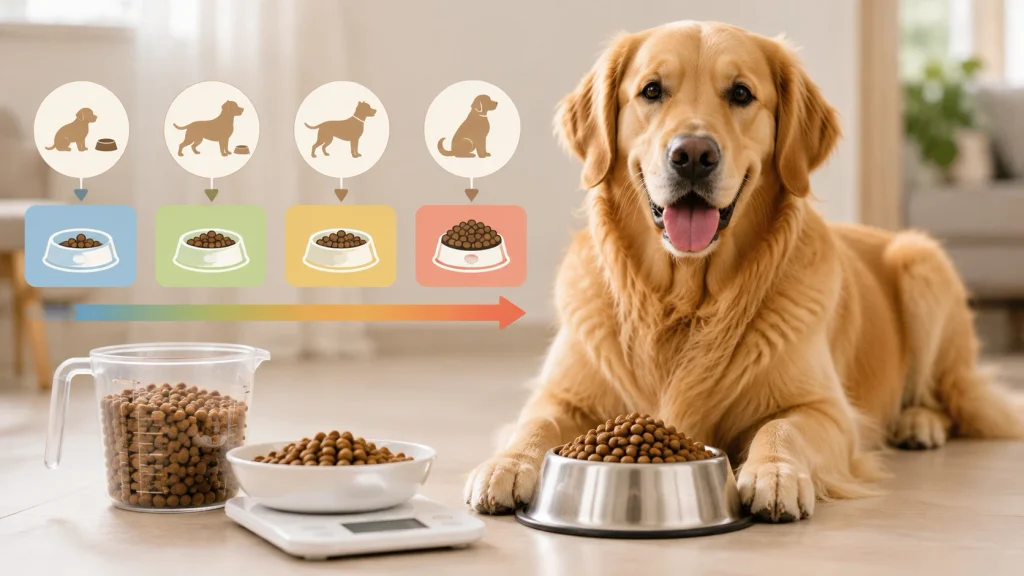
Picking the right food only solves half the obesity problem. The other half is portion size, and this is where well-intentioned Golden owners often go wrong, since this breed is notoriously food-motivated and rarely self-regulates.
As a general guide, a moderately active adult Golden Retriever weighing 55–75 lbs typically needs somewhere in the 1,100–1,450 kcal per day range, depending on activity level, age, and whether the dog is spayed or neutered, which generally lowers calorie needs somewhat. This is a starting point, not a prescription. Consult your vet if your dog has unusually high activity levels, is a working dog, or is recovering from illness.
Using that range, here’s roughly how many cups per day that translates to for each product on this list, at three reference weights:
| Product | Kcal/cup | ~55 lb Golden | ~65 lb Golden | ~75 lb Golden |
|---|---|---|---|---|
| Royal Canin GR Adult | 278 | 4.0 cups | 4.5 cups | 5.0 cups |
| Purina Pro Plan Complete Essentials | 369 | 3.0 cups | 3.4 cups | 3.8 cups |
| Purina Pro Plan Weight Management LB | 355 | 3.1 cups | 3.5 cups | 3.9 cups |
| Hill’s Healthy Mobility LB | 359 | 3.1 cups | 3.5 cups | 3.9 cups |
| Purina Pro Plan Sensitive Skin & Stomach | 404 | 2.7 cups | 3.1 cups | 3.4 cups |
| Blue Buffalo LPF Large Breed Adult | 355 | 3.1 cups | 3.6 cups | 3.9 cups |
| Purina Pro Plan Senior 7+ LB | 374 | 3.0 cups | 3.3 cups | 3.7 cups |
Based on a 1,275 kcal/day midpoint estimate. Adjust up or down based on your dog’s actual activity level and body condition.
These are starting points, not fixed rules. The most reliable way to check if you’re feeding the right amount is the same one vets use: you should be able to feel your Golden’s ribs with light pressure, and see a visible waist when looking down at them from above. If you can’t do either, adjust portions or talk to your vet, regardless of which food you’re feeding.
How We Chose These 8 Foods?
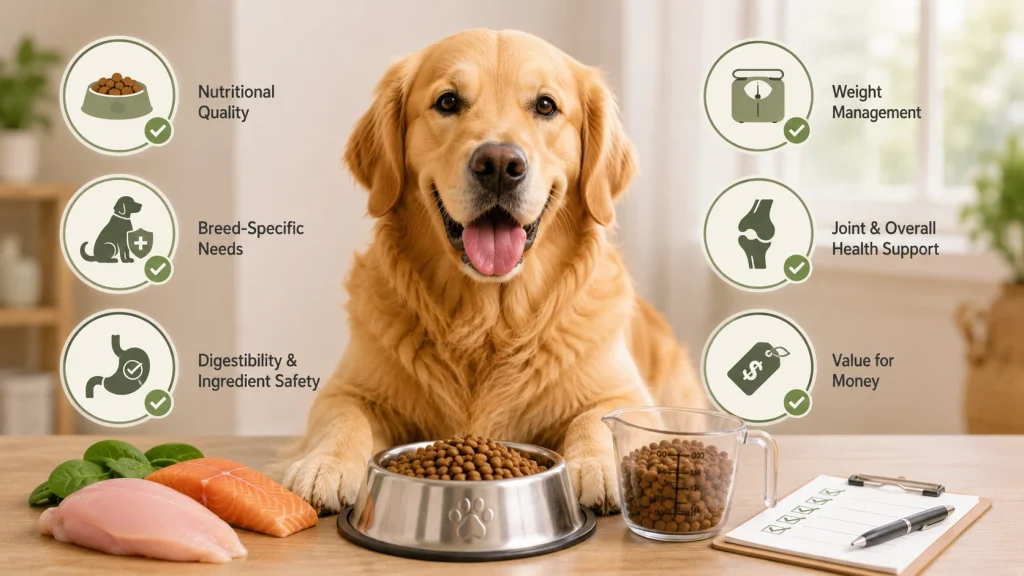
Every product on this list was evaluated using AAFCO substantiation statements (feeding-trial tested or formulated to meet nutrient profiles), standardized cost-per-day calculations using a consistent 1,000 kcal/day reference, Amazon-verified current pricing and ratings, and a direct check against the FDA’s pet food recall database. None of these eight products currently appear on it.
Golden Retriever Dog Food Comparison Table
| Product | Best For | Price | Kcal/cup | AAFCO Life Stage | Rating |
|---|---|---|---|---|---|
| Royal Canin Golden Retriever Adult | Breed-specific | $99.99 | 278 | Adult maintenance | 4.6 (1,656) |
| Royal Canin Golden Retriever Puppy | Puppies | $104.99 | 339 | Growth (large breed) | 4.6 (1,058) |
| Purina Pro Plan Complete Essentials | Everyday adult | $74.48 | 369 | All life stages | 4.6 (16,948) |
| Purina Pro Plan Weight Management LB | Weight management | $77.48 | 355 | Adult maintenance | 4.7 (1,978) |
| Hill’s Healthy Mobility LB | Joint support | $89.99 | 359 | Adult maintenance | 4.7 (2,661) |
| Purina Pro Plan Sensitive Skin & Stomach | Skin & stomach | $97.98 | 404 | Adult maintenance | 4.6 (3,837) |
| Blue Buffalo LPF Large Breed Adult | Alternative brand | $72.97 | 355 | Adult maintenance | 4.7 (4,105) |
| Purina Pro Plan Senior 7+ LB | Senior Goldens | $77.48 | 374 | Senior (7+) | 4.5 (94) |
A Golden Retriever–Specific Note on Grain-Free Diets and Heart Health
Golden Retrievers specifically, not just large breeds in general, came up in the research behind one of the most significant pet food safety investigations of the past decade, so this is worth addressing directly.
In 2018, the FDA began investigating a potential link between grain-free diets and a heart condition called dilated cardiomyopathy (DCM) in dogs. Part of what triggered that investigation was a cardiologist at UC Davis observing a cluster of Golden Retrievers with DCM, low taurine levels, and grain-free diets in common.
Here’s the current picture, based directly on FDA’s published statements: the FDA has not established that grain-free diets cause DCM. The agency stopped publicly updating its list of implicated brands, partly because many companies changed their formulations since the original alert. More recent veterinary research points toward legume- and pea-heavy formulations broadly, a category that includes both grain-free and some grain-inclusive foods, rather than the absence of grain itself being the issue.
In practical terms: switching a healthy Golden Retriever off grain-free food isn’t necessarily “the fix,” and choosing a grain-inclusive formula isn’t automatically the safer choice. Neither claim is well-supported by current evidence. If your Golden Retriever is currently on a grain-free diet and doing well, this isn’t a reason to switch foods out of caution alone.
That said, if your Golden Retriever shows any of the following, consult your vet before making any diet changes on your own: exercise intolerance, coughing at rest, fainting, or noticeably labored breathing. These can be symptoms of DCM or other cardiac issues. Diet-related DCM has been shown in research to sometimes improve if caught early and managed with a vet’s guidance, but changing food alone isn’t a substitute for that guidance.
None of the products listed in this article claim to prevent or treat DCM, and no such claim should be inferred from their inclusion here.
Cost Per Day: What You’re Actually Paying?
Bag price alone doesn’t tell you the real cost of feeding a large dog. A cheaper bag with lower calorie density can cost more per day than a pricier bag that’s more calorie-dense. Using a standardized 1,000 kcal/day reference, roughly what a moderately active 50 lb adult dog needs, here’s how these eight products actually compare:
| Product | Cost per 1,000 kcal/day |
|---|---|
| Purina Pro Plan Complete Essentials | $1.24 |
| Purina Pro Plan Senior 7+ LB | $1.31 |
| Purina Pro Plan Weight Management LB | $1.43 |
| Blue Buffalo LPF Large Breed Adult | $1.52 |
| Purina Pro Plan Sensitive Skin & Stomach | $1.78 |
| Hill’s Healthy Mobility LB | $1.83 |
| Royal Canin GR Adult | $2.09 |
| Royal Canin GR Puppy | $2.14 |
The breed-specific Royal Canin formulas are the most expensive per day. That’s the tradeoff for the tailored formulation. The Purina Pro Plan large-breed line consistently offers the best value per calorie across this list.
Transitioning Your Golden Retriever to a New Food
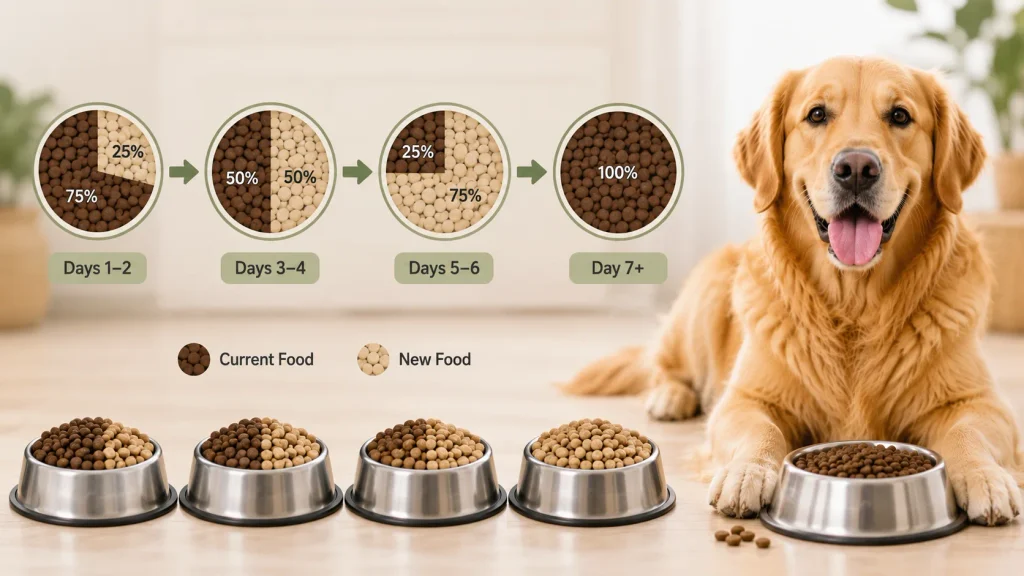
Switch gradually, regardless of which food you choose. Golden Retrievers can be prone to digestive upset with abrupt diet changes, which matters given how many of the picks above involve skin or stomach sensitivity.
A standard 7-day transition:
- Days 1–2: 75% old food, 25% new food
- Days 3–4: 50% old food, 50% new food
- Days 5–6: 25% old food, 75% new food
- Day 7: 100% new food
Watch for loose stool, vomiting, or unusual lethargy during the transition. If any of that shows up, slow the transition down rather than pushing through it.
Frequently Asked Questions
What is the best dog food for a Golden Retriever puppy?
A large-breed puppy formula with controlled calcium and calorie density, like Royal Canin Golden Retriever Puppy, helps manage the breed’s fast growth rate and reduces developmental joint risk. Consult your vet if your puppy is tracking above the typical weight curve for their age.
Should Golden Retrievers eat large-breed formulas?
Yes. Adult Golden Retrievers typically weigh 55–75 lbs, which puts them squarely in large-breed territory. Formulas built for this size category account for joint support and calorie density more appropriately than generic adult formulas.
Is grain-free food bad for Golden Retrievers?
Not definitively. The FDA has not established that grain-free diets cause heart disease in dogs. Golden Retrievers were part of the original research that raised the question, so it’s worth being informed, but current evidence doesn’t support automatically avoiding grain-free food. Consult your vet if your dog shows any signs of exercise intolerance, coughing, or fainting.
How much should an adult Golden Retriever eat per day?
Roughly 1,100–1,450 kcal per day for a moderately active adult Golden weighing 55–75 lbs, adjusted for activity level and whether the dog is spayed or neutered. See the feeding chart above for cup-based amounts by product.
What food helps with Golden Retriever skin allergies?
Formulas with a single novel protein source, no corn, wheat, or soy, and added omega fatty acids, like Purina Pro Plan Sensitive Skin & Stomach Large Breed, are typically the best starting point for skin-related sensitivities. Consult your vet if symptoms persist after a food change.
When should a Golden Retriever switch from puppy to adult food?
Most Golden Retrievers transition between 12 and 15 months, though your vet may adjust this based on your dog’s individual growth and body condition.
When should a Golden Retriever switch to a senior formula?
Around age 7, most Golden Retrievers benefit from switching to a senior formula with adjusted calorie density and added joint support, though this varies based on individual health and activity level.
Final Recommendation
There isn’t one “best” dog food for every Golden Retriever, because the breed’s real risks — obesity, joint disease, skin sensitivity, and age-related change — don’t all show up in the same dog at the same time.
If your Golden is healthy with no specific concerns, Purina Pro Plan Complete Essentials Chicken & Rice is a dependable, well-priced everyday choice. If weight is the concern, and for more than half of this breed it eventually is, Purina Pro Plan Weight Management Large Breed addresses that directly. For joint support, sensitive skin, puppy growth, or senior life stage, the scenario-specific picks above are built around exactly those needs.
Whichever you choose, portion control and a gradual transition matter just as much as the formula itself, especially for a breed this prone to overeating.