 Marco Williams
Rawhide has been the default dog chew for decades. It’s cheap, it’s everywhere, and most owners grew up giving it to their dogs without a second thought.
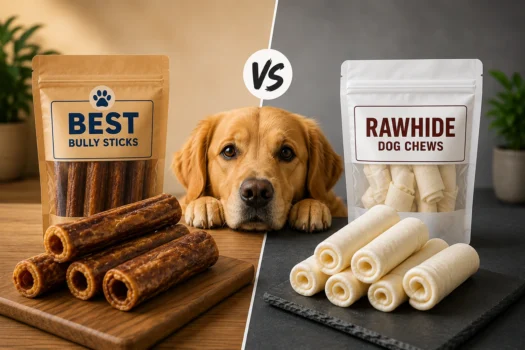
Bully sticks cost more, sometimes a lot more. They’re marketed as the safer choice, and that claim shows up on nearly every pet store shelf and pet blog today. So which one actually deserves your money? We looked at the safety data, the FDA recall history for both categories, and real Amazon pricing to find out. Here’s what the evidence shows, not just which chew is more popular right now.
- Best Overall / Everyday Chewer → Best Bully Sticks 6 Inch (25 Count) — ~$0.50–$1.00/day
- Best Budget / Bulk Rawhide → Dingo Twist Sticks (50 Count) — ~$0.59–$1.18/day
What Are Bully Sticks?
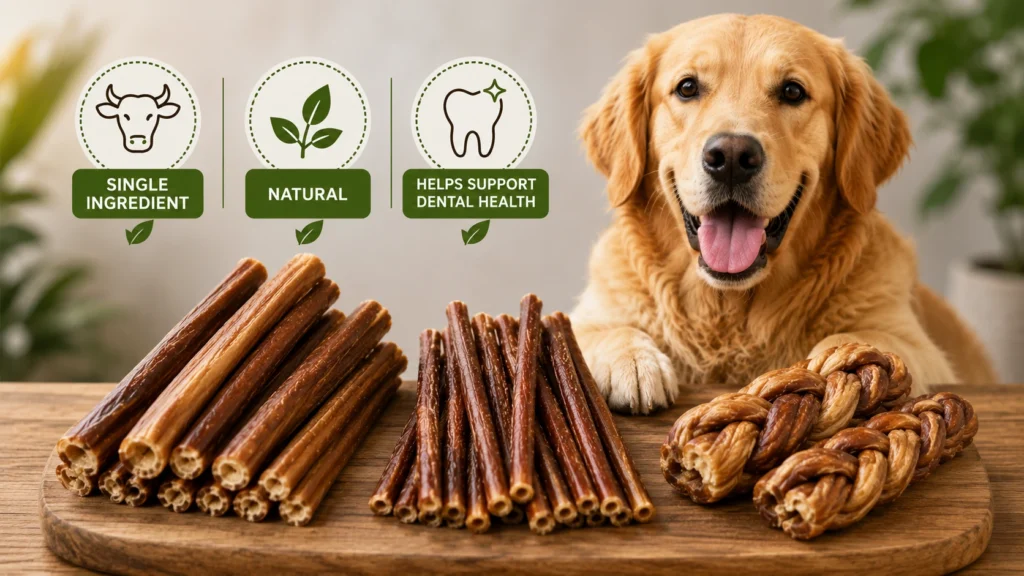
Bully sticks are made from dried bull pizzle, a single cut of muscle tissue rather than a hide byproduct. That distinction is the core reason their safety profile differs so much from rawhide’s.
They come in a few standard formats:
- Standard sticks — straight, single pieces in various lengths
- Thin sticks — narrower diameter, made for small dogs, seniors, or gentle chewers
- Thick or braided sticks — multiple pieces twisted together for extra durability, made for power chewers
Because they’re a single natural ingredient, quality bully sticks don’t need chemical processing to hold their shape or texture. What’s on the label is largely what’s in the stick.
What Is Rawhide?
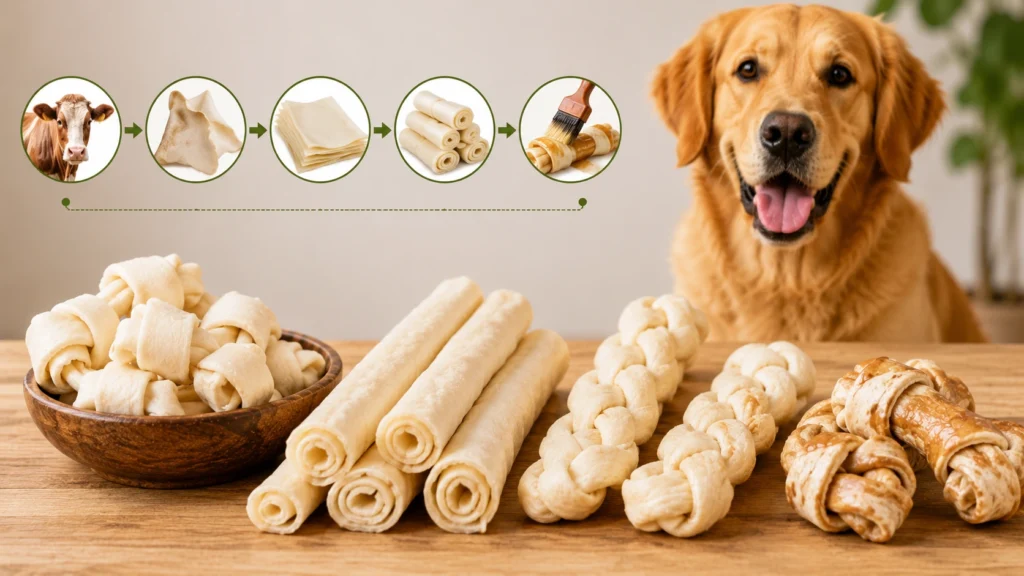
Rawhide comes from a different source entirely. It’s made from the inner layer of cattle (or occasionally horse) hide, a byproduct of the leather industry rather than a food-grade cut of meat.
Manufacturing typically involves:
- Cleaning and de-hairing the hide
- Lime baths and bleaching to prepare the material
- Cutting, rolling, pressing, or braiding into the final shape
- Basting or coating with flavor, such as peanut butter, chicken, or beef
You’ll also see the term beefhide on some packaging. That’s not a different product — it’s rawhide specifically sourced from cattle hide, as opposed to other animals. Amazon itself files beefhide products under its “Rawhide” category. For this comparison, beefhide and rawhide are treated as the same thing.
Top Picks: Bully Sticks & Rawhide by Category
No single bully stick or rawhide product fits every dog. Size, chewing style, and age all change what “safe” looks like. We grouped our picks below by the dog each one is built for. The safety reasoning behind these size recommendations follows in the next section.
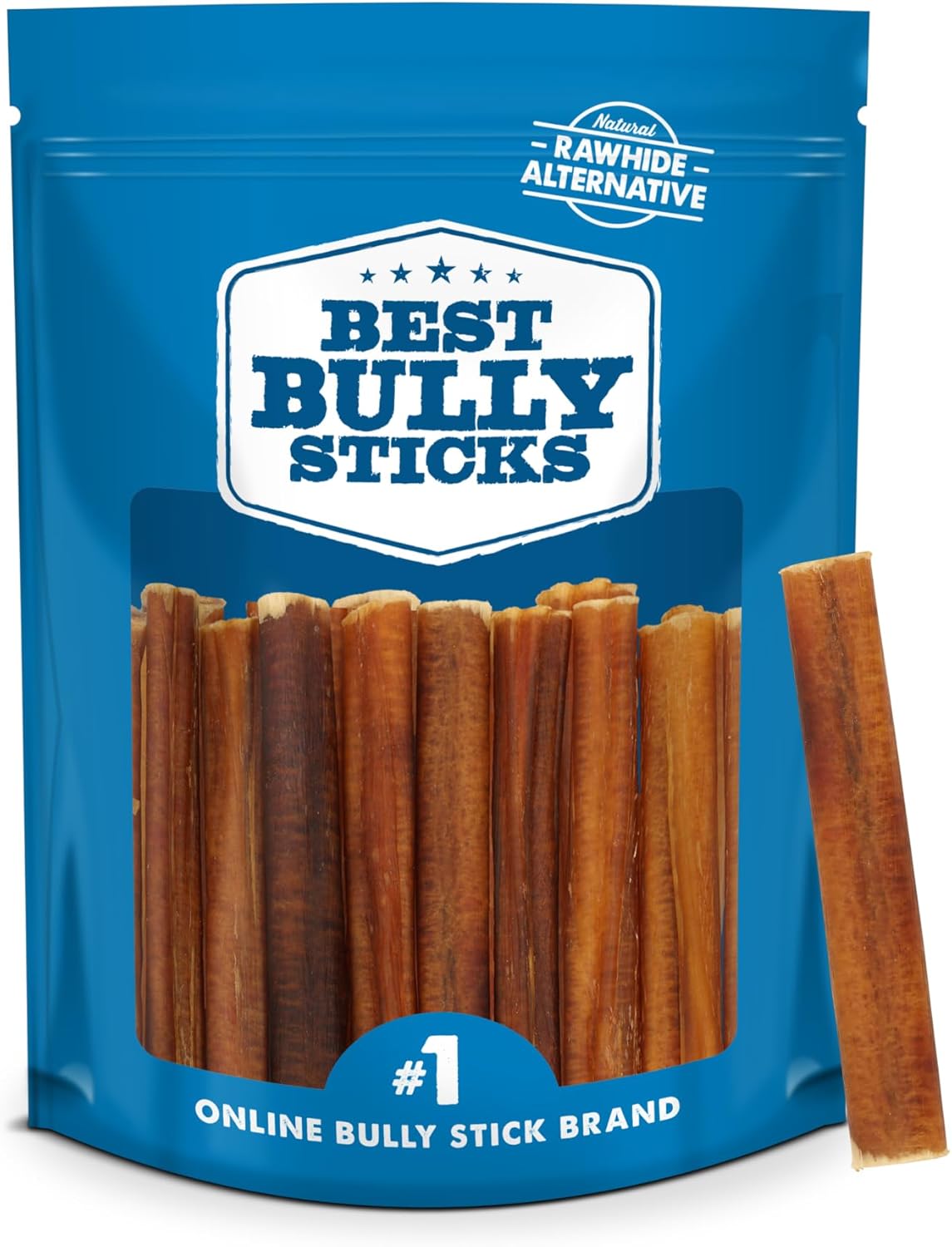
Best For: Puppies and small-breed dogs under 20 lbs.
Cost Per Day: $25.99 per bag ($51.98/lb) — runs higher per ounce, but a 4-inch stick is sized for shorter, lighter sessions, so it stretches further per dog than the price-per-pound suggests.
Why It Made the List?
- Single-ingredient formula — Natural Beef Pizzle, no additives
- 4-inch length sized specifically for small mouths and puppies
- Amazon’s Choice badge with 13,490+ reviews at a 4.2-star average
Key Specs
- Protein (min) 72%, Fat (min) 1%, Fiber (max) 3%, Moisture (max) 12%, 3,300 kcal/kg
- Not AAFCO life-stage regulated — treats fall outside AAFCO‘s complete-and-balanced feeding trial requirements; brand lists “All Life Stages” suitability
- Ingredients: Natural Beef Pizzle (single ingredient). Country of Origin: Brazil
Honest Take
- A genuinely simple product — one ingredient, sized correctly for small mouths
- Main tradeoff is cost per ounce compared to the larger sizes in this lineup
- Most common owner report: good starter size for puppies and small dogs.
- Most common complaint: natural scent is noticeable — consistent with broader Best Bully Sticks feedback that the sticks aren’t completely odor-free.

Best For: Small to medium dogs, everyday chewing.
Cost Per Day: $73.49 for 25 sticks ($2.94/stick) — a moderate chewer working through one stick every few days lands well under $1 a day.
Why It Made the List?
- Same single-ingredient formula as the 4-inch option, in the most versatile size
- 25-count bag lowers per-stick cost versus smaller pack sizes
- Amazon’s Choice badge with 7,764 reviews
Key Specs
- Protein (min) 72%, Fat (min) 1%, Fiber (max) 3%, Moisture (max) 12%, 3,300 kcal/kg
- Not AAFCO life-stage regulated; brand lists “All Life Stages” suitability
- Ingredients: Natural Beef Pizzle (single ingredient). Country of Origin: Brazil
Honest Take
- Best value in the lineup for a dog that goes through sticks regularly
- 4.0-star average is the lowest of the four Best Bully Sticks products in this comparison
- Most common owner report: good everyday dental chew.
- Most common complaint: some size and thickness variability reported across orders, a pattern noted on other sizes in this product line as well.

Best For: Medium to large dogs, aggressive or determined chewers.
Cost Per Day: $62.99 for 10 sticks ($6.30/stick) — higher per-stick cost, but a 12-inch stick can occupy a large dog for an hour or more per session, often across multiple sittings.
Why It Made the List?
- Length and thickness built for dogs that finish a 6-inch stick too quickly to be safe
- Same single-ingredient formula and guaranteed analysis as the 6-inch line
- 4.2-star average across 2,719 reviews
Key Specs
- Protein (min) 72%, Fat (min) 1%, Fiber (max) 3%, Moisture (max) 12%, 3,300 kcal/kg
- Not AAFCO life-stage regulated; brand lists “All Life Stages” suitability
- Ingredients: Natural Beef Pizzle (single ingredient). Country of Origin: Brazil
Honest Take
- No Amazon’s Choice badge on this listing, unlike the other three Best Bully Sticks products here
- Best fit specifically for dogs that need length and thickness, not just a bigger bag
- Most common owner report: high quality and good value for the price.
- Most common complaint: mixed feedback on thickness — some find them nicely thick, others say too thin for larger dogs.

Best For: Senior dogs, dogs with dental sensitivity, gentle chewers.
Cost Per Day: $39.99 for 24 sticks ($1.67/stick) — the thin profile means less resistance per bite, which matters for dogs with weaker jaws or fewer teeth.
Why It Made the List?
- Purpose-built thin profile, not just a smaller version of the standard stick
- Amazon’s Choice badge with 4,863 reviews and 2K+ bought in past month
- Same single-ingredient, additive-free formula as the rest of the line
Key Specs
- Guaranteed analysis not listed on this specific variant’s Amazon page
- Not AAFCO life-stage regulated; brand lists “All Life Stages” suitability
- Ingredients: Natural Beef Pizzle (single ingredient). Country of Origin: Brazil, made in FDA-approved facilities
Honest Take
- A more appropriate choice for aging dogs than simply buying a smaller size of the standard stick
- Listing explicitly targets senior dogs and sensitive chewers, not just small breeds
- Most common owner report: gentle option, positioned by the brand for senior dogs and sensitive chewers.
- Most common complaint: natural scent, the same odor feedback seen across this product line.
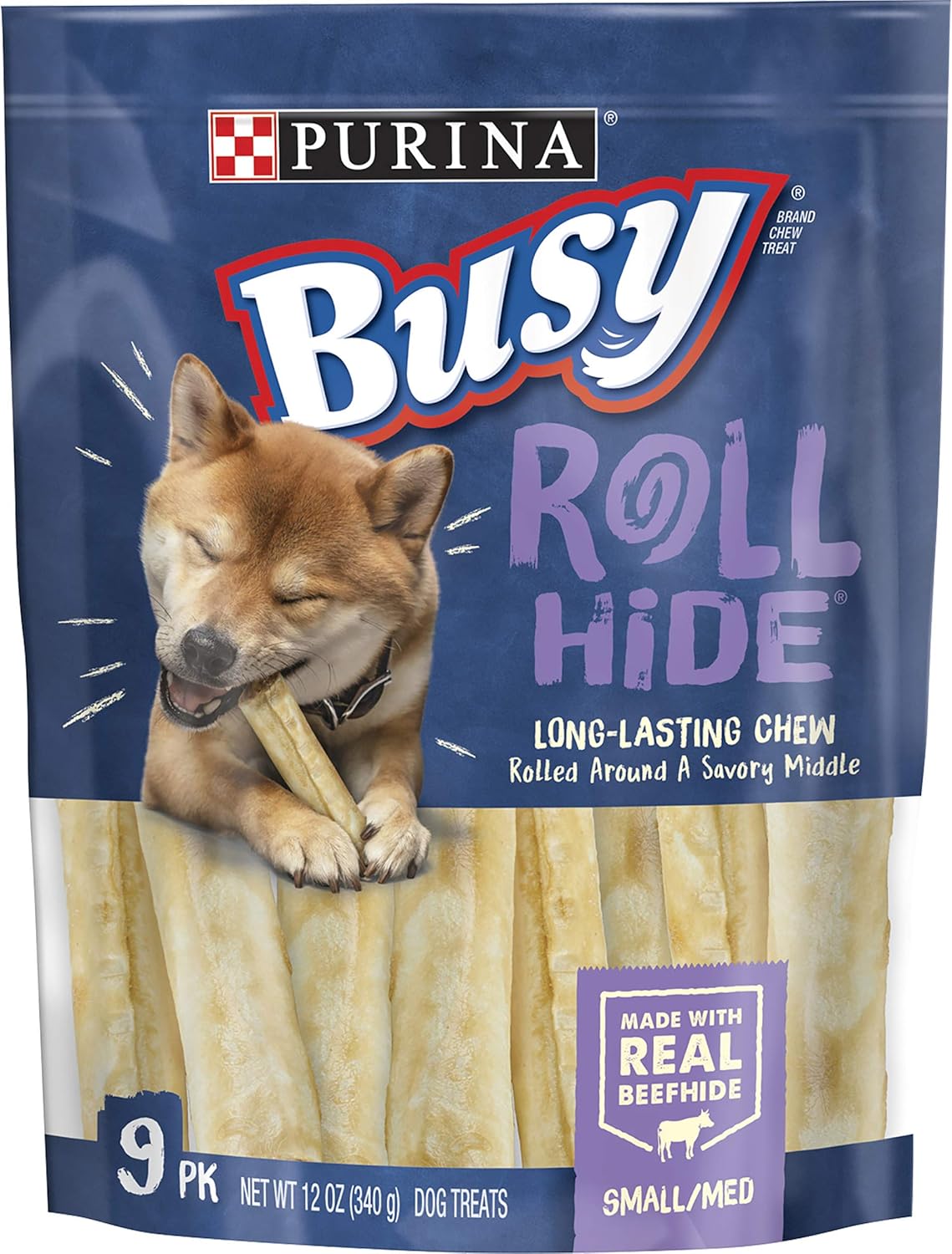
Best For: Small to medium dogs, owners who want a widely available, recognizable brand.
Cost Per Day: $9.48 for 9 pieces ($1.05/piece) — meaningfully cheaper per unit than any bully stick option in this comparison.
Why It Made the List?
- Backed by a major, long-established brand with consistent manufacturing standards
- 4.6-star average across 9,695 reviews, 8K+ bought in past month
- Amazon’s Choice badge
Key Specs
- Crude Protein (min) 20.0%, Crude Fat (min) 1.0%, Crude Fiber (max) 2.5%, Moisture (max) 15.0%
- Not AAFCO life-stage regulated; brand lists “Adult” suitability
- Ingredients: Beefhide, maltodextrins, rye flour, sugar, wheat flour
Honest Take
- Lower price comes with a longer ingredient list than any bully stick on this page
- Contains added sugar and three separate preservatives — worth knowing before comparing on cost alone
- Most common owner report: keeps dogs occupied for extended periods without digestive issues.
- Most common complaint: dogs chew it to a small nub and stash the remaining piece rather than finishing it.

Best For: Small dogs, dogs that prefer a flavored or meat-wrapped chew.
Cost Per Day: $9.19 for 10 pieces ($0.92/piece) — the lowest per-unit cost among the small-dog options in this comparison.
Why It Made the List?
- America’s longest-running rawhide brand, patented in 1997
- Real chicken wrapped around the rawhide core, not just a flavor coating
- 4.7-star average across 880 reviews
Key Specs
- Guaranteed analysis not listed on this product’s Amazon page
- Not AAFCO life-stage regulated; brand lists “Adult” suitability
- Ingredients: Rawhide, Chicken, Pork, Water, Dextrose, Salt, Potassium Sorbate (Preservative), FD&C Red 40
Honest Take
- Contains an artificial dye alongside a preservative — the only product in this comparison that does
- Highest star rating of the two Dingo products on this page
- Most common owner report: dogs enjoy the chicken flavor.
- Most common complaint: mixed safety feedback, including some owner-reported choking concerns and digestive issues in small dogs — worth extra supervision with this product specifically.
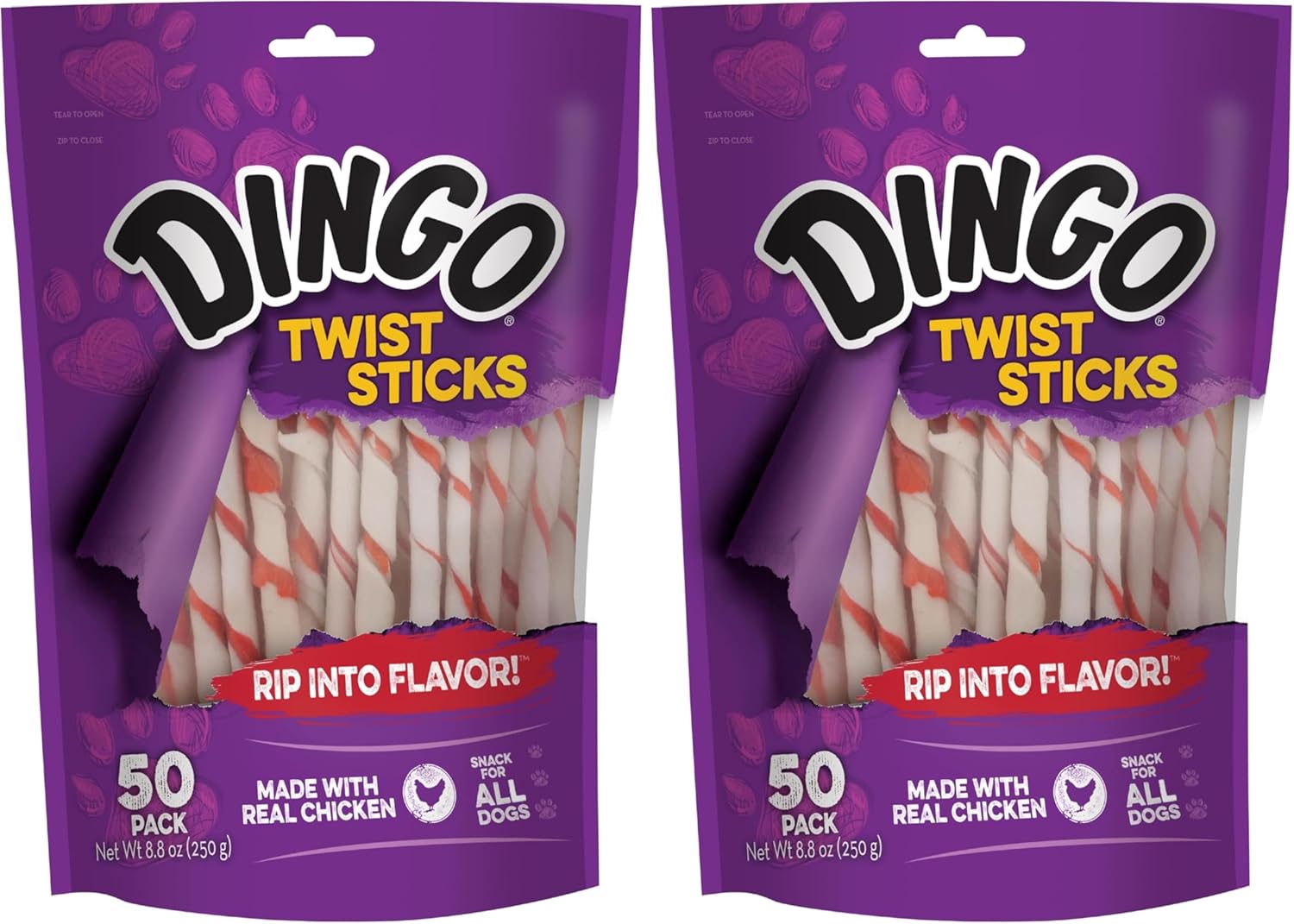
Best For: Multi-dog households, owners who want the lowest cost per treat.
Cost Per Day: $29.58 for 50 sticks ($0.59/stick) — the cheapest option in this entire comparison by a wide margin.
Why It Made the List?
- Same trusted Dingo manufacturing as the Dynostix pick above, in a bulk format
- Amazon’s Choice badge with 9,354 reviews at a 4.7-star average
- No artificial dye, unlike the Dynostix pick from the same brand
Key Specs
- Guaranteed analysis not listed on this product’s Amazon page
- Not AAFCO life-stage regulated; brand lists “Adult” suitability
- Ingredients: Rawhide, Chicken, Water, Natural Color, Corn Sugar, Salt, Potassium Sorbate (Preservative)
Honest Take
- Cleanest ingredient list of the three rawhide picks in this comparison
- Bulk 50-count format makes it the clear pick for multi-dog households
- Most common owner report: good quality and value, well-liked even by picky eaters.
- Most common complaint: some owners find the individual sticks on the small side for larger dogs.
Safety Comparison: Digestibility, Choking & Chemical Exposure
The size and thickness recommendations above aren’t arbitrary. They come directly from how each material behaves once your dog starts chewing.
Digestibility is the core difference. Bully sticks are muscle protein, so pieces that get swallowed break down the same way any other meat protein does. Rawhide behaves differently: it’s difficult to digest because it’s a byproduct of leather, which creates a risk of obstruction in the esophagus or intestines if a dog swallows a large piece.
Sizing matters more with rawhide than most owners realize. VCA Animal Hospitals doesn’t recommend avoiding rawhide outright, but their guidance is specific: if you’re going to offer rawhide, choose one made from U.S. cattle hides, pick the thickest hides available, and select pieces too large for your dog to swallow whole, with no knots on the ends, since knots can be pulled off and swallowed, leading to a trip to the vet for surgery. This is exactly why the sizing guidance in our picks above matters. A 4-inch stick for a 70 lb dog, or a large rawhide knot for a 10 lb dog, both defeat the purpose.
Consumption pattern is a difference most comparisons miss. Rawhide chews tend to disappear faster than people expect: most dogs find rawhide highly palatable and often consume an entire chew during a single session, according to the ASPCA. Bully sticks, especially thinner or smaller ones, tend to last across multiple sessions, sometimes spread over several days for smaller dogs. That difference matters for supervision. A chew your dog finishes in one sitting gives you less time to notice a problem developing than one your dog works on gradually.
Real owner feedback backs this up. Buyer reviews for one of the small-dog rawhide picks in this comparison describe mixed experiences, including reports of choking concerns and digestive issues alongside positive feedback. That’s not unique to one brand, but it’s a useful reminder that “rawhide” as a category carries enough real-world risk reports that supervision isn’t optional, even with a reputable, long-established manufacturer.
Dental wear is a smaller but real concern for both. Chewing hard objects, including rawhide, can gradually wear down teeth or cause fractures, according to veterinary research cited by Whole Dog Journal.
If you’re unsure whether a specific chew size or hardness is appropriate for your dog’s age, breed, or dental history, talk to your vet before buying in bulk.
Suitability by Dog Type
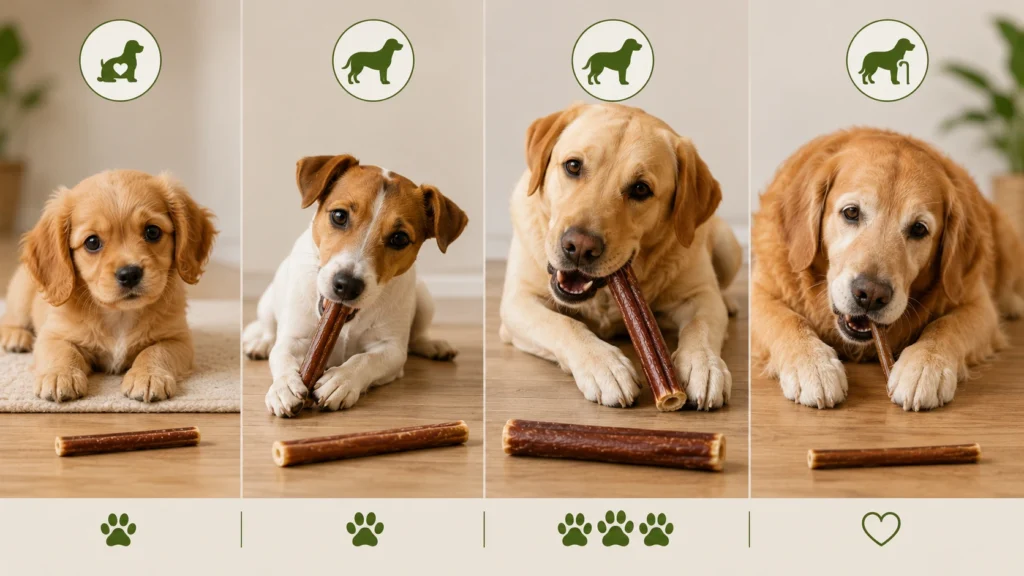
The picks above cover most situations, but a few scenarios deserve extra attention.
| Dog Type | Recommended Pick | Why? |
|---|---|---|
| Puppy / small breed | Best Bully Sticks 4″ | Sized correctly, single ingredient, easier on developing teeth |
| Standard / everyday chewer | Best Bully Sticks 6″ | Best value-to-durability ratio for most dogs |
| Power chewer / large breed | Best Bully Sticks 12″ | Length and thickness slow down aggressive chewers |
| Senior / sensitive chewer | Best Bully Sticks 6″ Thin | Less resistance per bite |
| Budget-conscious, small/medium dog | Purina Busy Rollhide | Recognizable brand, lower per-unit cost |
| Small dog, flavor preference | Dingo Dynostix | Meat-wrapped rawhide core |
| Multi-dog household | Dingo Twist Sticks | Lowest cost per treat at scale |
A few situations the table doesn’t fully capture:
Multi-dog households should watch for resource guarding around any high-value chew, bully stick or rawhide. Give chews in separate spaces if your dogs tend to compete over treats.
Dogs with existing dental issues, including missing teeth, past fractures, or diagnosed periodontal disease, should generally lean toward the thinner, softer end of either category. Run this one by your vet directly, since the right choice depends on the specific dental history involved.
Transitioning a dog off rawhide doesn’t need to happen overnight. If your dog is used to rawhide’s texture and resistance, a thick or braided bully stick offers a closer chewing experience than a thin one, which can help ease the switch.
Recall History — FDA.gov Verified
Most articles comparing these two chews only mention rawhide recalls. Both categories have documented FDA recall history, and it’s worth knowing regardless of which one you choose.
Rawhide: United Pet Group issued a voluntary recall of multiple rawhide brands, including American Beefhide, Digest-eeze, Healthy Hide, Healthy Hide Good n Fun, and Healthy Hide Good n Fit, after identifying that manufacturing facilities in Mexico and Colombia, and a supplier in Brazil, were using a quaternary ammonium compound as a processing aid. That compound is approved for cleaning food processing equipment in the U.S., but wasn’t approved as a rawhide processing aid. The recall covered products with expiration dates between June 2019 and May 2020, and it has since been completed and terminated by the FDA.
Bully sticks: Redbarn Pet Products issued two recalls in 2018. The first, on February 9, covered a single lot of its 7-inch Bully Stick three-pack after a retail sample tested positive for Salmonella. The recall expanded on March 7 to cover 24 SKUs across the Redbarn, Chewy Louie, Dentley’s, and Good Lovin’ brands, all manufactured using raw material from a single supplier, for products distributed between March 2017 and February 2018. No illnesses were reported in connection with either recall, and both have since been completed and terminated by the FDA.
Neither category is recall-free. The difference is in what triggered each one. Rawhide’s issue was an unapproved processing chemical; bully sticks’ issue was a supplier-level bacterial contamination risk, the same type of issue that affects many protein-based pet treats.
Cost Comparison
| Product | Price | Per-Unit Cost | Typical Session Length |
|---|---|---|---|
| Best Bully Sticks 4″ (8 oz) | $25.99 | — | 10–20 min, puppy/small dog |
| Best Bully Sticks 6″ (25 ct) | $73.49 | $2.94 | 20–40 min, moderate chewer |
| Best Bully Sticks 12″ (10 ct) | $62.99 | $6.30 | 1–2+ hours, large/power chewer |
| Best Bully Sticks 6″ Thin (24 ct) | $39.99 | $1.67 | Extended, multi-session for small dogs |
| Purina Busy Rollhide S/M (9 ct) | $9.48 | $1.05 | Often finished in a single session |
| Dingo Dynostix (10 ct) | $9.19 | $0.92 | Often finished in a single session |
| Dingo Twist Sticks (50 ct) | $29.58 | $0.59 | Often finished in a single session |
Rawhide wins clearly on sticker price, running roughly half the per-unit cost of bully sticks, sometimes less. But the single-session consumption pattern noted earlier narrows that gap in practice. A dog that finishes a $0.92 rawhide piece in one sitting and needs a new one that day may end up spending close to what a dog chewing a $2.94 bully stick over two or three sessions spends per day.
Bully sticks, particularly the thinner and standard sizes, tend to stretch further across multiple short sessions, especially for smaller dogs, which narrows the real day-to-day cost gap even though the sticker price difference looks larger.
When to Call Your Vet?
A couple of specific moments are worth flagging directly, rather than leaving as generic advice buried in a disclaimer.
- If you’re unsure what size or texture is appropriate for your dog’s age, breed, or chewing style, ask your vet before buying in bulk. This matters especially if you’re considering rawhide, given VCA’s sizing guidance above.
- If your dog shows vomiting, straining, decreased appetite, or lethargy after chewing, stop the chew and contact your vet. These are early signs associated with digestive blockage or bacterial illness, and they’re worth taking seriously rather than waiting to see if symptoms pass on their own.
Frequently Asked Questions
Are bully sticks safer than rawhide?
Generally, yes. Bully sticks are fully digestible muscle protein, while rawhide resists digestion and carries a documented blockage risk if large pieces are swallowed. Both categories have had FDA recalls, so “safer” doesn’t mean risk-free. If your dog has a history of digestive issues, consult your vet before introducing either.
Can puppies have bully sticks or rawhide?
Puppies can have appropriately sized bully sticks, generally thinner and shorter options matched to their mouth size. Rawhide is a higher-risk option for puppies because of their smaller mouths and less developed chewing control. Check with your vet before introducing either.
How long should I let my dog chew before taking it away?
Most guidance points to 15–30 minute supervised sessions, with the chew removed once it’s small enough to be swallowed whole. This applies to both bully sticks and rawhide. If you notice unusual gulping or straining, stop the session and consult your vet.
Are bully sticks or rawhide better for dogs with sensitive stomachs?
Bully sticks are generally the better choice here, since they’re easier to digest. If your dog has a known sensitive stomach or history of digestive issues, discuss this with your vet before trying either product.
Do bully sticks smell bad?
Some do. It’s a natural byproduct of the drying process, not a sign of poor quality. Odor-free processed versions exist if this is a concern for your household.
What’s a safe alternative if my dog can’t have either?
Options like beef collagen sticks or beef cheek rolls offer a similar chewing experience without rawhide’s digestibility concerns, for dogs that don’t tolerate bully sticks well. Talk to your vet if your dog has ongoing chewing or digestive issues regardless of which chew type you’re considering.
Final Recommendation
For most dogs, a bully stick sized correctly for their chewing style is the safer everyday choice. The Best Bully Sticks 6 Inch line covers the widest range of dogs, with the 12 Inch option stepping in for power chewers who’d go through a standard stick too fast to be safe.
If cost is the deciding factor and you’re set on rawhide, Dingo’s Twist Sticks offer the lowest per-unit price of anything in this comparison, paired with a cleaner ingredient list than some of the flavored alternatives. Apply VCA’s sizing guidance above regardless of which rawhide product you choose, and supervise every session.