 Marco Williams
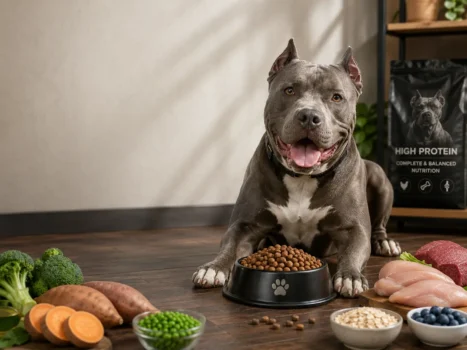
If you’ve spent any time researching food for a Pitbull, you’ve probably hit the same wall. Half the articles tell you to avoid chicken because “Pitbulls are allergic to it.” The other half push high-protein formulas because the breed looks muscular. Neither claim holds up once you check the data: most Pitbull skin issues trace back to environmental triggers, not food, and when food is the cause, chicken isn’t even the most common culprit.
This guide skips the breed mythology. Every product below was verified at the SKU level: exact Guaranteed Analysis, exact ingredient deck, exact recall history, rather than assumed from the brand name. We also break down what the research says about grain-free diets, high-protein claims, and the chicken-allergy myth, so you can make the call with solid information instead of marketing copy.
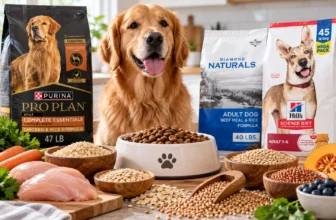
- Best Overall / High-Protein → Purina Pro Plan Sport 30/20 — ~$1.99–$2.24/day
- Best for Skin & Coat Sensitivities → Pro Plan Sensitive Skin & Stomach (Salmon) — ~$2.60–$2.88/day
- Best Budget → Diamond Naturals Large Breed Adult — ~$0.99–$1.10/day
- Best for Puppies → Wellness Complete Health Puppy — ~$1.68–$1.87/day
- Best for Weight Management → Pro Plan Weight Management Large Breed — ~$2.05–$2.28/day
- Best Limited Ingredient Diet → Natural Balance L.I.D. Lamb, Large Breed — ~$2.53–$2.81/day
- Best Overall Runner-Up → Blue Buffalo Life Protection Large Breed — ~$2.19–$2.43/day
Daily cost estimates assume a 55 lb adult Pitbull at moderate activity, feeding per the manufacturer’s guideline range. Confirm live pricing before publishing — Amazon prices shift, and Subscribe & Save rates differ from one-time pricing.
Pitbull Food Comparison At a Glance
| Product | Best For | Protein (min) | Fat (min) | Price/lb | AAFCO Stage |
|---|---|---|---|---|---|
| Pro Plan Sport 30/20 | Overall / High-Protein | 30.0% | 20.0% | $2.00 | All Life Stages |
| Pro Plan Sensitive Skin & Stomach | Skin & Coat | 26.0% | 12.0% | $2.88 | Adult |
| Diamond Naturals Large Breed | Budget | 23.0% | 13.0% | $1.10 | Adult Maintenance |
| Wellness Complete Health Puppy | Puppies | 29.0% | 18.0% | $1.87 | Growth, incl. large-breed (70+ lb) |
| Pro Plan Weight Management | Weight Management | 27.0% | 9.5–13.5% | $2.28 | Adult – Large Breed (50+ lb) |
| Natural Balance L.I.D. Lamb | Limited Ingredient | 22.0% | 12.0% | $2.81 | Adult |
| Blue Buffalo Life Protection | Overall Runner-Up | 22.0% | 12.0% | $2.43 | Adult |
How We Chose These 7?
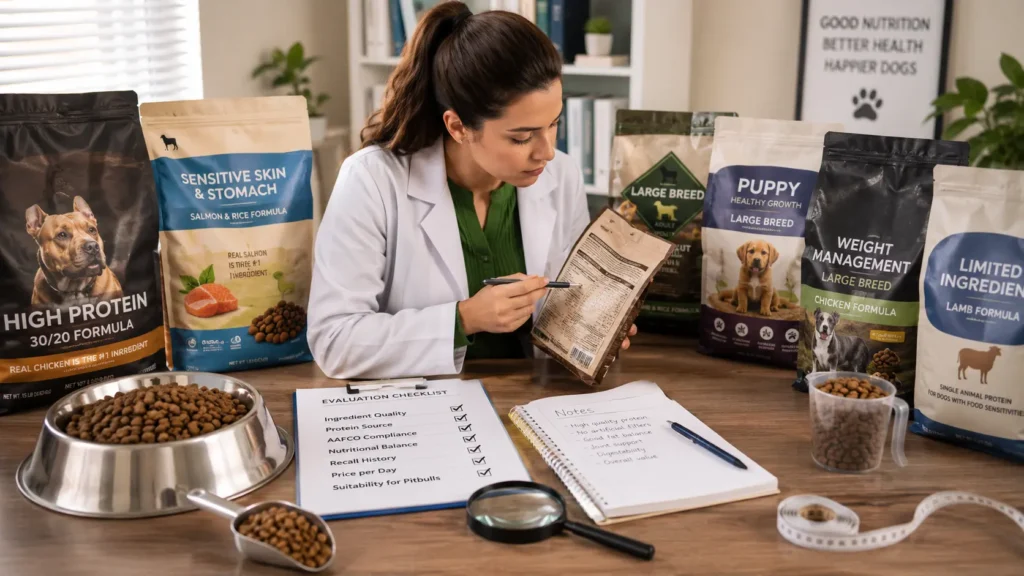
Every product on this list was benchmarked against a 55 lb, three-year-old adult Pitbull at moderate-to-high activity, the profile most Pitbull owners are feeding day to day. We pulled Guaranteed Analysis figures, ingredient decks, and AAFCO life-stage statements directly from manufacturer labels and official spec sheets, not from brand marketing copy or aggregator sites.
We also cut candidates that looked good on paper but failed a specific check. Victor Hi-Pro Plus didn’t make the list because Mid America Pet Food expanded a recall to its entire product line in November 2023. Just Food For Dogs, We Feed Raw, and Spot & Tango are excellent fresh-food options, but they aren’t sold through Amazon, so they fall outside the scope of this roundup. If you want fresh food, that’s a separate guide. Every product below is currently in stock and Amazon-fulfilled at the time of research.
Why Pitbulls Have Different Food Needs?: Best Dog Food for Pitbulls, Explained
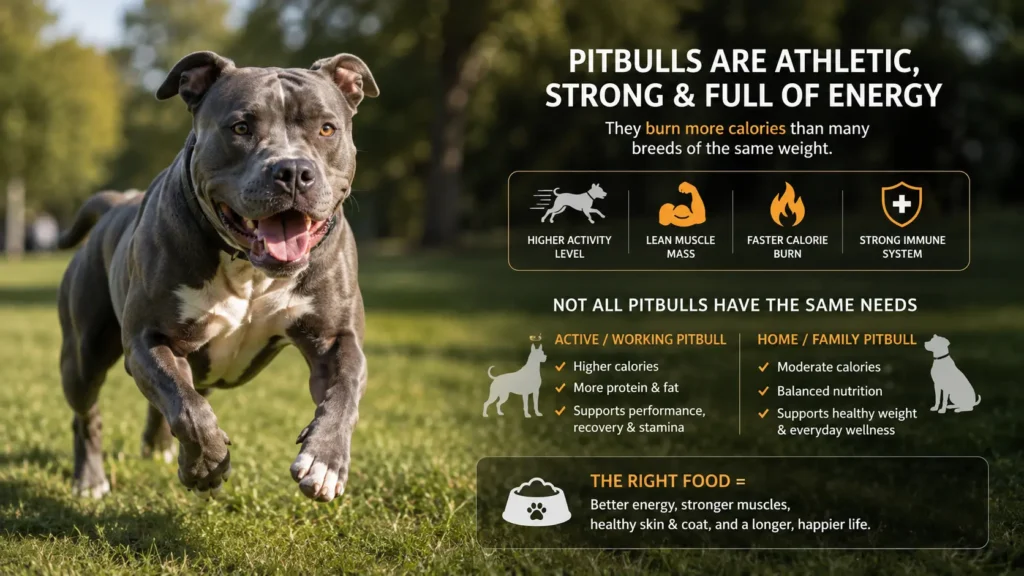
Pitbulls carry a muscle-dense, athletic build that does burn through calories faster than a sedentary breed of the same weight. That’s the part the marketing gets right. Where it goes wrong is assuming every Pitbull needs the same food. A couch-oriented family Pitbull and a working or sport-driven one have very different nutritional needs, even at the same body weight.
The bigger misconception is around skin issues. Pitbulls do show up in vet offices for itching, hot spots, and recurring ear infections more than some breeds, but food allergies account for a small minority of those cases. Industry data from large-scale veterinary hospital networks puts environmental allergies (pollen, dust mites, mold, fleas) at roughly 80% of canine allergy cases, with true food allergies making up the remaining 20% or less. If your Pitbull is scratching constantly, a food switch might help, but it makes sense to rule out fleas and environmental triggers first. Consult your vet before assuming a food allergy is the cause. A proper diagnosis usually requires an elimination trial under veterinary guidance, not trial-and-error bag-swapping.
The Chicken Allergy Myth, and What Actually Triggers Pitbull Skin Issues?
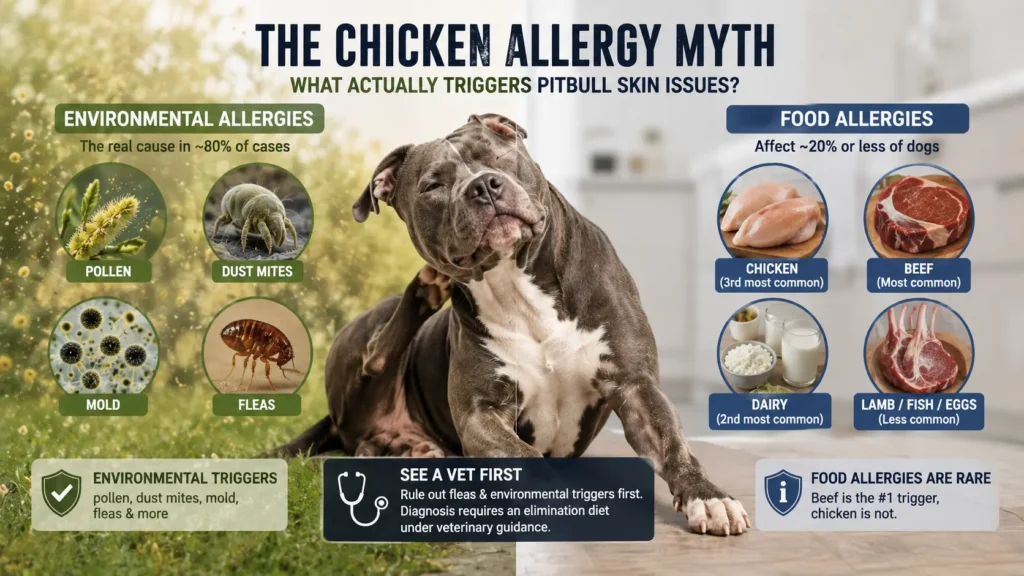
“Avoid chicken, it’s the top allergen” is repeated so often in dog food content that it’s treated as settled fact. It isn’t. Research on confirmed canine food allergy cases consistently shows beef as the most common trigger, implicated in roughly a third of cases, followed by dairy. Chicken lands third, well behind both.
The reason chicken gets blamed so often isn’t biology. It’s exposure. Chicken is the most widely used protein in commercial dog food, so more dogs eat it more often, and more dogs eventually react to it. That’s an exposure-frequency pattern, not evidence that chicken is inherently more allergenic than beef, lamb, or fish. If your Pitbull has a confirmed chicken sensitivity, avoiding it is the right call. But switching to chicken-free food as a blanket precaution, without a confirmed trigger, isn’t backed by the data.
Signs your Pitbull’s food isn’t working for them:
- Persistent paw or belly licking that doesn’t track with flea season. This pattern also shows up with environmental allergies, so it’s worth a vet visit before a food change.
- Loose stool or gas that started with a new bag. An ingredient reaction usually shows up within days of switching, not weeks.
- Recurring ear infections — one of the more reliable food-allergy indicators, though still less common than environmental causes.
- Dull coat despite adequate fat intake — can point to a digestibility issue with the current formula rather than a true allergy.
Grain-Free and DCM: What Pitbull Owners Should Actually Know?
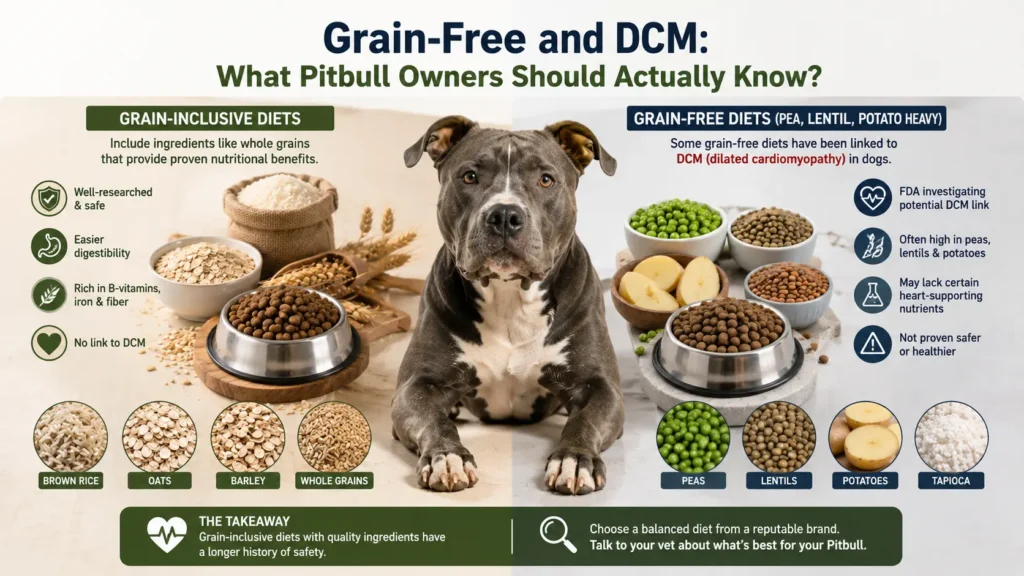
The FDA opened an investigation in 2018 into a possible link between grain-free diets and dilated cardiomyopathy (DCM), a serious heart condition, in dogs eating certain formulas. The agency hasn’t issued a public update since 2022 and has stated it lacks sufficient data to establish direct causation. That’s the honest, current state of the science — not resolved, not dismissed.
What the FDA’s own data does show is that the common thread in flagged cases wasn’t “grain-free” as a category. It was a high proportion of peas, lentils, or other legumes in the ingredient deck, appearing in both grain-free and grain-inclusive formulas. This is why several picks on this list, including the budget and puppy options, are grain-inclusive by design: it sidesteps the open question entirely rather than betting on a still-unresolved link. If your Pitbull is on a grain-free diet already and doing well, this isn’t a reason to panic-switch. It’s a reason to bring it up with your vet at your next visit.
Do Pitbulls Actually Need High-Protein Food?
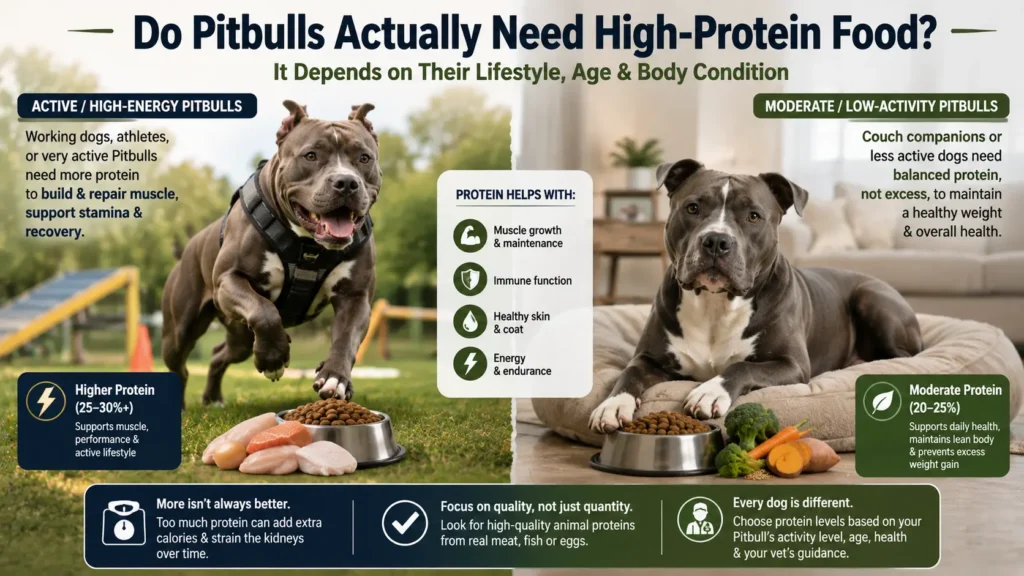
The honest answer: it depends on activity level, not breed identity. A dog that’s truly active, running, pulling, working, competing, burns through and rebuilds muscle protein at a meaningfully faster rate, and a 28–30% protein formula supports that need. A Pitbull that gets a couple of walks and some yard time a day doesn’t have that same demand, even if the dog looks muscular at rest.
This is why Pro Plan Sport 30/20 is positioned for active dogs below, not just muscular-looking ones. Feeding a high-protein sport formula to a low-activity dog isn’t dangerous, but it isn’t doing anything extra for a dog that isn’t using that protein, and you’ll likely pay more per bag for a benefit your dog isn’t tapping into.
The 7 Best Dog Foods for Pitbulls
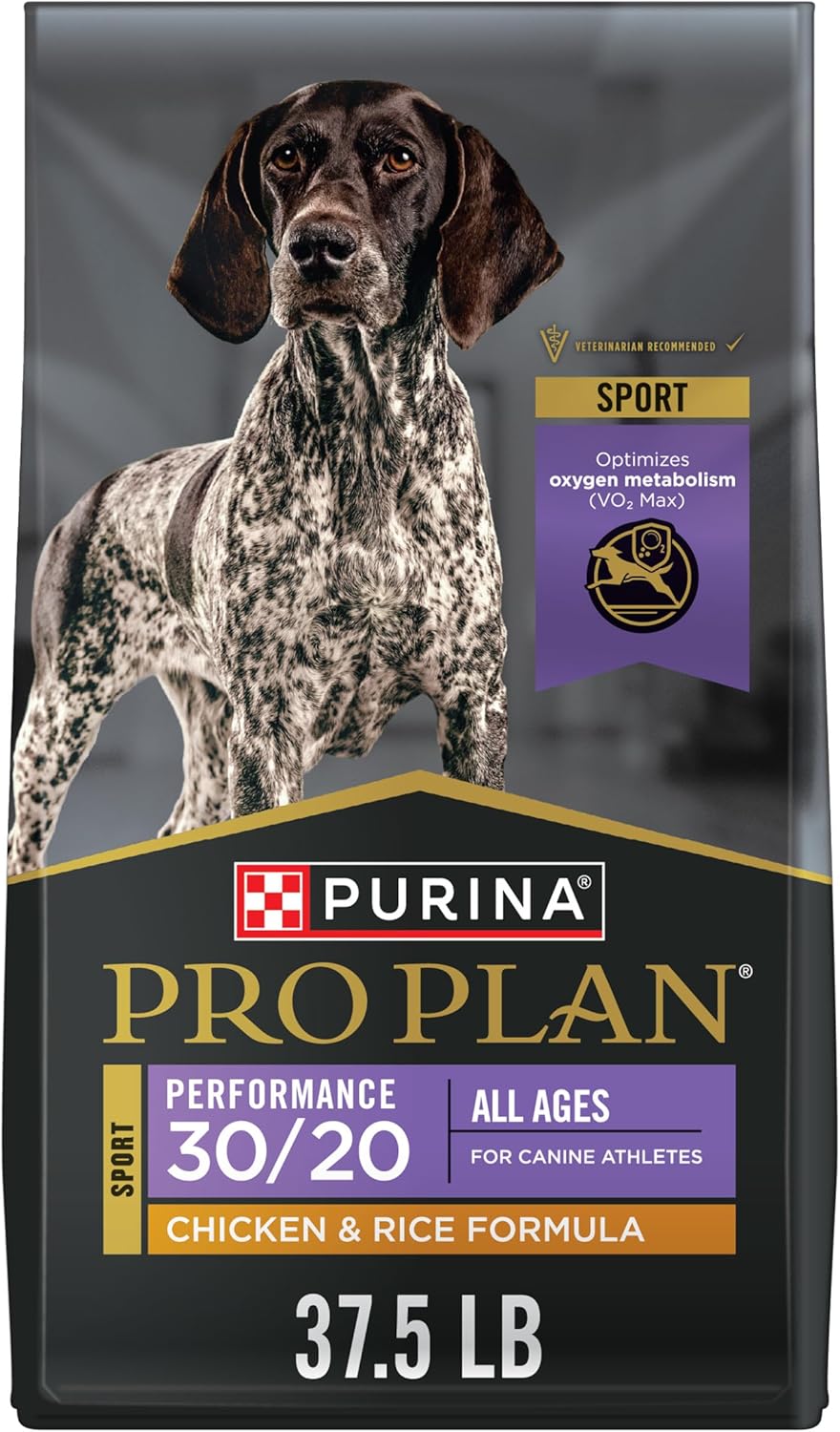
Best For: Genuinely active Pitbulls — running, working, sport, or heavy daily exercise.
Cost Per Day: ~$1.99–$2.24 for a 55 lb dog.
Why It Made the List?
- 30% protein / 20% fat, formulated specifically for canine athletes with elevated protein turnover.
- Chicken is the first ingredient, with glucosamine and EPA built in for joint support.
- All Life Stages AAFCO statement — one bag works across your dog’s adult life.
Key Specs
- Protein 30.0% min / Fat 20.0% min / Fiber 3.0% max / Moisture 12.0% max.
- AAFCO: All Life Stages.
- First 5 ingredients: Chicken, Corn Gluten Meal, Rice, Beef Fat (preserved with mixed-tocopherols), Poultry By-Product Meal.
Honest Take
- Chicken leads the ingredient list, but corn gluten meal and poultry by-product meal contribute meaningfully to the 30% protein figure. This isn’t a single-source-protein formula.
- Grain-inclusive (rice, corn), which sidesteps the grain-free/legume question entirely.
- Most common owner report: visible coat and energy improvement in truly active dogs. Most common complaint: overkill and unnecessary cost for low-activity dogs.

Best For: Pitbulls with diagnosed or suspected skin and stomach sensitivity.
Cost Per Day: ~$2.60–$2.88 for a 55 lb dog.
Why It Made the List?
- Salmon-first formula — salmon isn’t a top-3 canine allergen, unlike beef, dairy, or chicken.
- Glucosamine and EPA are included at levels meant for actual joint and skin support, not as a label claim alone.
- Large-breed formulation built for dogs over 50 lb.
Key Specs
- Protein 26.0% min / Fat 12.0% min / Fiber 4.5% max / Moisture 12.0% max.
- AAFCO: Adult Maintenance.
- First 5 ingredients: Salmon, Rice, Barley, Oat Meal, Fish Meal.
Honest Take
- Grain-inclusive (rice, barley, oat meal) — no legumes in the top ingredients, so this sidesteps the DCM/legume question entirely.
- This is a different protein source from most of the other picks on this list, which is the point. It’s a purpose-built formula, not a “sensitive stomach” label slapped on a standard recipe.
- Most common owner report: visible reduction in itching and looser stool resolving within two weeks of switching. Most common complaint: higher price per pound than a standard adult formula.

Best For: Budget-conscious owners who still want a solid ingredient deck.
Cost Per Day: ~$0.99–$1.10 for a 55 lb dog.
Why It Made the List?
- At $1.10/lb, this undercuts most of the other picks on this list by roughly half.
- Two named meat sources (chicken, chicken meal) lead the ingredient deck, ahead of the grains.
- Glucosamine and chondroitin appear at meaningful large-breed levels rather than trace amounts.
Key Specs
- Protein 23.0% min / Fat 13.0% min / Fiber 3.5% max / Moisture 10.0% max.
- AAFCO: Adult Maintenance.
- First 5 ingredients: Chicken, Chicken Meal, Whole Grain Brown Rice, Cracked Pearled Barley, White Rice.
Honest Take
- Last recall traces back to 2012, with no confirmed recalls on this line since. Check the FDA database periodically before repurchasing, as you would with any brand.
- Grain-inclusive, no legumes in the top ingredients.
- Most common owner report: dogs do well long-term at this price point with no digestive issues. Most common complaint: protein percentage is lower than premium competitors, which matters if your dog is truly active.
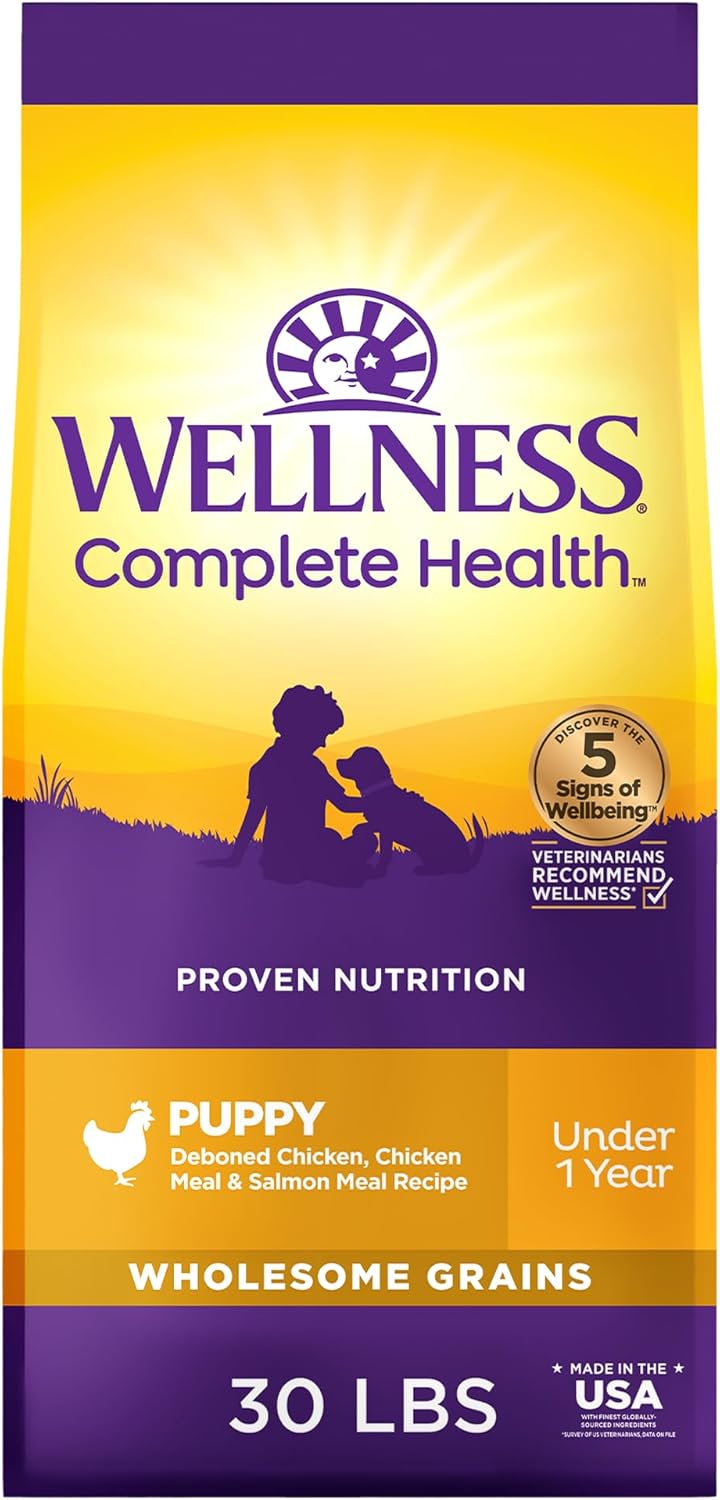
Best For: Pitbull puppies, including those projected to reach large-breed adult weight.
Cost Per Day: ~$1.68–$1.87 for a growing puppy.
Why It Made the List?
- Formulated to meet AAFCO nutrient profiles for growth, including large-size dogs (70 lb or more as an adult), verified directly from the official label, not brand copy.
- Calcium and phosphorus levels are controlled at 1.20% and 1.00% respectively, within the safe range for large-breed growth.
- Salmon meal and DHA support brain development alongside joint-friendly nutrient levels.
Key Specs
- Protein 29.0% min / Fat 18.0% min / Fiber 4.5% max / Moisture 10.0% max.
- AAFCO: Growth and gestation/lactation, including large-size dogs.
- First 5 ingredients: Deboned Chicken, Chicken Meal, Oatmeal, Ground Barley, Peas.
Honest Take
- Peas appear at position 5 in the ingredient deck. This isn’t disqualifying on its own: the concern flagged by FDA research is about high legume proportion, and this formula is grain-inclusive with peas as a supporting ingredient, not the base carbohydrate.
- Higher fat content (18%) than adult formulas, appropriate for puppy growth but worth tapering as your dog approaches adult weight.
- Most common owner report: steady, controlled growth without excess weight gain. Most common complaint: kibble size runs small for some large-breed puppies’ preference.

Best For: Overweight or under-exercised Pitbulls over 50 lb.
Cost Per Day: ~$2.05–$2.28 for a 55 lb dog.
Why It Made the List?
- Explicitly formulated for large breeds over 50 lb, a rare case of the label stating an exact weight threshold rather than a vague size category.
- 27% protein at only 9.5–13.5% fat, built to preserve lean muscle mass during a calorie deficit.
- Glucosamine and EPA included for joint support, relevant for a heavier-bodied dog carrying excess weight.
Key Specs
- Protein 27.0% min / Fat 9.5–13.5% / Fiber 5.5% max / Moisture 12.0% max.
- AAFCO: Adult – Large Breed (50+ lb).
- First 5 ingredients: Chicken, Rice, Whole Grain Wheat, Poultry By-Product Meal, Corn Protein Meal.
Honest Take
- Contains wheat, so it’s not a fit if your dog has a suspected grain or wheat sensitivity. Best suited to weight management in a dog without known food allergies.
- Pea fiber appears at position 8, well down the ingredient list and a smaller contribution than whole peas earlier in a formula.
- Most common owner report: visible, gradual weight loss over 8–12 weeks without excessive hunger. Most common complaint: some dogs find the lower-fat kibble less palatable than a standard formula.

Best For: Pitbulls needing an elimination-diet-style formula for suspected food sensitivities.
Cost Per Day: ~$2.53–$2.81 for a 55 lb dog.
Why It Made the List?
- Single animal protein source (lamb). Lamb isn’t among the top canine food allergens, unlike beef, dairy, or chicken.
- A true limited-ingredient deck, not a “sensitive” label on a standard recipe.
- Lamb meal is explicitly called out as the glucosamine source, a named, traceable ingredient rather than a vague supplement claim.
Key Specs
- Protein 22.0% min / Fat 12.0% min / Fiber 4.0% max / Moisture 10.0% max.
- AAFCO: Adult Maintenance.
- First 5 ingredients: Lamb, Lamb Meal (source of glucosamine), Brown Rice, Brewers Rice, Oatmeal.
Honest Take
- Grain-inclusive, no legumes in the top ingredients, one of the cleanest DCM-question profiles on this list.
- Runs higher per pound than the budget and overall picks, which is typical for limited-ingredient formulas generally, not specific to this brand.
- Most common owner report: noticeable improvement in dogs with suspected chicken or beef sensitivity. Most common complaint: smaller kibble size than expected in some bags.

Best For: Owners who want a well-known, widely-stocked brand as an alternative to Pick #1.
Cost Per Day: ~$2.19–$2.43 for a 55 lb dog.
Why It Made the List?
- Deboned chicken and chicken meal lead the ingredient deck, and glucosamine and chondroitin are confirmed in the full label rather than only in marketing copy.
- Large-breed-specific formulation with joint-support nutrients calibrated for bigger dogs.
- Widely stocked and easy to find as a backup if your primary pick is ever out of stock.
Key Specs
- Protein 22.0% min / Fat 12.0% min / Fiber 6.0% max / Moisture 10.0% max.
- AAFCO: Adult Maintenance.
- First 5 ingredients: Deboned Chicken, Chicken Meal, Brown Rice, Oatmeal, Barley.
Honest Take
- Peas and pea starch both appear in the top 8 ingredients, the most notable legume presence of any pick on this list. Still grain-inclusive overall, but a relevant detail if you’re being cautious on the DCM question specifically.
- For full transparency: a 2010 Blue Buffalo recall for elevated Vitamin D specifically named this same product line (Large Breed Adult Chicken & Brown Rice, 30 lb bag). That recall is over 15 years old and unrelated to current production, and Blue Buffalo has no active recalls as of this writing. We include it because omitting a direct-line-match recall while flagging others would be an inconsistent standard.
- Most common owner report: good coat condition and consistent stool quality. Most common complaint: some dogs show sensitivity to the pea content specifically.
Which Pitbull Food Fits Your Situation?
Still not sure which pick applies to your dog? Match your situation to one of the scenarios below.
If your Pitbull has itchy skin →
Rule out fleas and environmental allergens first, since most itching in Pitbulls isn’t food-related. If food is confirmed as the trigger, salmon or lamb-based formulas avoid the three most common canine allergens (beef, dairy, chicken).
If your Pitbull is overweight →
A dedicated weight management formula preserves lean muscle while cutting calories, which matters more for a muscular breed than a generic low-calorie food. Consult your vet before starting a weight-loss diet. They can confirm your dog’s target weight and rule out a medical cause for the gain.
If you’re on a tight budget →
Diamond Naturals delivers a named-meat ingredient deck with joint-support nutrients at roughly half the per-pound cost of the premium picks on this list. It’s a solid option in its own right, not just the cheapest bag on the shelf.
If you have a truly active Pitbull →
A high-protein sport formula makes sense here, where it wouldn’t for a low-activity dog. The extra protein supports muscle turnover from actual exercise, not just breed appearance.
Joint Health and Hip Dysplasia: What to Look for in the Ingredient Deck?
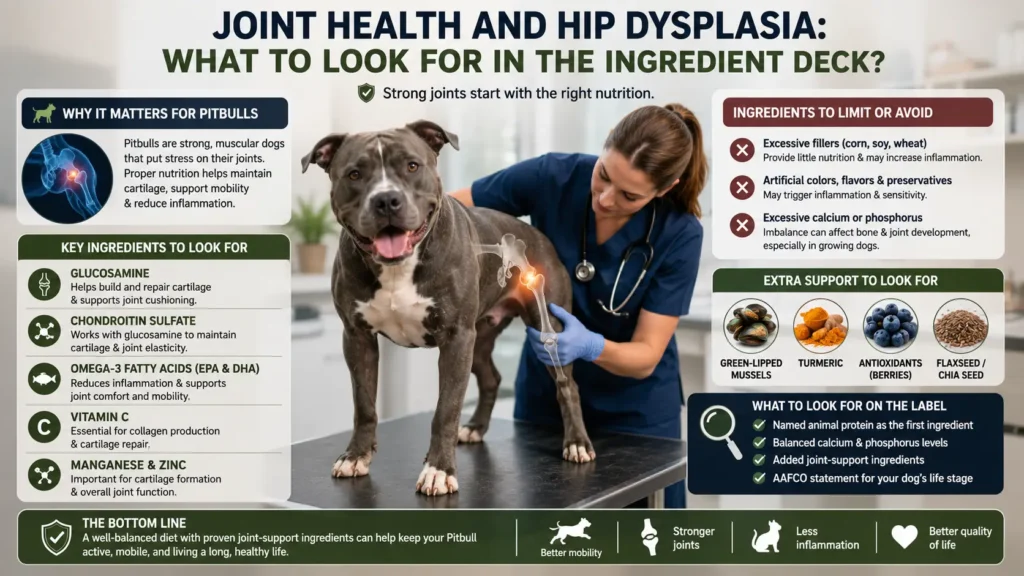
Pitbulls aren’t at the top of the hip dysplasia risk list, but the breed’s dense muscle mass puts real load on the joints over a lifetime, so glucosamine and chondroitin support is worth paying attention to. Not every “joint support” claim on a bag means the same thing. The disclosed milligram amount matters more than the phrase on the front label.
Among the 7 picks above, Diamond Naturals and Natural Balance both disclose 750 mg/kg of glucosamine, the highest confirmed levels on this list. Blue Buffalo discloses 700 mg/kg. Purina’s Pro Plan formulas disclose lower confirmed amounts, roughly 350–500 ppm depending on the specific formula. That isn’t necessarily a problem, but it does mean the joint-support claim carries less substance than the budget and limited-ingredient picks in this specific category.
Frequently Asked Questions
What’s the best food for a Pitbull with skin allergies?
Pro Plan Sensitive Skin & Stomach (Salmon) is our top pick, since salmon isn’t among the top three canine food allergens (beef, dairy, and chicken are). But most Pitbull itching is environmental, not food-related, so consult your vet before assuming a food switch alone will resolve the issue.
Do Pitbulls need high-protein food?
Only if your dog is truly active. High-protein formulas like Pro Plan Sport 30/20 benefit dogs with genuine exercise demands, such as running, working, or sport, not dogs that just look muscular at rest. A moderately active Pitbull does fine on a standard 22–27% protein formula.
Is grain-free food bad for Pitbulls?
Not necessarily. The FDA’s ongoing investigation into diet-associated DCM hasn’t established that grain-free formulas cause the condition. The flagged common factor is a high proportion of legumes (peas, lentils) in the ingredient deck, which can appear in grain-inclusive foods too. If you’re concerned, a grain-inclusive formula like Diamond Naturals or Natural Balance sidesteps the question entirely.
What’s the best budget dog food for a Pitbull?
Diamond Naturals Large Breed Adult at roughly $1.10/lb, with chicken and chicken meal leading the ingredient deck and glucosamine/chondroitin included for joint support. It’s a solid formula at a lower price point, not just the cheapest bag available.
How much should I feed an adult Pitbull?
Feeding amount depends on the specific food’s calorie density, your dog’s weight, and activity level. Follow the feeding guideline on your chosen bag as a starting point, then adjust based on body condition. A 55 lb moderately active Pitbull typically needs 2.5–3.5 cups per day, split into two meals. Consult your vet if you’re unsure about your dog’s ideal weight.
When should I switch my Pitbull puppy to adult food?
Most large-breed Pitbull puppies can transition to adult food between 12 and 18 months, once growth has slowed. Switching too early can affect joint development in a large-breed puppy, so consult your vet to confirm timing based on your individual dog’s growth curve.
Our Verdict
For most Pitbull owners, Purina Pro Plan Sport 30/20 is the strongest overall pick, but only if your dog is truly active. If your Pitbull is more of a couch companion, Blue Buffalo Life Protection Large Breed or Diamond Naturals are better-matched, more cost-effective choices.
If skin sensitivity is your main concern, don’t reach for a chicken-free formula by default. Try Pro Plan Sensitive Skin & Stomach or Natural Balance L.I.D. Lamb only after ruling out environmental causes with your vet. And if you’re raising a Pitbull puppy tracking toward a large adult size, Wellness Complete Health Puppy is verified appropriate for large-breed growth, not a standard puppy formula in a bigger bag.