 Marco Williams
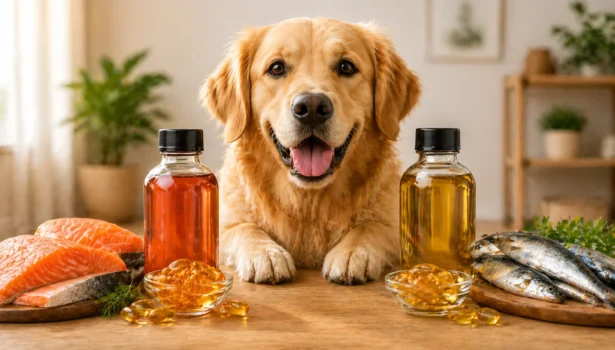
Most dog owners are overpaying for omega-3 supplements — or underdosing them entirely — because the label says “fish oil” and they assume that’s enough information. It isn’t. Salmon oil and generic fish oil are not the same product. They share the same core omega-3 fatty acids, but differ in source consistency, astaxanthin content, EPA-to-DHA ratio, and real cost per dose. When you’re choosing between salmon oil vs fish oil for dogs, those differences determine whether your dog actually sees results within 4–6 weeks or you quietly stop buying after two bottles.
Fish oil is also one of the most studied pet supplements available, with a well-established safety profile at normal doses — so if you’re on the fence about supplementing at all, the evidence is solid. The question is which form is right for your specific dog.
The short answer: salmon oil wins for brain health, consistency, and palatability. A high-quality fish oil blend wins for maximum EPA delivery and budget value. The full breakdown — including which to buy in each scenario — is below.
Already feeding a premium kibble and wondering whether omega-3 content is already covered? See how the two best-sellers compare on omega-3 in the base formula before you add a supplement: Purina Pro Plan vs Royal Canin.
- Best overall: Vital Pet Life Wild Alaskan Salmon Oil — Single-source wild-caught salmon oil with the best price-per-1,000mg EPA+DHA in its category at the 32 oz size.
- Best budget pick: Zesty Paws Wild Alaskan Salmon Oil — Bestselling omega-3 supplement on Amazon and Chewy; NASC-certified with a no-mess pump bottle.
- Best for skin and coat: Pet Honesty Wild Caught Omega-3 Fish Oil — 800mg EPA + 525mg DHA per serving, one of the highest-potency picks in this category.
- Best for large dogs: Nordic Naturals Omega-3 Pet Liquid — Third-party tested every batch, re-esterified triglyceride form for superior absorption, vet-recommended for over a decade.
Prices verified April 2026. Confirm live pricing before purchasing.
Salmon Oil vs Fish Oil for Dogs: What’s Actually Different?
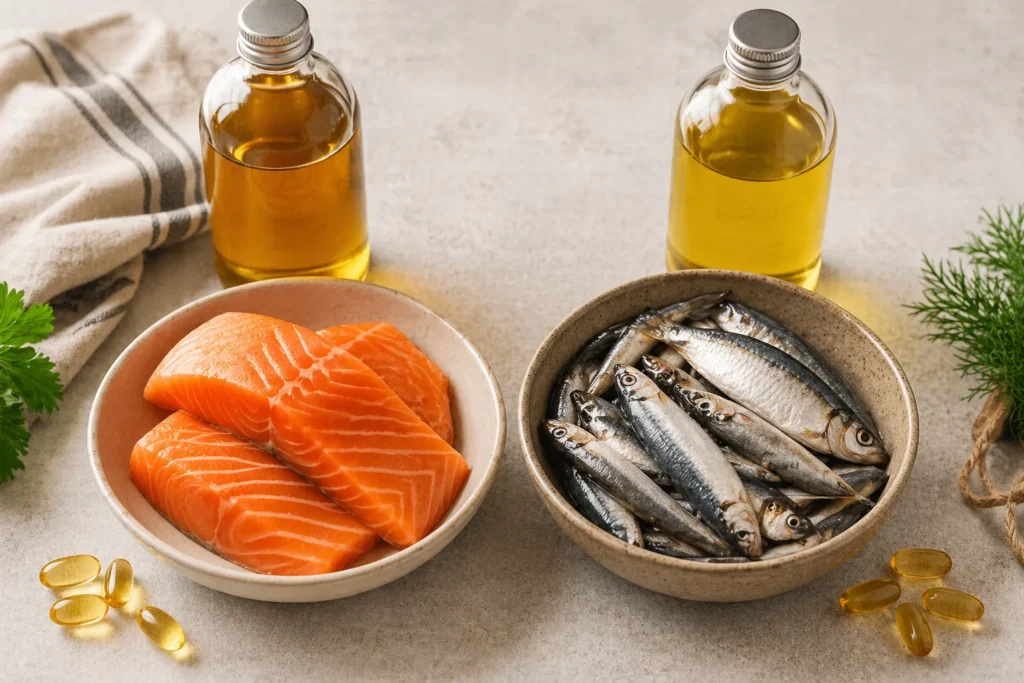
The most important thing to establish upfront: salmon oil is a type of fish oil. All salmon oil is fish oil — but not all fish oil is salmon oil. The confusion comes from marketing. “Fish oil” on a pet supplement label almost always means a blend of small cold-water fish (anchovy, sardine, pollock, mackerel), not salmon.
Here’s where it gets practical. Salmon oil comes from one species, giving it a consistent nutritional profile batch to batch. Generic fish oil blends vary depending on which species are in production at any given time, which means EPA and DHA levels can shift between bottles from the same brand. That inconsistency matters if you’re trying to dial in a therapeutic dose for a dog with arthritis or chronic skin issues.
The other real distinction is astaxanthin — a natural antioxidant that gives salmon its pink color. No anchovy or sardine-based oil contains it. Astaxanthin provides additional anti-inflammatory and cell-protection benefits that standard fish oil blends don’t offer, and it’s not a minor footnote — it’s the clearest reason to choose salmon oil over a blended product when potency is otherwise comparable.
On the bioavailability side, look for products in triglyceride (TG) form. Many cheaper fish oil concentrates use ethyl ester (EE) form — dogs absorb it far less efficiently than TG-form omega-3s. Quality brands like Nordic Naturals specify TG form on the label. If a label doesn’t mention the molecular form, assume it’s EE unless proven otherwise.
| Factor | Salmon Oil | Fish Oil (Generic Blend) |
|---|---|---|
| Source fish | Salmon only (usually wild Alaskan) | Anchovy, sardine, pollock, mackerel — blended |
| EPA per tsp | ~400–600mg | ~600–800mg+ |
| DHA per tsp | ~400–500mg | ~400–525mg |
| Astaxanthin | Yes — naturally present | No |
| Batch consistency | High — single species | Variable — blend ratios shift |
| Avg cost per oz | $1.50–$2.50 | $0.90–$2.00 |
| Best use case | Brain health, sensitive dogs, picky eaters | High-dose anti-inflammation, budget buyers |
The 6 Best Salmon Oil and Fish Oil Products for Dogs: Researched and Ranked
These six products were selected based on EPA and DHA content per dollar, label transparency (mg not just percentages), sourcing verification, and Amazon and Chewy review data as of April 2026.

Best for: Owners wanting single-source salmon oil at the lowest cost-per-1,000mg EPA+DHA. Ideal for dogs on limited-ingredient protocols or with food sensitivities who need a clean one-ingredient supplement.
Why It Made the List
- Approximately $0.20 per 1,000mg EPA+DHA at the 32 oz size — the lowest cost-per-dose in this entire roundup, confirmed by dividing the retail price by the EPA+DHA mg per serving
- Single-ingredient formula — just wild Alaskan salmon oil and mixed tocopherols as a natural preservative — making it compatible with strict elimination diets and dogs with multiple food sensitivities
- NASC member, Made in USA, wild-caught verified — all three sourcing claims on one label, which is uncommon at this price point
Key Specs
- ~500mg EPA + ~400mg DHA per tsp | Price: ~$28–34 (32 oz) | ~$0.90–$1.06 per oz
- Source: Wild-caught Alaskan salmon | Certifications: NASC, Made in USA
- Star rating: 4.5/5 (15,000+ reviews on Amazon)
Honest Take
- The value case is genuinely strong at scale — for large dogs on daily maintenance doses, this is the formula where cost-per-dose math matters most, and Vital Pet Life wins it clearly
- Single-ingredient formulation is a real advantage for sensitive dogs — no ancillary ingredients that could introduce new dietary variables during an elimination protocol
- Most common owner report: Improved coat shine and reduced shedding within 4–6 weeks, particularly in medium to large breeds. Most common complaint: Pump failure on roughly 1 in 8 bottles — easily resolved by transferring to a mason jar if it happens.

Best for: Owners who want milligram-level label transparency and human-grade fish sourcing without stepping up to the price tier of Nordic Naturals. A strong middle ground between budget salmon oil and premium fish oil blends.
Why It Made the List
- Publishes EPA and DHA in actual milligrams — ~598mg EPA + ~368mg DHA per tsp — rather than percentages, which is the difference between a label you can verify and one you have to trust
- Fish extracted at human-grade processing facilities co-located with human food production — a genuine sourcing advantage over most pet-channel competitors who use feed-grade fish byproducts
- NASC Quality Seal and sustainably sourced certification on a mid-range product — unusual for this price bracket, where most brands skip third-party quality programs to cut costs
Key Specs
- ~598mg EPA + ~368mg DHA per tsp | Price: ~$34.49 (16 oz) | ~$2.16 per oz
- Source: Wild Alaskan salmon, pollock, and whitefish — all wild-caught | Certifications: NASC Quality Seal, sustainably sourced
- Star rating: 4.4/5 (10,000+ reviews on Amazon)
Honest Take
- The milligram transparency is genuinely useful — you can calculate exact daily dosing by weight rather than estimating from percentage figures, which matters when you’re adjusting for a large dog or therapeutic dosing
- At $2.16/oz this is more expensive than Vital Pet Life and Zesty Paws per ounce, but the human-grade sourcing and potency (~966mg total EPA+DHA per tsp) close that gap on cost-per-dose
- Most common owner report: Noticeably improved coat texture within 3–4 weeks, particularly in double-coated breeds. Most common complaint: Strong fish smell — if your dog rejects it by scent, try Zesty Paws first, which has a milder odor profile.
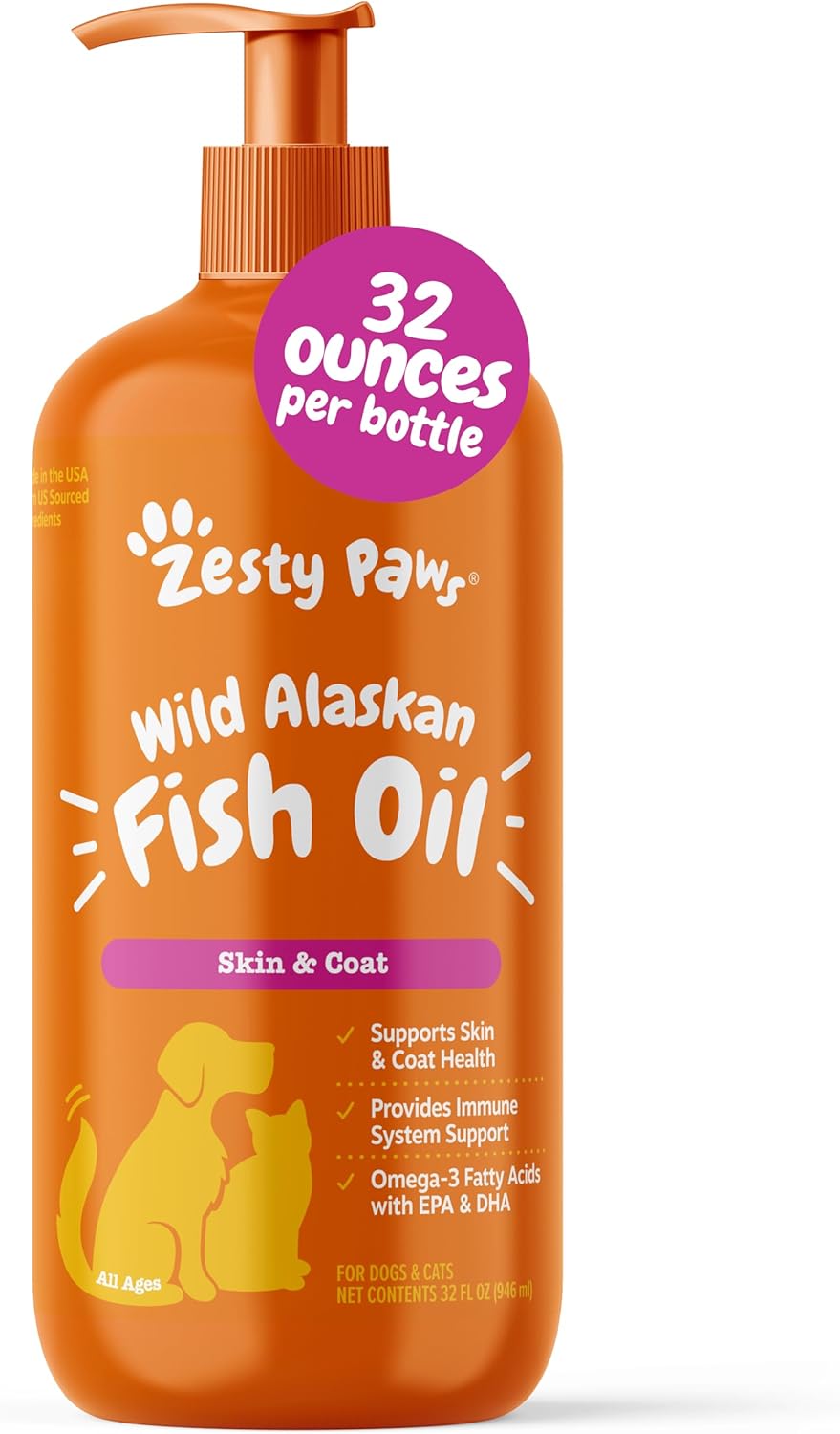
Best for: Owners starting their first omega-3 supplement or dogs under 50 lbs needing general skin and coat maintenance. The bestselling format in the category at a price point that’s sustainable for daily long-term use.
Why It Made the List
- Bestselling pet omega-3 supplement in the U.S. by a significant margin — 50,000+ reviews on Amazon and Chewy combined, reflecting consistent results across a broad range of breeds and ages
- NASC Quality Seal and B Corp certified — both certifications are uncommon together at this price point, signaling a brand with above-average quality accountability
- Wild-caught Alaskan salmon and pollock blend at $1.69/oz — the lowest price-per-ounce of any salmon oil in this roundup, making it the right entry point for owners unsure whether their dog will respond well to supplementation
Key Specs
- ~340–405mg EPA + ~225–425mg DHA per tsp | Price: ~$26.97 (16 oz) | ~$1.69 per oz
- Source: Wild-caught Alaskan salmon and pollock blend | Certifications: NASC Quality Seal, B Corp
- Star rating: 4.3–4.4/5 (50,000+ reviews on Amazon and Chewy)
Honest Take
- One transparency gap worth knowing: the label lists EPA and DHA as percentages rather than milligrams, requiring calculation to make a fair comparison against competitors — this is a minor but real inconvenience for owners tracking therapeutic dosing
- Potency is lower than Grizzly or Vital Pet Life on a per-tsp basis, which is fine for dogs under 50 lbs but means larger dogs may need more product per day to hit therapeutic doses — at which point Vital Pet Life’s 32 oz cost math becomes more favorable
- Most common owner report: Visible reduction in shedding and improved coat texture within 4 weeks in small and medium breeds. Most common complaint: Potency isn’t sufficient for large dogs with active skin conditions — upgrade to Pet Honesty or Nordic Naturals in those cases.

Best for: Dogs under 40 lbs already eating a quality diet, where the goal is general daily omega-3 wellness rather than therapeutic dosing for joint disease or active skin conditions.
Why It Made the List
- Adds biotin and a balanced omega-3/6/9 ratio from wheat germ oil — making it a whole-profile daily wellness supplement rather than a standalone EPA/DHA delivery vehicle, which suits owners wanting one supplement to cover multiple bases
- Developed with input from veterinary nutritionists and carries NASC certification — both less common in the sub-$40 fish oil category where most products skip professional formulation oversight
- Pump dispenser with clear per-pump dosing makes it one of the easiest formats to use accurately without measuring spoons — reducing over- or under-dosing for owners supplementing multiple dogs at different weights
Key Specs
- ~136mg EPA + ~159mg DHA per pump (½ tsp) | Price: ~$35 (16 oz) | ~$2.19 per oz
- Source: Wild-caught pollock and salmon, wheat germ oil, biotin | Certifications: NASC, vet-nutritionist developed
- Star rating: 4.3/5 (5,000+ reviews on Amazon and Chewy)
Honest Take
- The EPA and DHA per serving is the lowest in this roundup — ~295mg combined per pump vs 900mg+ in Vital Pet Life — so this is not the right choice if your dog has active joint inflammation, a diagnosed skin condition, or is a large breed needing meaningful therapeutic doses
- The broader nutrient profile (omega-3/6/9 + biotin) is genuinely useful for daily maintenance, but owners looking purely at cost-per-mg EPA+DHA will find better value elsewhere — this is a wellness supplement, not a therapeutic one
- Most common owner report: Easy palatability and good acceptance even in picky small breeds; owners appreciate the pump dosing system. Most common complaint: Insufficient potency for large dogs or dogs with active skin or joint conditions — upgrade to Pet Honesty or Nordic Naturals for those cases.
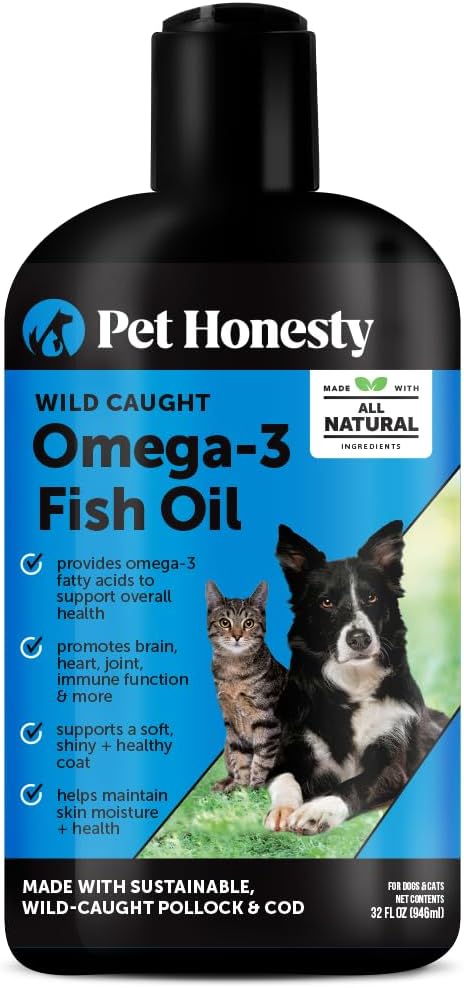
Best for: Dogs with active skin allergies, hot spots, itchy skin, or inflammatory conditions where maximum EPA delivery per serving is the priority. One of the highest-potency formulas available without a prescription.
Why It Made the List
- 800mg EPA + 525mg DHA per serving — 1,438mg total omega-3 — one of the highest combined EPA+DHA doses per serving in the over-the-counter pet supplement category
- GMP-certified, FDA-inspected facility in the USA with 99% odor removal — the odor reduction is practically relevant for dogs that reject high-fish-scent products, which are common in this potency tier
- Wild-caught Alaskan salmon and pollock sourcing with NASC certification — the combination of high potency, domestic manufacturing, and quality certification is uncommon at this price point
Key Specs
- 800mg EPA + 525mg DHA (1,438mg total) per serving | Price: ~$28–35 (16 oz) | ~$1.75–$2.19 per oz
- Source: Wild-caught Alaskan salmon and pollock | Certifications: GMP, FDA-inspected facility, NASC
- Star rating: 4.5/5 (3,000+ reviews on Chewy)
Honest Take
- The 800mg EPA per serving is the strongest anti-inflammatory dose in this roundup — for dogs with confirmed skin allergies or hot spots, this is the meaningful differentiator over lower-potency salmon oils
- The bottle pours rather than pumps — “messy dispensing” appears in enough reviews that it’s worth decanting into a pump bottle on first use; the potency more than compensates for the setup inconvenience
- Most common owner report: Visible reduction in itching and hot spot recurrence within 4–6 weeks of daily use at the full recommended dose. Most common complaint: Dispensing mess when pouring directly from the bottle — use a pump or measuring spoon to avoid waste.

Best for: Large and giant breed dogs needing high daily doses with batch-verified purity, and dogs where a veterinarian has specifically recommended TG-form omega-3s for joint or inflammatory conditions. The right choice when certainty about what’s in the bottle matters more than price.
Why It Made the List
- Every batch third-party tested with a Certificate of Analysis available on request — the only product in this roundup that offers per-batch verification rather than general brand-level certification
- Re-esterified triglyceride (TG) form — the molecular structure dogs absorb most efficiently; EE-form concentrates used in cheaper products deliver meaningfully less omega-3 per dose at the cellular level
- Friend of the Sea certified, non-GMO, NASC — three independent third-party certifications on one product, covering sustainability, ingredient integrity, and manufacturing quality
Key Specs
- 736mg EPA + 460mg DHA (1,380mg total) per serving | Price: ~$38–48 (16 oz) | ~$2.38–$3.00 per oz
- Source: Wild-caught sardines and anchovies (South Pacific) | Certifications: NASC, non-GMO, Friend of the Sea, re-esterified TG form
- Star rating: 4.5/5 (8,000+ reviews on Amazon and Chewy)
Honest Take
- The TG-form absorption advantage closes the real-world cost gap with cheaper EE-form products — more omega-3 reaching the bloodstream per dose means you need less product to achieve the same therapeutic effect
- The large bottle has no pump, and picky dogs may reject the sardine and anchovy scent — the softgel format is worth considering if your dog refuses the liquid, as it eliminates the odor issue entirely
- Most common owner report: Improved joint mobility and reduced stiffness in older large breeds within 8–10 weeks of consistent use. Most common complaint: Highest price per ounce in the roundup — justified for large dogs or therapeutic dosing, but hard to justify for small dogs on general maintenance.
Full Product Comparison
| Product | Type | Price/oz | EPA+DHA per serving | Source | Best For |
|---|---|---|---|---|---|
| Vital Pet Life Salmon Oil | Salmon oil | ~$0.90–$1.06 | ~900mg | Wild Alaskan salmon | Overall value at scale |
| Grizzly Salmon Plus | Salmon oil blend | ~$2.16 | ~966mg | Wild Alaskan salmon/pollock/whitefish | Potency + label transparency |
| Zesty Paws Salmon Oil | Salmon oil blend | ~$1.69 | ~630mg | Wild Alaskan salmon/pollock | Budget, small to medium dogs |
| Native Pet Omega Oil | Fish oil blend | ~$2.19 | ~295mg per pump | Wild pollock/salmon + wheat germ | Daily wellness, small dogs |
| Pet Honesty Fish Oil | Fish oil blend | ~$1.75–$2.19 | ~1,325mg | Wild Alaskan salmon/pollock | Skin/coat, high-dose anti-inflammation |
| Nordic Naturals Omega-3 Pet | Fish oil (anchovy/sardine) | ~$2.38–$3.00 | ~1,196mg | Wild sardine/anchovy | Purity, absorption, large dogs |
Salmon Oil or Fish Oil: Which Should You Actually Buy?
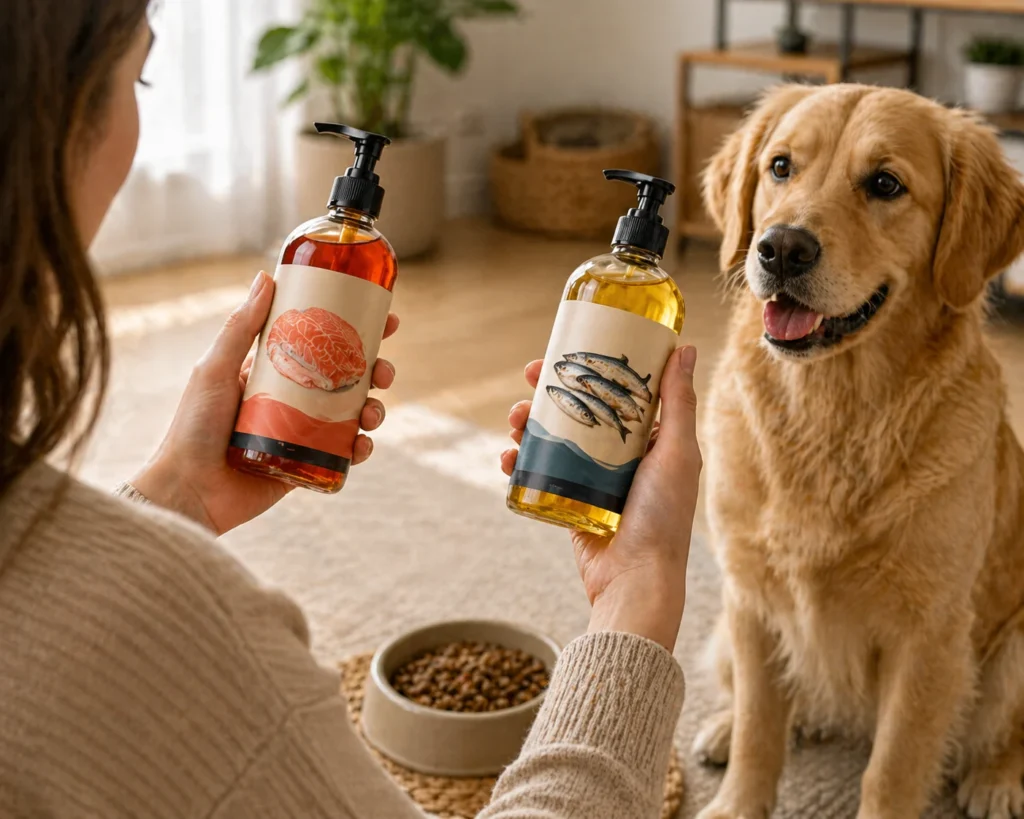
If your dog has itchy skin or allergies
Go with Pet Honesty Wild Caught Omega-3 Fish Oil. At 1,438mg total omega-3 per serving — including 800mg EPA — it delivers the anti-inflammatory load needed to make a measurable difference in dogs with active skin inflammation. Improvements in itching and coat quality typically appear within 4–6 weeks of consistent daily use. Pair it with a limited-ingredient diet if your dog also has food sensitivities, and consult your vet before adding a high-dose supplement alongside any existing allergy medication.
If you’re on a budget
Vital Pet Life Wild Alaskan Salmon Oil at 32 oz wins on cost-per-1,000mg EPA+DHA at approximately $0.20 — the lowest in this roundup. That’s the number that actually matters, not price per bottle. Zesty Paws is a solid runner-up if you’d rather start with a smaller quantity and is widely available at local pet stores if you need it same-day.
If you have a large or giant breed dog
Nordic Naturals Omega-3 Pet Liquid is the right call. Large dogs may need 4–5 tsp per day for joint support at therapeutic doses — at those volumes you need certainty that what the label claims is what the bottle contains. Nordic Naturals’ batch-by-batch third-party testing removes that doubt entirely. The re-esterified TG form also means more omega-3 reaches the bloodstream per dose. Always confirm high-dose supplementation with your vet before starting, particularly in dogs with existing joint conditions or those on anti-inflammatory medication.
If your dog is a picky eater
Salmon oil — specifically Grizzly Salmon Plus or Vital Pet Life. The richer salmon scent that some owners find off-putting is exactly what makes picky dogs eat it willingly. Dogs that consistently reject sardine or anchovy-based oils almost universally accept salmon oil. Start with half a pump mixed thoroughly into wet food and build up over a week.
One scenario where no supplement is the best answer: if your dog is already eating a quality fresh or raw diet with regular oily fish — sardines packed in water, wild salmon, mackerel — their omega-3 needs may already be met through whole food. Adding a supplement on top of an already omega-3-rich diet isn’t harmful in moderation, but it’s unnecessary and adds cost.
How Much Fish Oil Should You Give Your Dog?
These are general guidelines for healthy adult dogs — always check with your vet before starting any supplement, particularly if your dog is on blood thinners, anti-inflammatories, or scheduled for surgery. Omega-3s have mild blood-thinning effects at high doses that interact with certain medications.
| Dog Weight | Omega-3 per day (general wellness) | Salmon Oil (approx. tsp) | Fish Oil softgel (180mg EPA / 120mg DHA) |
|---|---|---|---|
| Under 10 lbs | ~250–500mg | ¼ tsp | 1 softgel |
| 10–25 lbs | ~500–750mg | ½ tsp | 2 softgels |
| 25–50 lbs | ~750–1,000mg | 1 tsp | 3 softgels |
| 50–75 lbs | ~1,000–1,500mg | 1–1½ tsp | 4–5 softgels |
| 75–100 lbs | ~1,500–2,000mg | 1½–2 tsp | 5–6 softgels |
| 100+ lbs | ~2,000mg+ | 2+ tsp | Consult your vet before exceeding standard doses |
Note: Dogs with osteoarthritis may benefit from therapeutic doses up to 310mg/kg EPA+DHA per day — this is well above wellness dosing and should always be confirmed with your veterinarian before adjusting.
- Signs you’re giving too much: Loose or greasy stools are the most common signal — back off to half the dose and reintroduce slowly over a week. Less common signs include unusually strong fishy breath, lethargy, or increased itching. All resolve quickly when you reduce the dose.
- How to introduce it: Start at half the recommended dose for the first week. The most common cause of GI upset with fish oil isn’t the product — it’s jumping from zero to full dose on day one.
- Which form works best: Liquids are easiest to mix into food and work well for most dogs. Softgels suit owners willing to puncture and squeeze them, or dogs that eat them as treats. Chews are the most palatable format but typically deliver less EPA and DHA per serving than liquids — check the label before assuming a chew is equivalent to a liquid at the same dose.
Frequently Asked Questions
Is salmon oil better than fish oil for dogs?
For most dogs, yes — with one important exception. Salmon oil provides a consistent single-source omega-3 profile, natural astaxanthin, and better palatability for picky eaters. Where a multi-source fish oil blend wins is maximum EPA delivery: anchovy and sardine-based blends like Pet Honesty can deliver 800mg EPA per serving, which outperforms most salmon oils on raw anti-inflammatory potency. If your dog has active joint disease or severe skin inflammation, a high-EPA fish oil blend may be the stronger clinical choice. Consult your vet before starting therapeutic-dose supplementation.
Can I give my dog human fish oil capsules?
Human-grade fish oil is generally safe for dogs if the ingredient list is clean — no xylitol, no artificial flavorings, no additives beyond the oil and a natural preservative like mixed tocopherols. The real risk is dosing: human capsules are formulated for a 150+ lb adult, and the per-capsule dose is often far more than a small or medium dog needs. Pet-specific products with weight-based dosing instructions remove that guesswork and are the safer default.
How long does it take for fish oil to work in dogs?
Most owners see visible improvements in skin and coat within 4–6 weeks of consistent daily use. Joint-related improvements typically take 8–12 continuous weeks — omega-3s work through gradual cell membrane integration, not immediate symptom relief. Stopping after three weeks because nothing is happening is the most common reason supplementation fails. Give it the full 8-week trial before drawing conclusions.
What are signs my dog needs more omega-3s?
The clearest visual signals are a dull or brittle coat, excessive shedding, dry or visibly flaky skin especially around the base of the tail and along the back, and persistent scratching with no identified allergen trigger. In older dogs, new stiffness when getting up after rest — particularly in cold weather — can also indicate an omega-3 gap. These signs overlap with other conditions, so consult your vet to rule out underlying causes before assuming a supplement will resolve them.
Does fish oil expire? How do I store it?
Yes — fish oil oxidizes and goes rancid, and rancid oil is harmful rather than just ineffective. After opening, store in a cool dark location or refrigerate; most products last 60–90 days once opened. If the smell shifts from fishy to sour or chemical, discard the bottle regardless of the expiration date. Dark glass or opaque plastic bottles indicate the brand understands oxidation — clear plastic bottles are a minor red flag.
What’s the difference between salmon oil and krill oil for dogs?
Krill oil delivers omega-3s in phospholipid form, which may absorb more efficiently than the triglyceride form found in most fish and salmon oils — but the EPA and DHA per dose is typically much lower, and krill oil costs significantly more per milligram of omega-3. For most dogs, a quality TG-form salmon or fish oil is more practical and cost-effective. Krill oil is worth considering for very small dogs needing tiny doses where the phospholipid absorption advantage is more meaningful.
Our Verdict: Salmon Oil vs Fish Oil for Dogs
Salmon oil is the overall winner — but not because it delivers more omega-3 per serving. In raw EPA numbers, a high-quality anchovy/sardine blend often outperforms it. Salmon oil wins because of three things that compound: single-source consistency means you know what you’re getting every bottle; natural astaxanthin adds an anti-inflammatory benefit no generic fish oil can match; and the palatability advantage means your dog will actually eat it — which makes any potency comparison irrelevant if the alternative is a rejected bowl.
When fish oil makes more sense: your dog has severe joint inflammation or a documented skin condition requiring maximum EPA doses, and you want batch-verified purity. In that case, go with Nordic Naturals Omega-3 Pet Liquid — the third-party testing and TG-form absorption make it the right clinical choice for large dogs or dogs with specific health needs.
For most dog owners buying their first omega-3 supplement, the pick is Vital Pet Life Wild Alaskan Salmon Oil — single-source, wild-caught, NASC-certified, and the best cost-per-1,000mg EPA+DHA in the salmon oil category at the 32 oz size. If your dog has active skin issues, step up to Pet Honesty. If they’re large and you need verified purity at therapeutic doses, go Nordic Naturals.